Featured
Project Maintainer Post
When Kubernetes restarts your pod — And when it doesn’t
A production internals guide verified against Kubernetes 1.35 GACompanion repository: github.com/opscart/k8s-pod-restart-mechanics The terminology problem Engineers say “the pod restarted” when they mean four different things. Getting this wrong leads to flawed runbooks and bad on-call decisions....
March 17, 2026 | Shamsher Khan, Project Maintainer
Showing 889 of 2653 posts
Member Post
Automating root cause analysis at scale: Multi-signal correlation for cloud native incident response
The problem: Humans shouldn’t be correlation engines At Atlassian’s scale, hundreds of interconnected microservices distributed across multiple regions mean a production incident generates an overwhelming volume of telemetry. The problem is that finding the causal factor...
August 24, 2026 | Santosh Balaranganathan, Michael Yoo, James Moessis, James Kieltyka, Jason Lee, Lavender Neesham - Atlassian

Member Post
How to turn slow queries into actionable reliability metrics with OpenTelemetry
Slow SQL queries degrade user experience, cause cascading failures, and turn simple operations into production incidents. The traditional fix? Collect more telemetry. But more telemetry means more things to look at, not necessarily more understanding. Instead...
August 21, 2026 | Severin Neumann, Causely

Member Post
German ciphers, telegrams, and cloud native data sovereignty
A lesson from 1917 In January 1917, Germany sent a secret telegram. It went to Mexico. The offer: join the war against the United States, and you can have Texas, Arizona and New Mexico back. The...
August 20, 2026 | James Hirst and Budhaditya Bhattacharya, Tyk
Member Post
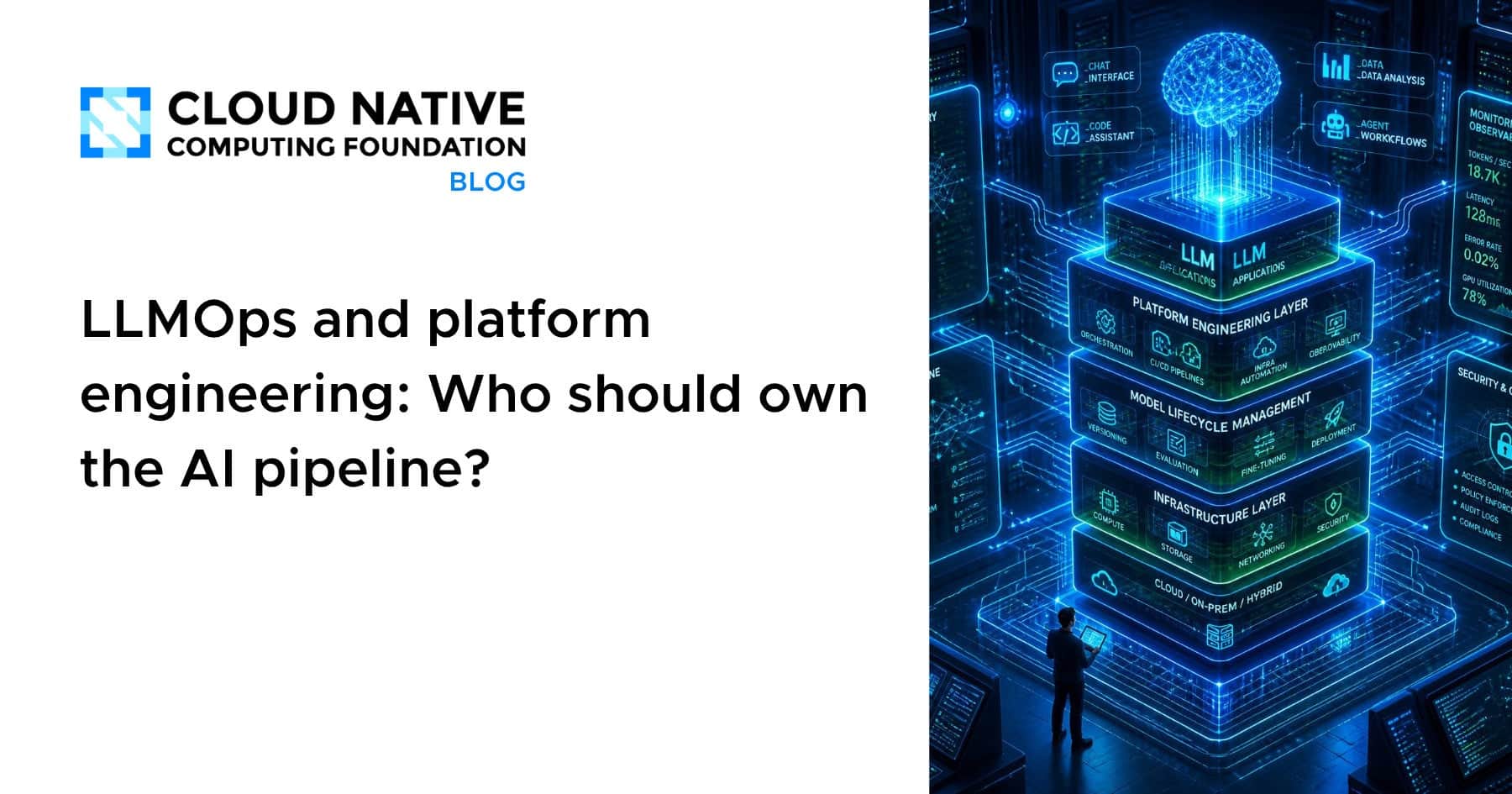
LLMOps and platform engineering: Who should own the AI pipeline?
A few years ago, getting a model into production meant a data scientist, a DevOps engineer, and a narrow set of tools: train it, test it, ship it, watch the dashboards. Large language models broke that...
August 13, 2026 | Daniel Bryant, Syntasso

Member Post
Advancing AI model interoperability with Docker and ModelPack
The rise in the number of tools available for creating and running AI content has lowered the barrier of entry and offered the flexibility of choice when choosing the appropriate solution for a given use case....
August 12, 2026 | Andrew Block, Red Hat
Member Post
A practical guide to solving when zero+zero=two in mesh observability
A Service Mesh like Istio, together with Kiali gives you a lot on day one. You install the mesh, point Prometheus at it, and suddenly you have request rate, latency, error rate, and a fairly good...
August 11, 2026 | Israel Blancas, Software Engineer at Coralogix and Jose Gomez-Selles, Product Lead at VictoriaMetrics

Member Post
Shadow AI in CI/CD: Threat-modeling the path from developer laptop to Kubernetes
Artificial intelligence is becoming part of daily software delivery, often before it becomes part of the security architecture. That gap has a name: Shadow AI. It is any AI tool, model, agent, extension, or integration used...
August 7, 2026 | Matteo Bisi, ReeVo SpA
Member Post
You can’t debug what you can’t see — Observability for AI Agents
This article reflects practical experience building and operating production AI agent systems. Traditional APM can’t tell you why your agent spent far more than usual asking the same question three times. We’ve been running AI agents...
August 4, 2026 | Sabith K Soopy, Principal Engineer at StackGen

Member Post
Scaling Kubernetes pods with KEDA based on Amazon SQS queue depth
In event-driven Kubernetes architectures, CPU and memory utilization often fail to reflect real system pressure. A worker pod may sit idle from a CPU perspective while thousands of messages pile up in an Amazon SQS queue....
July 31, 2026 | Albena Galabova, Itgix

Member Post
The future of AI is community driven and open
Kubernetes has become the de facto operating system for AI. In CNCF’s 2025 Annual Cloud Native Survey, 82% of container users now run Kubernetes in production, and 66% of organizations hosting generative AI use it to...
July 23, 2026 | Erin A. Boyd, Senior Director at NVIDIA and CNCF Governing Board Member
Member Post
Platform engineering for the agentic enterprise: Managing applications, resources, and AI agents
Platform engineering is evolving Platform engineering has become one of the defining disciplines of the cloud native era. As organizations embraced Kubernetes, microservices, GitOps, and distributed architectures, the complexity of building and operating software grew beyond...
July 21, 2026 | Lakmal Warusawithana, WSO2
Member Post
Why your agent needs access to your documentation
What 1,192 agent conversations taught us about knowledge base search A few months ago we shipped an agent inside our own product. It lives in our web app and lets users ask questions about their deployment,...
July 21, 2026 | Finn Bauer, kapa.ai
Member Post
Why goodput matters more than throughput for LLM serving
When we benchmark an LLM serving setup, the number almost everyone reaches for first is throughput: how many requests per second the system can push through. It is easy to measure, easy to compare, and it...
July 20, 2026 | Graziano Casto, Akamas

Member Post
Running a self-hosted LLM in Kubernetes with vLLM
Running large language model (LLM) workloads in-house is one of several patterns teams adopt alongside managed API services. Managed API services are convenient and well suited to many workloads. Self-hosting is a complementary option that some...
July 16, 2026 | Matt Kereczman, LINBIT

Member Post
On-prem DBaaS in 2026: Platforms, standards, and gaps
For application teams, databases should feel like a solved problem. A team needs PostgreSQL, MariaDB, Redis, or another data service, submits a request, receives credentials, and starts building. In practice, the experience is rarely that simple....
July 15, 2026 | Oliver Wolf, anynines

Member Post
Where should AI workloads run? A sovereign and sensible approach
Opinions on AI range from transformative optimism to deep skepticism, but one thing is clear: AI is becoming an increasingly important part of enterprise technology strategies. Feel free to pick whichever you like. But whatever you...
July 10, 2026 | Johannes Hemminger and Martin Hafner, KubeOps
Member Post
Navigating the ingress-NGINX retirement
1. The Post-March 2026 landscape ⚠ The CatalystAcknowledge the March 2026 retirement of the Kubernetes SIG Network ingress-nginx controller. Staying on this controller introduces severe operational risks, including unpatched CVEs and a complete halt of feature...
July 9, 2026 | Sunny Chan, TCC Consulting

Member Post
Network boundary for AI agents using NGINX and OpenTelemetry
I recently had an interesting conversation at a KCD about OpenClaw with one of the attendees, and they remarked that they wouldn’t put an agent in their network, because “we don’t know what that thing really...
July 8, 2026 | Marko Sluga, F5

Member Post
The 4-body problem of SRE: Why autonomous operations depend on context
What a room full of senior SREs confirmed about the trust gap, and where the actual work begins I spent a day last week at an event in Bengaluru asking a room full of senior SREs,...
July 6, 2026 | Sanjeev Sharma, Field CTO at StackGen

Member Post
Evolving platform engineering for AI-native workloads
Platform Engineering 1.0 delivered real value. Golden paths accelerated deployment. Internal Developer Platforms (IDPs) reduced cognitive load for developers. Self-service infrastructure gave developers back hours they had been spending filing tickets. Pipelines provided a standard vehicle to...
July 6, 2026 | Pankaj Gupta, Senior Director of Private Cloud Solutions for VMware by Broadcom