A Database Management System (DBMS) is software used to manage data from a database. It acts as an interface between the database and end users or applications, ensuring data is consistently organised, easily accessible, and secure.
- A database is a structured collection of data that is stored in an electronic device. The data can be text, video, image, or any other format.
- A relational database stores data in the form of tables, and a NoSQL database stores data in the form of key-value pairs.
- A DBMS is a software that allows to create, update, and retrieval of data in an organised way. It also provides security to the database.
- Examples of relational DBMS are MySQL, Oracle, Microsoft SQL Server, PostgreSQL, and Snowflake.
- Examples of NoSQL DBMS are MongoDB, Cassandra, DynamoDB, and Redis.
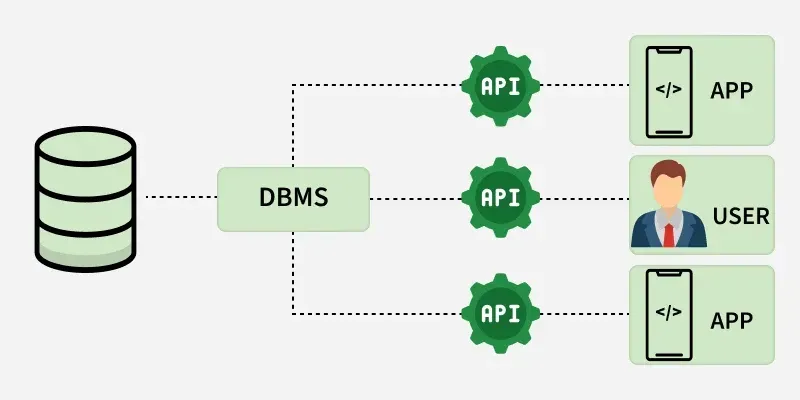
Understand the basics of DBMS, explore how it works, and learn about different database architectures used in real-world systems.
It is a conceptual model for designing a databases to represent real-world data using entities, attributes, and relationships.
- ER Model
- Enhanced ER Model
- Minimization of ER Diagram
- Generalization, Specialization and Aggregation
- Recursive Relationships
Provides a structured way to organize data into tables and how queries are expressed mathematically and logically to retrieve data from relational databases.
- Relational Model
- Keys (Candidate, Super, Primary, Alternate and Foreign)
- Functional Dependency
- Attribute Closure
- Equivalence of Functional Dependencies
- Canonical Cover
- Anomalies in Relational Model
- Mapping from ER Model to Relational Model
- Strategies for Schema design
- Schema Integration
- Quiz: ER and Relational Model
Important process in database design that helps improve the database's efficiency, consistency, and accuracy.
- Introduction
- Normal Forms
- The Problem of redundancy in Database
- Dependency Preserving Decomposition
- Lossless Join Decomposition
- How to find the Highest Normal Form of a Relation
- Domain Key normal form
- Denormalization in Databases
- Data Replication
- Quiz: Normal Forms
Formal query languages used in DBMS to retrieve and manipulate data from relational databases.
- Introduction
- Basic Operators
- Extended Operators
- Inner Join vs Outer Join
- Join operation Vs nested query
- Tuple Relational Calculus
- Row oriented vs. column oriented data stores
Ensure reliable execution of database operations and manages simultaneous access without conflicts.
- Introduction
- ACID Properties
- Lock Based Protocol
- Graph Based Protocol
- Multiple Granularity Locking
- Timestamp Ordering Protocols
- Thomas Write Rule
- Timestamp and Deadlock Prevention Schemes
- Log based recovery
- Types of OLAP Systems
- Quiz: Transactions and concurrency control
Method of storing data records in a file so they can be accessed efficiently. It determines how data is arranged, stored, and retrieved from physical storage.
- File Organization
- Indexing in Databases
- SQL queries on clustered and non-clustered Indexes
- B-Tree
- B+ Tree
- Bitmap Indexing
- Inverted Index
- Practice questions on B and B+ Trees
- Quiz: Indexing, B and B+ Trees , File structures
Concepts focus on improving performance, scalability, security, and data retrieval across modern systems.
- RAID
- Distributed Database System
- Query Optimization
- Difference between RDBMS and HBase
- Challenges of database security
- Data Management issues in Mobile database
- Future Works in Geographic Information System
- Web Information Retrieval | Vector Space Model
Store large volumes of historical data and discover useful patterns from it.
- Data Warehousing
- Data Warehouse Architecture
- Data Mining
- Dimensional Data Modeling
- Data Marts
- Apache HBase
- Apache Hive
- Architecture and Working of Hive
SQL is the standard language used to store, retrieve, and manipulate data in relational databases.
- SQL Tutorial
- Quiz on SQL
- SQL Interview Questions
- PostgreSQL Interview Questions
- PL/SQL Interview Questions
- DBMS interview questions
Help build a deeper understanding of how databases interact with users, applications, and internal structures.
- DBMS Interfaces
- Categories of DBMS Users
- Data Abstraction and Data Independence
- Database Objects
- Impedance Mismatch
- Database Management Systems | Set 1
- Database Management Systems | Set 2
- Database Management Systems | Set 3
- Database Management Systems | Set 4
- Database Management Systems | Set 5
- Database Management Systems | Set 6
- Database Management Systems | Set 7
- Database Management Systems | Set 8
- Database Management Systems | Set 9
- Database Management Systems | Set 10
- Database Management Systems | Set 11