- Courses
- Tutorials
- Interview Prep
SQL
Question 1
Table A:
Table B:
Table C:

Consider the above tables A, B and C. How many tuples does the result of the following SQL query contains?
SELECT A.id
FROM   A
WHERE  A.age > ALL (SELECT B.age
                    FROM   B
                    WHERE  B. name = "arun")
4
3
0
1
Question 2
A table T(X, Y) initially has one record (1, 1). New records are inserted 128 times with:
X = MX + 1, Y = 2*MY + 1
where MX and MY are the current maximums of X and Y.What will MAX(X) and MAX(Y) be after all insertions?
SELECT Y FROM T WHERE X=7;127
255
129
257
Question 3
Database table by name Loan_Records is given below.
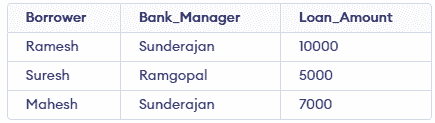
What is the output of the following SQL query?
SELECT Count(*)
FROM  ( ( SELECT Borrower, Bank_Manager
          FROM Loan_Records) AS S
          NATURAL JOIN ( SELECT Bank_Manager, Loan_Amount
                         FROM Loan_Records) AS T );
3
9
5
6
Question 4
A relational schema for a train reservation database is given below. Passenger (pid, pname, age) Reservation (pid, class, tid)
Table: Passenger
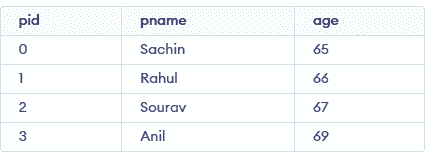
Table : Reservation
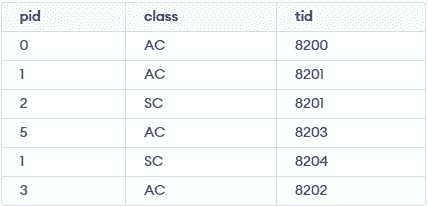
What pids are returned by the following SQL query for the above instance of the tables?
SLECT pid
FROM Reservation ,
WHERE class ‘AC’ AND
    EXISTS (SELECT *
       FROM Passenger
       WHERE age > 65 AND
       Passenger. pid = Reservation.pid)
1, 0
1, 2
1, 3
1, 5
Question 5
Let R and S be relational schemes such that R={a,b,c} and S={c}. Now consider the following queries on the database:
IV) SELECT R.a, R.b
       FROM R,S
            WHERE R.c=S.c
Which of the above queries are equivalent?
I and II
I and III
II and IV
III and IV
Question 6
Consider the following relational schema:
Suppliers(sid:integer, sname:string, city:string, street:string)
Parts(pid:integer, pname:string, color:string)
Catalog(sid:integer, pid:integer, cost:real)
Consider the following relational query on the above database:
SELECT S.sname
    FROM Suppliers S
        WHERE S.sid NOT IN (SELECT C.sid
                            FROM Catalog C
                            WHERE C.pid NOT IN (SELECT P.pid
                                                FROM Parts P
                                                WHERE P.color<> 'blue'))
Assume that relations corresponding to the above schema are not empty. Which one of the following is the correct interpretation of the above query?
Find the names of all suppliers who have supplied a non-blue part.
Find the names of all suppliers who have not supplied a non-blue part.
Find the names of all suppliers who have supplied only blue parts.
Find the names of all suppliers who have not supplied only blue parts.
Question 7
A library relational database system uses the following schema
USERS (User#, UserName, HomeTown)
BOOKS (Book#, BookTitle, AuthorName)
ISSUED (Book#, User#, Date)
Explain in one English sentence, what each of the following relational algebra queries is designed to determine

Show all the Book Title which have been issued by User# 6.
The user who’s home town is Delhi and issued a book, Show all the name authors of the book he/she have issued.
Question 8
Consider the set of relations given below and the SQL query that follows
Students : (Roll number, Name, Date of birth)
Courses: (Course number, Course name, instructor)
Grades: (Roll number, Course number, Grade)
SELECT DISTINCT Name
FROM Students, Courses, Grades
WHERE Students.Roll_number = Grades.Roll_number
       AND Courses.Instructor =Sriram
       AND Courses.Course_number = Grades.Course_number
       AND Grades.Grade = A
Which of the following sets is computed by the above query?
Names of Students who have got an A grade in all courses taught by Sriram
Names of Students who have got an A grade in all courses
Names of Students who have got an A grade in at least one of the courses taught by Sriram
None of the above
Question 9
Consider the following relational schema:
Suppliers(sid:integer, sname:string, city:string, street:string)
Parts(pid:integer, pname:string, color:string)
Catalog(sid:integer, pid:integer, cost:real)
Consider the following relational query on the above database:
SELECT S.sname
    FROM Suppliers S
        WHERE S.sid NOT IN (SELECT C.sid
                            FROM Catalog C
                            WHERE C.pid NOT IN (SELECT P.pid
                                                FROM Parts P
                                                WHERE P.color<> 'blue'))
Assume that relations corresponding to the above schema are not empty. Which one of the following is the correct interpretation of the above query?
Find the names of all suppliers who have supplied a non-blue part.
Find the names of all suppliers who have not supplied a non-blue part
Find the names of all suppliers who have supplied only non blue parts.
Find the names of all suppliers who have not supplied only non-blue parts.
Question 10
- I and II are correct.
- II and III are correct.
- Only III is correct.
- Only I is correct.
There are 66 questions to complete.