Abstract
Topological superconductivity is an exotic phenomenon due to the symmetry-protected topological surface state, in which a quantum system has an energy gap in the bulk but supports gapless excitations confined to its boundary. Symmetries including central and time-reversal symmetry (TRS), along with their relations with topology, are crucial for topological superconductivity. We report muon spin relaxation/rotation (μSR) experiments on a topological noncentrosymmetric superconductor PbTaSe2 to study its TRS and gap symmetry. Zero-field μSR experiments indicate the absence of internal magnetic field in the superconducting state, consistent with previous μSR results. Furthermore, transverse-field μSR measurements reveals that the superconducting gap of PbTaSe2 is an isotropic three-dimensional fully-gapped single-band. The fully-gapped results can help understand the pairing mechanism and further classify the topological superconductivity in this system.
Original content from this work may be used under the terms of the Creative Commons Attribution 4.0 licence. Any further distribution of this work must maintain attribution to the author(s) and the title of the work, journal citation and DOI.
1. Introduction
In unconventional superconductors, symmetries in addition to U(1) gauge symmetry are broken in the superconducting state, leading to exotic and potentially useful properties, therefore realization and study of superconductivity in systems with reduced symmetry is one of the most crucial research field. Among these, noncentrosymmetric crystal structures with significant spin-orbital coupling are of particular interest [1]. In superconductors with noncentrosymmetric crystal structures, the absence of inversion symmetry leads to the splitting of the Fermi surfaces into two opposite spin configurations, and results in the mixed singlet–triplet nature in the order parameter [1–4]. As a result, it can give rise to a range of novel phenomena, including the recently proposed topological superconductivity [5–8].
Topological superconductivity is an exotic phenomenon due to the symmetry-protected topological surface state [9]. In a topological superconductor, the bulk state is a fully gapped superconducting state, while the surface state is a metal state. The Hamiltonian of such state is defined by several important symmetries. The most important symmetry for a topological material is time-reversal symmetry (TRS), which determines the topological mode of the material [9]. TRS is also one of the most intensely studied symmetries for a superconductor, and has been observed in a handful of weakly correlated noncentrosymmetric superconductors [10–15]. Despite broken TRS being a clear signature of unconventional superconductivity was observed, many other properties resemble conventional superconductors. This immediately raises an important question, namely what is the origin of the TRS breaking in this kind of material, or does TRS breaking occur together with a conventional electron–phonon pairing mechanism? Furthermore, the relationship between TRS breaking and breaking inversion symmetry requires clarification since there are also examples in which TRS breaking occurs in centrosymmetric systems [16].
Recently, a noncentrosymmetric superconductor PbTaSe2 with transition temperature Tc = 3.7 K was reported to host a  topological state with topological nodal-line state by ab initio calculations, angle-resolved photoemission spectroscopy (ARPES) and soft point-contact spectroscopy experiments [17–22]. Zero-field (ZF) muon spin relaxation (μSR) measurement shows no evidence for a TRS breaking field greater than 0.05 G in the superconducting state [23]. Different techniques, including specific heat and nuclear magnetic resonance (NMR) measurements [17, 24], agree with an in-plane fully gapped superconducting state of PbTaSe2. A recent calculation work suggests multi-band superconductivity due to the complex band structure revealed by ARPES [18, 19, 25]. However, experimentally it remains controversial whether it is single band or multi-band superconductor. The tunnel diode oscillator experiment supports single band [26], but the thermal conductivity measurement suggests multi-band picture [27]. In addition, while both scanning tunnel microscopy (STM) and μSR results can be described by either single or multi-band model, STM result gives similar magnitude of gap values from different bands, and μSR result indicates two different gaps [20, 23].
It is worth noting that PbTaSe2 is a three-dimensional material with strong anisotropic behavior [28]. All the superconducting pairing symmetry studies of PbTaSe2 were in ab-plane so far, due to the limitation of measurement along the c-direction. It is particularly important to perform the gap symmetry study along c-direction, to clarify the relationship between topology, TRS, and superconducting pairing symmetry of this noncentrosymmetric superconductor.
We report the μSR experiment results on single crystalline PbTaSe2. No evidence of TRS breaking is confirmed. We find fully-gapped superconductivity in both in-plane and out-of-plane directions. Our results prefer the single-band picture. Most intriguingly, the normalized superfluid density in two directions have exactly same temperature dependence, suggesting a possible isotropic three-dimensional gap.
2. Experimental details
PbTaSe2 single crystals were grown by the chemical vapor transport method as previously reported [18]. The typical size of obtained single crystals is 5 × 5 × 0.02 mm3. The quality of the single crystals was checked by x-ray diffraction, magnetic susceptibility and resistivity measurements [27].
μSR experiments were performed at the DOLLY beam line at Paul Scherrer Institute, Villigen, Switzerland. A mosaic of single crystals were stacked and aligned with the (001) basal plane attached to a copper sample holder using dilute GE varnish. Helium-3 cryostat was used to cool the sample down to 0.25 K. In a μSR experiment, spin-polarized positive muons are implanted into a sample. On decay of the muon after an average lifetime of 2.2 μs, a positron is emitted preferentially along the direction of the muon spin. The time evolution of muon spin polarization is determined by detecting decay positrons from an ensemble of 1–2 × 10⁷ muons. The functional form of the muon spin polarization depends on the spatial distribution and dynamical fluctuations of the muon magnetic environment.
During the experiments, the initial muon spin is 45° from the c-axis, which was surrounded by four detectors: forward, backward, up, and down. Hence we can measure the muon spin polarization along two different directions, i.e. parallel and perpendicular to the c-axis. As a trade, due to the angle between muon spin and detectors, the initial asymmetry in our experiments is much lower than the common value that is about 0.25. ZF μSR was performed above and below Tc to study whether there is spontaneous small magnetic field in the superconducting state due to the TRS breaking [10, 29, 30].
In transverse-field (TF) μSR experiments, an external magnetic field μ0 H (field cooled from above Tc in a superconductor) was applied to induce a flux-line lattice (FLL) where the internal magnetic field distribution is determined by the magnetic penetration depth λ, the vortex core radius and the structure of the FLL. The external field μ0 H should be between μ0 Hc1 and μ0 Hc2. In our case, μ0 Hc1 is about 4–9 mT [17, 23, 28], μ0 Hc2 along c-axis is about 0.32 T, and μ0 Hc2 parallel to ab-plane is about 1.25 T [28].
The μSR rate is related to the root-mean-square width of the internal magnetic field distribution in the FLL, and hence also related to λ, the details of which will be discussed after presenting the experimental results. We first applied magnetic field parallel to c-axis to obtain the penetration depth in the ab-plane and study the gap symmetry in that direction [31], and compare with the published work [23]. Then we apply an external field normal to c-axis. Since the samples were not aligned along a or b-axes, the gap symmetry in ac or bc-plane cannot be obtained. Instead, we obtained the average gap symmetry in planes that includes c-axis but with random directions in ab-plane. If there is any node in the superconducting gap out of ab-plane, the temperature dependence of superfluid density should deviate from the s-wave behavior.
The μSR data were analyzed with musrfit software package [32].
3. Results
3.1. ZF-μSR
Representative ZF asymmetry time spectra at selective temperatures are shown in figure 1(a). No significant difference can be observed between the data above and below Tc = 3.84 K. The μSR asymmetry spectrum consists of two contributions: a signal from muons stop in the sample and a slowly relaxing background signal from muons that stop in the copper sample holder. The spectra in both directions can be well described by the function

where the first and second terms represent sample and background signals, respectively. Here a0 is the initial asymmetry, and f denotes the fraction of muons stopping in the sample. The data of the first 0.1 μs is dropped to avoid the early-time problems. The temperature independent f = 0.68 is determined from TF-μSR. The dynamic ZF Kubo–Toyabe (KT) function  , which was used previously to fit ZF-μSR data of Cu [33–35], describes the data adequately. We obtain
  and ν = 0.4 MHz, same as previously reported [34, 35].
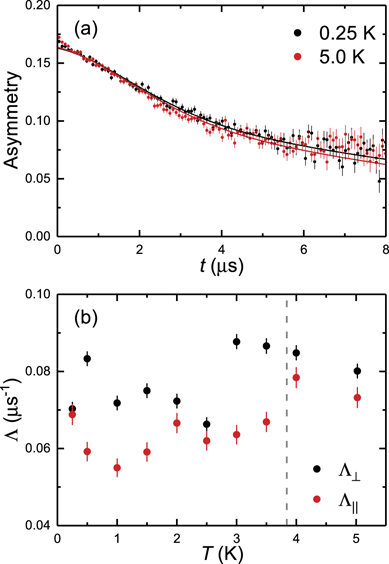
Figure 1. ZF μSR. (a) μSR asymmetry spectra asy(t). Black circles: superconducting state. Red circles: normal state. Solid curves: fits to the data with equation (1). (b) Temperature dependence of relaxation rate Λ. Dashed line marks Tc.
Download figure:
Standard image High-resolution imageThe temperature dependence of the ZF relaxation rate Λ is shown in figure 1(b). Consistent with previous report [23], no significant change crossing Tc is observed down to 0.25 K in our study. Such results suggest that there is no spontaneous magnetic field appearing in the superconducting state. Therefore, there is no TRS breaking, excluding the existence of triplet pairing [23]. Recently, it is reported that although the positive charge of muon could modify the local environment in ZF-μSR experiments, TRS property shown by μSR is intrinsic since the effect induced by muon’s charge is several eV below Fermi energy, which is much larger than the magnitude of superconducting gap (at the decade of meV) [36].
3.2. TF-μSR
3.2.1. H ∥ c-axis
Figure 2(a) shows the TF-μSR muon spin precession signals at applied field of 13 mT in the normal and superconducting states of PbTaSe2. As seen in figure 2(a), in the superconducting state the damping of signal is enhanced due to the field broadening generated by the vortex lattice.
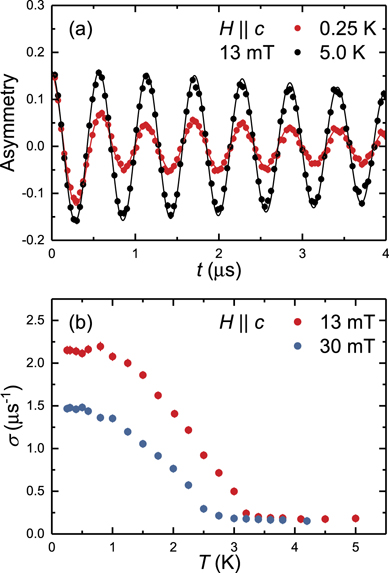
Figure 2. TF μSR with external field H parallel to c-axis. (a) μSR asymmetry spectra asy(t), μ0 H = 13 mT. Black circles: normal state. Red circles: superconducting state. Solid curves: fits to the data with equation (2). (b) Temperature dependence of relaxation rate σ measured in 13 and 30 mT.
Download figure:
Standard image High-resolution imageThe TF-μSR asymmetry spectra in PbTaSe2 can be well described by the function

where the first and second terms represent sample and background signals, respectively. The relaxation rate of copper  μs−1 is also temperature independent, consistent with previous report [37]. The ratio of ZF and TF relaxation rate of copper is 1.58, consistent with the theoretical value [33]. The Gaussian relaxation rate σ from the sample is due to nuclear dipolar field in the normal state and it enhanced in the superconducting state by the vortex lattice. γμ
/2π = 135.5 MHz/T is the gyromagnetic ratio of muon, Hint is the internal field, which is reduced due to diamagnetic screening. The curves in figure 2(a) are the fits of equation (2).
μs−1 is also temperature independent, consistent with previous report [37]. The ratio of ZF and TF relaxation rate of copper is 1.58, consistent with the theoretical value [33]. The Gaussian relaxation rate σ from the sample is due to nuclear dipolar field in the normal state and it enhanced in the superconducting state by the vortex lattice. γμ
/2π = 135.5 MHz/T is the gyromagnetic ratio of muon, Hint is the internal field, which is reduced due to diamagnetic screening. The curves in figure 2(a) are the fits of equation (2).
Temperature dependence of σ is shown in figure 2(b) at two different applied magnetic fields. The temperature independence of σ above Tc and the increase of σ with decreasing temperature below Tc are observed, indicating the bulk superconductivity occurs below Tc. The lower Tc in the 30 mT is consistent with the suppressing effect on superconductivity by external magnetic field.
3.2.2. H ∥ ab-plane
Similar results were obtained with field parallel to ab-plane, shown in figure 3. The μSR asymmetry spectra can also be well described by equation (2). However, compared with σ in 13 mT field along c-axis, the relaxation rate σ here is much larger, suggesting a much broader field distribution. Similar results were also reported in Mo3P [38]. Such difference between different directions can be attributed to the strong anisotropy of Hc2 [31]. The estimated μ0 Hc2 along c-axis is 0.32 T, while μ0 Hc2 is 1.25 T parallel to ab-plane determined from electrical resistivity measurements [28]. In figure 3(b), the larger Tc measured at magnetic field parallel to ab-plane also indicate larger Hc2 in that direction.
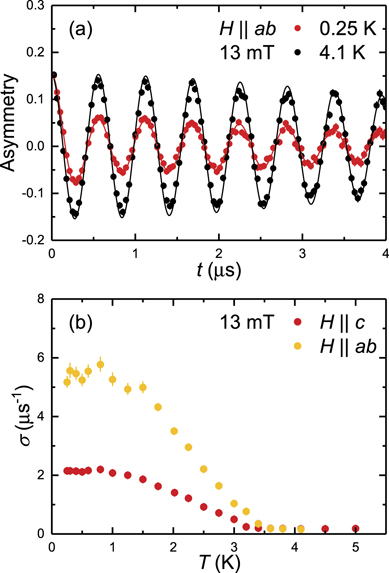
Figure 3. TF μSR with external field μ0 H = 13 mT parallel to ab-plane. (a) μSR asymmetry spectra asy(t). Black circles: normal state. Red circles: superconducting state. Solid curves: fits to the data with equation (2). (b) Temperature dependence of relaxation rate σ measured in two directions. Red circles: μ0 H ∥ c. Yellow circles: μ0 H ∥ ab.
Download figure:
Standard image High-resolution image3.2.3. Pairing symmetry
The Gaussian relaxation rate σ is related to the Gaussian internal field distribution [33]. For a type-II superconductor in vortex state, the internal field distribution is convolution of contribution from the vortex lattice and nuclear dipole field distribution of the host material. Thus σ is given by

where σSC is the vortex lattice contribution, and σdip is temperature independent in the normal state and is not expected to change in the superconducting state. After determining σdip = 0.181(7) μs−1 from the normal state data, we can get temperature dependence of σSC.
On the other hand, for a type-II superconductor, the internal field distribution can be described by penetration depth λ, which can be estimated based on μ0 Hc1 = 9 mT [28, 31]:

where Φ0 = 2.07 × 10⁻¹⁵ Wb is the fluxoid quantum, and ξ is the coherence length. Based on the well-known relation

we obtain ξc = 32.1 nm and ξab = 16.2 nm, where ξc and ξab are the coherence length parallel to c-axis and ab-plane, respectively [28]. Then we can estimate the value of λ along c-axis λc = 208.1 nm and in ab-plane λab = 242.0 nm, and Ginzburg–Landau parameter κ = λ/ξ can be further derived, which shows κc = 6.5 and κab = 14.9. With κ > 5, and a not-too-small reduced magnetic field h = H/Hc2 > 0.25/κ1.3, one can calculate penetration depth λ more accurately using [31]

That is to say, σSC is proportional to λ−2, and the complicated coefficient can be reduced by normalizing σSC(T) to σSC(0).
Based on the London approximation, the superfluid density ns(T) is also proportional to λ−2. For a fully gapped s-wave superconductor, ns can also be written as

where n0 is the superfluid density at zero temperature, E is the energy difference above the Fermi energy, f = 1/[exp(E/kB T) + 1] is the Fermi function, kB = 8.617 × 10⁻⁵ eV K−1 is the Boltzmann’s constant, and Δ is the gap function. For a fully-gapped s-wave superconductor, the temperature dependence of Δ can be approximated by

where Δ0 is the zero temperature gap [39].
The fitting results of normalized superfluid density ns(T)/ns(0) are plotted in figure 4. All three groups of data can be well fitted by single gap s-wave model. The derived zero temperature gap Δ0 is 0.463(7) meV for μ0 H = 13 mT along c-axis, 0.383(11) meV for μ0 H = 30 mT along c-axis, and 0.458(15) meV for μ0 H = 13 mT parallel to ab-plane. Interestingly, all three curves stack together and share the same behavior. Besides, unlike other anisotropic properties, even including the relaxation rates σSC for the superfluid density fitting, the two gap derived from two directions are very close (0.463(7) and 0.458(15) meV).
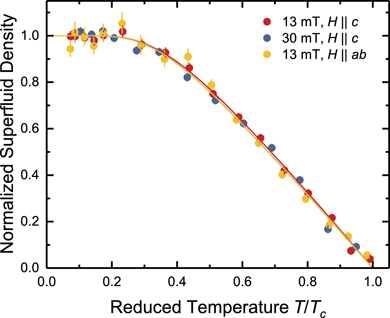
Figure 4. Normalized superfluid density ns(T)/ns(0) plotted versus reduced temperature T/Tc. Red circles: μ0 H = 13 mT parallel to c-axis. Blue circles: μ0 H = 30 mT parallel to c-axis. Yellow circles: μ0 H = 13 mT parallel to ab-plane. Solid curves: fits to the data with equation (7).
Download figure:
Standard image High-resolution image4. Discussion
Previous work using μSR reported that two-gap model could describe the in-plane behavior of PbTaSe2 better [23]. The evidence is not strong enough since there is no critical difference, and there is only one slightly increased point that influenced the conclusion. Our experiments can only be performed down to 0.25 K, just missing the critical point. Based on our results, PbTaSe2 is a fully gapped superconductor, and whether it is single gap or two gap needs experiments to a lower temperature with dilution refrigerator.
Comparing our experimental results with previous theoretical calculations, we can find similar isotropic superconducting gap around H point in reciprocal space as defined in reference [25]. The magnitude of gap derived from our results is also consistent with former reports [20, 23], but slightly smaller than the calculated values [25]. It could come from the suppression effect of external fields, which can be seen from the suppressed gap in our results. Although there are several other superconducting gaps derived by the theory, none of them is dominant in our experimental results. However, such a complicated band structure could account for the multi-band experimental results.
The anisotropy of relaxation rate in different directions suggest an anisotropic penetration depth λ. Since λ relates to effective mass, the strong anisotropy suggests a possible tensor effective mass. This point is further supported by the anisotropic μ0 Hc2 and coherence length ξ. Noticed that spin-orbital coupling plays the most significant role at H point that induces topological properties [18, 20], such complex phenomenon is easy to expect.
Given that the dominant superconducting gap of PbTaSe2 is the isotropic gap around H point, PbTaSe2 is a 3D material. Besides, the fully gapped picture is also consistent with topological superconductivity. The presence of TRS is consistent with the picture of a 3D  topological superconductor [19, 21, 40]. Based on the classification of topological superconductivity [40, 41], besides TRS, particle–hole symmetry (PHS) and chiral symmetry (SLS) are also symmetries of great significance. It is important to study PHS and SLS of PbTaSe2 to understand its topological properties better. Furthermore, it would be more intriguing to study the role of the absence of inversion symmetry in its topological properties.
5. Conclusion
In summary, we performed ZF and TF-μSR experiments on single crystalline PbTaSe2. The preservation of TRS is confirmed by ZF-μSR. The pairing symmetry is derived from TF-μSR, indicating an isotropic 3D fully-gapped single-band picture, satisfying the requirement of topological superconductivity. The complicated band structure could account for the multi-band picture, but other bands are not dominant in superconductivity.
Acknowledgments
This research was funded by the National Research and Development Program of China, No. 2017YFA0303104, the National Natural Science Foundations of China, No. 12174064 and 12174065, and the Shanghai Municipal Science and Technology (Major Project Grant Nos. 2019SHZDZX01 and 20ZR1405300).
Data availability statement
All data that support the findings of this study are included within the article (and any supplementary files).