Abstract
We present the catalog of InterPlanetary Network (IPN) localizations for 199 short-duration gamma-ray bursts (sGRBs) detected by the Konus-Wind (KW) experiment between 2011 January 1 and 2021 August 31, which extends the initial sample of IPN-localized KW sGRBs to 495 events. We present the most comprehensive IPN localization data on these events, including probability sky maps in Hierarchical Equal Area isoLatitude Pixelization format.
Original content from this work may be used under the terms of the Creative Commons Attribution 4.0 licence. Any further distribution of this work must maintain attribution to the author(s) and the title of the work, journal citation and DOI.
1. Introduction
Between 1994 November and 2021 August, the Konus-Wind (KW) gamma-ray spectrometer (Aptekar et al. 1995) on board the Global Geospace Science Wind spacecraft (s/c) detected 3394 gamma-ray bursts (GRBs) in the triggered mode, 495 of which were classified as short-duration gamma-ray bursts (sGRBs) or short bursts with extended emission (EE); see Svinkin et al. (2016, 2019) for the KW short/long GRB classification criteria.
Here we present the localization data obtained by arrival-time analysis, or “triangulation”, between the s/c in the 3rd InterPlanetary Network (IPN) for 199 sGRBs that occurred during the period from 2011 January 1 to 2021 August 31. The IPN localizations for 296 KW sGRBs detected in 1994–2010 have been presented earlier (Pal'shin et al. 2013, hereafter P13). Due to KW's continuous coverage (duty cycle ≳95%) of the full sky by two omnidirectional detectors over a wide energy range (∼20–15 MeV), the KW sample is the most complete set of sGRBs with fluences above ∼10−6 erg cm2 s−1 available to date.
The sGRB sample is not homogeneous: it includes both Type I (merger-origin) and Type II (collapsar-origin) GRBs; see Zhang et al. (2009) for more information on the Type I/II classification scheme. Taking into account the burst durations and hardness ratios (Svinkin et al. 2016, 2019), we estimate that about 20% of the bursts in our sample can be in fact Type II, or at least their classification as Type I is questionable. The sample also includes three possible sGRBs with EE.
Recently, rapid IPN localizations have facilitated significant discoveries in the GRB field, e.g., the localization of the short GRB 170817A, the counterpart of the gravitational-wave event GW170817 from a binary neutron star merger (Abbott et al. 2017), the detection of the extragalactic magnetar giant flare (MGF) in NGC 253 (Svinkin et al. 2021), and the discovery and confirmation of the shortest GRB from a collapsar (Ahumada et al. 2021). This catalog provides essential information for gravitational wave and neutrino searches from sGRBs, and for searches for extragalactic MGFs.
The novel feature of this catalog is the presentation of the final GRB localizations as probability sky maps using the Hierarchical Equal Area isoLatitude Pixelization (HEALPix 41 ) discretization (Górski et al. 2005; Zonca et al. 2019). Since HEALPix has been recently accepted as a standard data format for multimessenger astronomy, such localizations will aid the joint analysis of localizations involving gravitational-wave observatories, as well as ground- and space-based facilities across the electromagnetic spectrum.
This catalog is organized as follows. In Section 2 we describe the composition of the IPN in 2011–2021 and briefly discuss the instrumentation and GRB observations. In Section 3 we provide triangulation annuli, other localization constraints used, and the methodology of deriving IPN error regions. Section 4 presents the final IPN error regions and discusses the statistics of the localizations; in Section 5 we give our conclusions. A description of the data used and localization file format can be found in Appendices A and B, respectively. All coordinates are aberration-corrected equinox J2000.
2. Observations
The composition of the missions and experiments comprising the IPN changes as old missions are terminated and new missions are introduced. During the period covered in the present catalog (2011–2021), the IPN contained between seven and nine missions: KW, in orbit around the Lagrangian point L1; Mars Odyssey (a gamma-ray spectrometer, GRS, that includes the High-Energy Neutron Detector, HEND, with GRB detection capabilities; Hurley et al. 2006), in orbit around Mars; the Mercury Surface, Space Environment, Geochemistry, and Ranging mission (MESSENGER); the Gamma-Ray and Neutron Spectrometer (GRNS; Gold et al. 2001), in an eccentric orbit around Mercury; the International Gamma-Ray Laboratory (INTEGRAL; the anticoincidence shield of the spectrometer SPI (SPI-ACS), in an eccentric Earth orbit; Rau et al. 2005); RHESSI and the array of germanium detectors (GeD; Smith et al. 2002); the Neil Gehrels Swift Observatory (the Burst Alert Telescope, BAT; Gehrels et al. 2004); the Fermi Gamma-ray Space Telescope’s Gamma-Ray Burst Monitor (GBM; Meegan et al. 2009); the Suzaku mission (the Wide-band All-sky Monitor, WAM; Takahashi et al. 2007; Yamaoka et al. 2009); the Astro-rivelatore Gamma a Immagini LEggero mission (AGILE); the Mini-Calorimeter (MCAL; Tavani et al. 2009); the CALorimetric Electron Telescope on board the International Space Station (CALET); the Gamma-ray Burst Monitor (Yamaoka et al. 2013); the Hard X-ray Modulation Telescope (Insight-HXMT; the High-energy X-ray Telescope, HE; Zhang et al. 2020); and the Gravitational Wave High-energy Electromagnetic Counterpart All-sky Monitor (GECAM; gamma-ray detectors, GRDs; Chen et al. 2021; GECAM consists of two microsatellites, GECAM-A and GECAM-B, but currently only GECAM-B is in operation): all in low-Earth orbit. Table 1 lists the operation period, the distance from the Earth, the time resolution, the energy range of the detector used for triangulation, and the number of KW sGRBs observed by each mission/instrument.
Table 1. IPN Composition in 2011–2021
| Mission (Instrument) a | Designation | Operation | Earth Distance b | Energy Band c | Time Resolution d | NGRBs e |
|---|---|---|---|---|---|---|
| Period | (lt-s) | (keV) | (ms) | |||
| Wind (Konus) | KW | Since 1994 | Up to ∼6 | 80–1500 | 2–256 (T) | 199 |
| INTEGRAL (SPI-ACS) | INT | Since 2002 | Up to ∼0.5 | 75–8000 | 50 (R) | 164 |
| Swift (BAT) | SWI | Since 2004 | LEO | 25–350 | 64 (R), TTE (T) | 128 |
| Fermi (GBM) | FER | Since 2008 | LEO | 80–1000 | TTE (T) | 113 |
| AGILE (MCAL) | AGI | Since 2007 | LEO | ≳400 | TTE (T) | 52 |
| Suzaku (WAM) | SUZ | 2005–2015 | LEO | 110–5000 | 1/64 s (T) | 37 |
| Insight-HXMT (HE) | INS | Since 2017 | LEO | 200–3000 | TTE (T) | 35 |
| RHESSI (GeD) | RHE | 2002–2018 | LEO | ≳100 | TTE | 27 |
| ISS (CALET-CGBM) | CAL | Since 2015 | LEO | ≳40 | TTE (T) | 15 |
| GECAM-B (GRD) | GEC | Since 2020 | LEO | 10–5000 | TTE (T) | 1 |
| Mars Odyssey (HEND) | MO | Since 2001 | Up to ∼1250 | 50–3000 | 250 (R) | 72 |
| MESSENGER (GRNS) | MES | 2004–2015 | Up to ∼700 | 40–200 | 1000 (T) | 47 |
Notes.
a Instruments providing burst localizations, but not used for the triangulation: Fermi Large Area Telescope (LAT), Swift X-ray Telescope (XRT). b Light travel time from the s/c to the Earth center; LEO: low-Earth orbit. c Energy range used for triangulations. d TTE stands for time-tagged event data. In parentheses the detection mode is given: T, trigger; R, waiting-mode rate increase. e Number of Konus short bursts observed by each mission (for KW, the total number of bursts is given).Download table as: ASCIITypeset image
For each KW sGRB we searched for detections in the data of the IPN s/c taking into account the possible range of propagation time delays. For each instrument we searched for a corresponding trigger or waiting-mode detection (if available from the instrument team). For CALET we used triggered events reported via the Gamma-ray Burst Coordinates Network 42 (GCN) only. Appendix A provides the instrument data sources and supplementary information.
Table 2 lists the 199 KW sGRBs observed by the IPN. The first column gives the burst designation, “GRBYYYYMMDD_Tsssss”, where YYYYMMDD is the burst date, and sssss is the KW trigger time (s, UT) truncated to integer seconds (note that, due to Wind's large distance from Earth, this trigger time can differ by up to ∼5.6 s from the near-Earth s/c detection times). The second column gives the KW trigger time in the standard time format. The “Name” column specifies the GRB name as provided in the GCN circulars, if available. The “Type” column specifies the burst type following the classification given in Svinkin et al. (2016, 2019). The types are as follows: I (merger origin), II (collapsar origin), I/II (the type is uncertain), Iee (type I with EE), and Iee/II (the type is uncertain: Iee or II). The “Observed by” column lists the missions/instruments which observed the burst.
Table 2. IPN/Konus Short Gamma-Ray Bursts
| Designation | Konus-Wind | Name a | Type | Observed by b |
|---|---|---|---|---|
| Trigger Time (UT) | ||||
| GRB20110212_T47551 | 13:12:31.101 | ⋯ | I | INT(R), SWI(R), SUZ(T), AGI(T), FER(T) |
| GRB20110221_T18490 | 05:08:10.017 | ⋯ | I | MO(R), RHE(R), INT(R), SUZ(T), AGI(T) |
| GRB20110323_T57460 | 15:57:40.228 | ⋯ | I | INT(R), SUZ(T) |
| GRB20110401_T79461 | 22:04:21.937 | GRB 110401A | I/II | INT(R), SWI(R), AGI(T), FER(T) |
| GRB20110510_T80844 | 22:27:24.326 | ⋯ | I/II | MES(T), MO(R), SWI(R) |
Notes.
a As provided in the GCN circulars, if available. b AGI: AGILE (MCAL); CAL: International Space Station CALET Gamma-ray Burst Monitor; GEC: GECAM-B (GRD); FER: Fermi (GBM); INS: Insight-HXMT (HE); INT: INTEGRAL (SPI-ACS); KON: Wind (Konus); LAT: Fermi (LAT); MES: MESSENGER (GRNS); MO: Mars Odyssey (HEND); RHE: RHESSI (GeD); SUZ: Suzaku (WAM); SWI: Swift (BAT). In parentheses the detection mode is given: T, trigger; R, rate increase.Only a portion of this table is shown here to demonstrate its form and content. A machine-readable version of the full table is available.
Download table as: DataTypeset image
We found that 198 of 199 KW sGRBs were observed by at least one other IPN s/c, enabling their localizations to be constrained by triangulation. The detections are given in Table 2 and are also available on the IPN website. 43 In total, 164 (∼82%) GRBs were observed by INTEGRAL, 185 (∼92%) by any near-Earth s/c, and 119 (∼60%) by distant s/c (Mars Odyssey and/or MESSENGER): 24 by two distant s/c and 95 by one distant s/c; 27 bursts were precisely localized by Swift-BAT or XRT (including GRB 150831A, which was also localized by INTEGRAL-IBIS/ISGRI). The statistics of the events detected by each s/c are given in Table 1.
3. Localizations
3.1. Triangulation Annuli
Using a triangulation technique identical to that of P13 one or more triangulation annuli have been obtained for 198 KW short bursts.
From about 500 derived annuli, 435 were used in the catalog (including 115 annuli with distant s/c). For each burst we selected the annuli which form the smallest error region. Figure 1 shows the distributions of uncertainties in time delays and 3σ half-widths of these annuli.
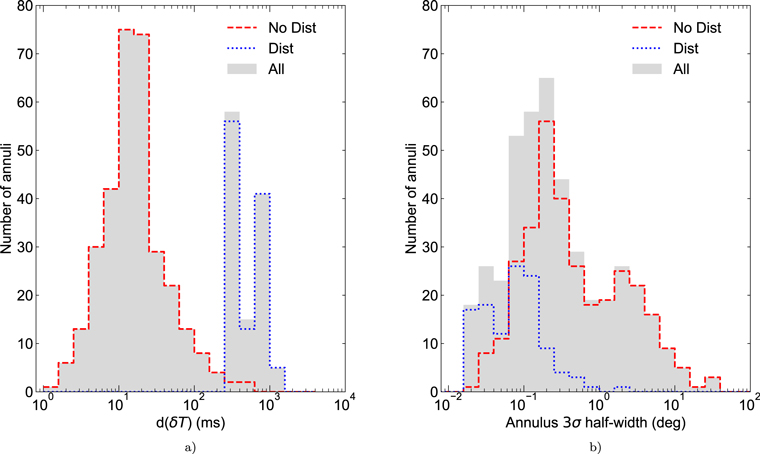
Figure 1. Distributions of uncertainties in time delay d(δ
T) = (d+(δ
T) + ∣d−(δ
T)∣)/2 (left) and 3σ half widths (HWs, right) of the 438 triangulation annuli. Blue dotted lines: 115 annuli involving at least one distant s/c; red dashed lines: 323 annuli not involving any distant s/c. For annuli obtained using the KW and near-Earth (or INTEGRAL) s/c data, the smallest d(δ
T) is 1.2 ms, the largest is 600 ms, the mean is 29 ms, and the geometric mean is 16 ms; the smallest HW is 0021 (1
3), the largest is 36
7, the mean is 1
6, and the geometric mean is 0
45. For annuli involving distant s/c, the smallest d(δ
T) is 361 ms, the largest is 1168 ms, the mean is 596 ms, and the geometric mean is 544 ms; the smallest HW is 0
016 (0
9), the largest is 2
1, the mean is 1
12, and the geometric mean is 0
72.
Download figure:
Standard image High-resolution imageThe detectors in the IPN vary widely in shape, composition, time resolution, and energy range. Also, onboard timekeeping techniques and accuracies differ from mission to mission, and s/c ephemeris data are given only as predictions for most missions. A detailed discussion of triangulation systematic effects is given in Hurley et al. (2017). Since the accuracy of the triangulation technique depends on all these parameters, end-to-end calibrations and sensitivity checks are a constant necessity.
3.2. Verifying Triangulation Annuli
Of the bursts localized by IPN, 27 were precisely localized by Swift-BAT or XRT (including GRB 150831A, which was also localized by INTEGRAL-IBIS/ISGRI). We utilized these bursts to verify our triangulations.
For these 27 bursts, 43 KW–near-Earth s/c (including 20 KW–INTEGRAL) and 16 KW (or Fermi)–distant s/c annuli were obtained. The Swift localizations were taken from either the Swift (XRT) catalog 44 , if an X-ray afterglow was found, or the third Swift (BAT) catalog (Lien et al. 2016). For recent GRBs, the BAT localizations were taken from GCN circulars with refined positions. In each case the triangulation annuli are in agreement with the precise Swift localization of the source, thereby confirming the reliability of our triangulations. A maximum offset of 3.3σ was found for the bright GRB 130603B; for this burst, it corresponds to ∼1 ms systematic uncertainty in time delay.
Figure 2 shows the distributions of relative source offsets (in σ) from the center lines of 43 KW–near-Earth s/c (including 20 KW–INTEGRAL) and 16 KW (or Fermi)–distant s/c annuli. For these subsamples, the mean offsets are 0.0 and 0.2; the standard deviations are 1.4 and 0.9, respectively.
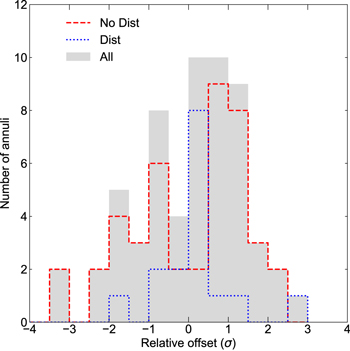
Figure 2. Distributions of relative offsets (in σ) of the 27 precise GRB positions from the center lines of the IPN annuli. Red dashed line: 43 KW–near-Earth s/c (including 20 KW–INTEGRAL) annuli; blue dotted line: 16 KW (or Fermi)–distant s/c annuli.
Download figure:
Standard image High-resolution image3.3. Additional Constraints
In addition to triangulation annuli, several other types of localization information are included in this catalog. They are ecliptic latitude range, autonomous burst localizations obtained by Fermi (GBM and LAT) or GECAM, and Earth or Mars blocking (MESSENGER was in an eccentric orbit around Mercury, so Mercury blocking was quite rare). This additional information helps to constrain the triangulation position, i.e., to choose one of two triangulation boxes, or to eliminate portions of a single annulus. In some cases the position of the BAT-coded field of view may constrain burst localization. In case a burst produced a significant (≳5σ) response in the BAT-summed array-rate light curve in the 15–350 keV energy band (see, e.g., Tohuvavohu et al. 2020 for the BAT data product description) and no BAT trigger was reported, the burst was most probably located outside the coded field of view of the BAT. Precise burst localizations by Swift-BAT or XRT are provided for verification of the IPN localizations.
3.3.1. Ecliptic Latitudes
The ecliptic latitudes of the bursts are derived by comparing the count rates of the two KW detectors (S1 and S2) mounted on the opposite faces of the rotationally stabilized Wind s/c. The axis of S2 points toward the north ecliptic pole, and the axis of S1 points toward the south ecliptic pole.
The triggered mode data are available from a single KW detector, typically the one with a smaller GRB incidence angle (<90°). Intense GRBs produce count-rate increases in the waiting-mode time history of both KW detectors measured with 2.944 s time resolution. The lack of a reliable Wind mass model and the s/c rotation do not allow us to directly derive the Wind incidence angle (the source ecliptic latitude) in a way similar to the Fermi (GBM) and GECAM burst-location techniques. Nevertheless, it is possible to estimate the source ecliptic latitude from the ratio of ∼80–350 keV count rates in S1 and S2, calibrated using a sample of well-localized GRBs.
The ecliptic latitude range, namely the best estimate, β, and the lower and upper limits,  and
and  , can be considered to be an annulus centered at the north pole, with a half-angle θ = 90° − β and half-width
  ,
,  . The ecliptic latitude uncertainty is estimated at the 99.73% (3σ) confidence level.
3.3.2. Planet Blocking
When a s/c in low-Earth or Martian orbit detects a burst, planet blocking may constrain burst localization, since the source position must be outside the occulted part of the sky. Since Fermi (GBM) has a higher sensitivity than KW across the unocculted sky it is possible to use GBM nondetections to constrain GRB positions. In this case the burst source is inside the Fermi Earth-occulted region. To check that the GBM is switched on and collecting data we use GBM POSHIST and CTIME data.
The allowed part of the sky is specified in the catalog as a degenerate annulus centered at the s/c's nadir vector, with a half-angle  , where R is the radius of the s/c orbit and Rplanet is the solid planet radius assuming a spherical shape. The annulus half-widths are d−(θ) = − θ, d+(θ) = 0, in case the burst was occulted by the planet for the s/c, and d−(θ) = 0, d+(θ) = 180° − θ in the opposite case.
3.3.3. Autonomous Localizations
The autonomous localizations, derived by comparing the count rates of several detectors with a cosine-like angular response, are affected by Earth’s albedo and absorption or scattering in the s/c structure, among other things; as a result, their shapes are rather complex. To produce the final IPN localization region we use GBM RoboBA localizations (Goldstein et al. 2020) in the HEALPix format publicly available for bursts since 2018; pre-2018 RoboBA localizations were provided for this work by the GBM team.
The error circles provided in GBM GRB catalogs (e.g., von Kienlin et al. 2020), are simple approximations to these shapes. They are centered at the most likely arrival direction for the burst, and their radii are defined as an average distance to the true 68% statistical-only error contour (Connaughton et al. 2015). In this catalog, in cases where GBM localizations constrain the burst location, we provide the GBM error circles for reference. For GRB20210307_T21404 (the only burst in the catalog detected by GECAM) we provide the GECAM localization.
Fermi (LAT) localizations provided in the catalog are circles centered at the LAT best-reconstructed position with 90% containment radius (statistical only) and were taken from either the Fermi (LAT) catalog (Ajello et al. 2019) or, for recent GRBs, from GCN circulars.
3.4. Localization Regions
The final localizations were produced using the set of IPN annuli and additional constraints. For those bursts which were detected by three or more well-separated s/c, a small localization region (down to tens of arcmin2) can be derived (Figure 3, top panel). For such bursts, we have typically provided three annuli in the catalog. We used the two of them which provided the most compact localization region to construct the localization. As a typical result two regions are produced and, with the help of the third annulus, we selected the final region.
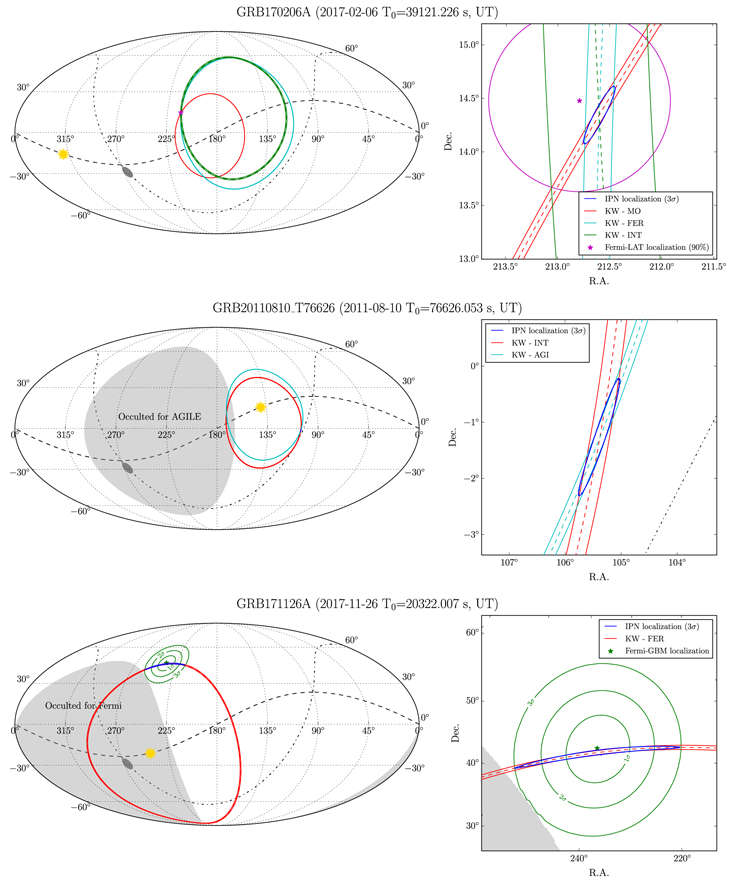
Figure 3. IPN localizations. The three panels present typical cases of IPN localization: GRB detected by four well-separated s/c (top panel); GRB detected by three s/c with an additional constraint used to select the final localization (middle panel); GRB detected by two s/c, the localization is formed by a single annulus and GBM localization (bottom panel). The left plot in each panel shows the whole sky with triangulation annuli and other constraints along with the ecliptic plane (dashed line) and Sun position at the GRB time; the Galactic plane (dashed–dotted line) and the Galactic center. The right plots are magnification insets showing the 3σ localization confidence region (blue solid line). The GRB name and the KW trigger time are given in the figure title.
Download figure:
Standard image High-resolution imageFor bursts not observed by any distant s/c, but observed by KW, INTEGRAL (SPI-ACS), and one or more near-Earth s/c, the localization region is formed by the intersections of the KW–near-Earth s/c annulus and an INTEGRAL–near-Earth s/c annulus, or by a KW–near-Earth s/c annulus and a KW–INTEGRAL annulus intersecting at grazing incidence. In this case the final region was selected taking into account additional constraints (Figure 3, middle panel). Where a GBM localization is used we exclude a region if it lies outside the GBM 3σ contour (calculated using the RoboBA localization). We also used Fermi (LAT) and precise Swift localizations (where available) for region selection.
For those bursts which were detected only by KW and one other s/c, or by KW and one or more near-Earth s/c, the resulting localization is formed by a triangulation annulus (the narrowest in the case of several KW–near-Earth s/c annuli) and additional constraints. These localizations consist of the entire annulus (in the case where it is entirely inside the allowed ecliptic latitude band and there are no other constraints) or one or two annulus segments, formed by the intersection of the annulus with the ecliptic latitude band, and/or by exclusion of the occulted part of the annulus, or by combination with the GBM localization (Figure 3, bottom panel).
3.4.1. Probability Sky Maps
Localization maps were produced in the multiresolution map HEALPix format 45 using the mhealpy Python package 46 in the following way. The probability density for the annulus was specified by a Gaussian distribution centered at the symmetrized annulus center line and having 3σ half-width equal to the annulus half-width. Localization annuli are typically asymmetrical with respect to the annulus center line; they are symmetrized by defining an average annulus half-width about a displaced center line. The planet-blocking regions were specified by a degenerate annulus on the sky with a uniform probability inside it and zero probability outside; see Section 3.3.2.
In case a burst was detected by BAT outside the coded field of view, the BAT-coded field of view was represented as a region with partial coding fraction >10% with zero probability inside it. The KW ecliptic latitude band was represented as an annulus with a uniform probability inside it and zero probability outside, centered at the north ecliptic pole with radius and half-width corresponding to the incident angle constraint. The final probability density was calculated as a product of the selected annuli and constraints.
We note that, in this work, the probability densities for each annuli are assumed to be independent, despite that they may involve overlapping data (e.g., in case of intersection of KW–FER and FER–INT annuli). Such simplification can be avoided in future with more sophisticated methods (e.g., Burgess et al.2021).
The localization contours were calculated using the ligo.skymap package 47 , modified for the multiresolution map case. Examples of the localization maps are given in Figure 3. The probability sky maps are stored in files following the Flexible Image Transport System (FITS) standard (see Appendix B for file description).
4. Localizations: Results
Table 3 summarizes localization information for 199 Konus short bursts. The first column gives the burst designation (see Table 2). The second column gives the number of localization constraints (the number of rows with localization information for the burst). The six subsequent columns give localizations expressed as a set of annuli: the third column gives the source of the location: either sc1–sc2 (triangulation annulus derived using sc1 and sc2), or “Ecl.Lat” (range of ecliptic latitudes), or “Pos.Instr” (“Instr” is one of the following: “SWI” for Swift-BAT or XRT, “GBM” or “LAT” for Fermi, and “GEC” for GECAM localizations), or “Occ.sc” (planet blocking for s/c); Columns 4–8 list the R.A. and decl. of the annulus center, the annulus radius θ, and the 3σ uncertainties in the radius d−(θ), d+(θ). Planet blocking, ecliptic latitude range, and autonomous localizations are given only if they constrain the location.
Table 3. IPN Localization Data
| Designation | N | Location | R.A. | Decl. | θ | d−(θ) | d+(θ) |
|---|---|---|---|---|---|---|---|
| Source | (deg) | (deg) | (deg) | (deg) | (deg) | ||
| GRB20110212_T47551 | 3 | KW–FER | 326.1161 | −19.9156 | 54.4586 | −0.0677 | +0.0676 |
| KW–INT | 324.7813 | −25.3330 | 49.3296 | −0.2804 | +0.1747 | ||
| Pos.GBM | 311.330 | −74.500 | 4.33 | ||||
| GRB20110221_T18490 | 3 | KW–MO | 330.8868 | −13.0377 | 16.0404 | −0.0657 | +0.0692 |
| KW–SUZ | 343.4756 | −13.1519 | 27.6975 | −0.2354 | +0.4076 | ||
| KW–INT | 342.3842 | −20.1351 | 29.0384 | −0.1671 | +0.3316 | ||
| GRB20110323_T57460 | 2 | KW–SUZ | 24.7970 | 9.8654 | 20.4803 | −0.4630 | +0.1954 |
| KW–INT | 24.5553 | 5.7015 | 17.2516 | −0.4805 | +0.9990 | ||
| GRB20110401_T79461 | 3 | KW–INT | 211.5140 | −12.0493 | 63.8888 | −0.2219 | +0.1969 |
| FER–INT | 91.5378 | 68.7932 | 85.6387 | −2.1886 | +3.1509 | ||
| Occ.SWI | 115.940 | 20.532 | 66.440 | −0.0 | +113.560 | ||
| GRB20110510_T80844 | 3 | KW–SWI | 228.2411 | −23.4898 | 84.5588 | −0.2262 | +0.1233 |
| KW–MO | 27.6375 | 10.6619 | 73.0224 | −0.0246 | +0.0246 | ||
| KW–MES | 22.7559 | 6.0257 | 66.3059 | −0.1203 | +0.1179 |
A machine-readable version of the table is available.
Download table as: DataTypeset image
Table 4 gives the description of the final IPN error regions (including the 27 imaged bursts). The nine columns contain the following information: (1) the burst designation (see Table 2); (2) the number of error regions for the burst, Nr : 1 or 2; (3) and (4) the R.A. and decl. of the most probable burst location for each region; (5) the maximum dimension of the region (that is, the maximum angular distance between two points at the 99.73% probability region boundary); (6) the minimum dimension of the region (that is, the full-width of the narrowest annulus forming the region); (7) the area (for two regions the area of each region) enclosing 99.73% probability. Distributions of the region dimensions and areas are shown in Figure 4.
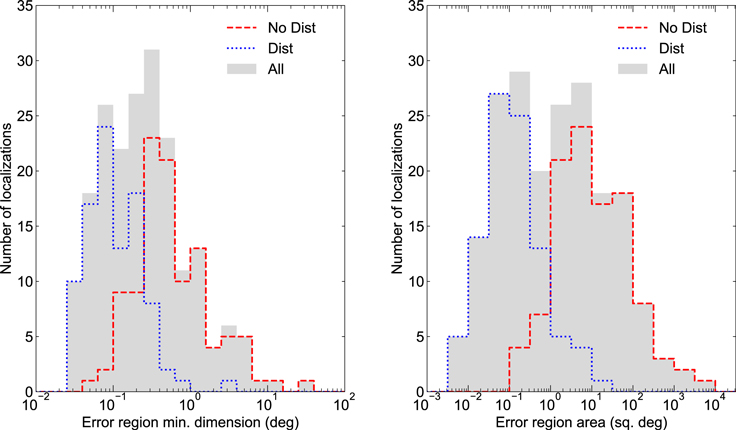
Figure 4. Distributions of minimum sizes (left) and areas (right) of the IPN localizations. Blue dotted lines: 94 Konus short bursts observed by at least one distant s/c; red dashed lines: 105 bursts not observed by any distant s/c. The minimum region dimensions range from 0033 (2
0) to 3
32 with a mean of 0
17, and a geometric mean of 0
11 (for bursts observed by distant s/c) and from 0
043 (2
6) to 36
5 with a mean of 1
5, and a geometric mean of 0
6 (for bursts without distant s/c detections). The areas range from 0.005 deg2 (18 arcmin2) to 14.4 deg2 with a mean of 0.70 deg2, and a geometric mean of 0.12 deg2 (for bursts observed by distant s/c) and from 0.156 deg2 to 3163 deg2 with a mean of 103 deg2, and a geometric mean of 11.0 deg2 (for bursts without distant s/c detections).
Download figure:
Standard image High-resolution imageTable 4. IPN Error Regions
| Designation | Nr | R.A. | Decl. | Max. Dim. | Min. Dim. | Area |
|---|---|---|---|---|---|---|
| (deg) | (deg) | (deg) | (deg) | (deg2) | ||
| GRB20110212_T47551 | 2 | 271.471 | −57.147 | 12.745 | 0.135 | 1.534 |
| 348.236 | −72.931 | 12.745 | 0.135 | 1.534 | ||
| GRB20110221_T18490 | 1 | 316.305 | −5.895 | 3.406 | 0.135 | 0.413 |
| GRB20110323_T57460 | 2 | 10.195 | −4.350 | 12.197 | 0.658 | 6.496 |
| 37.705 | −5.885 | 12.197 | 0.658 | 6.494 | ||
| GRB20110401_T79461 | 1 | 264.968 | +24.902 | 6.948 | 0.419 | 2.955 |
| GRB20110510_T80844 | 1 | 334.020 | −43.873 | 3.216 | 0.050 | 0.131 |
A machine-readable version of the table is available.
Download table as: DataTypeset image
5. Conclusions
This paper continues a series of catalogs of GRB localizations obtained by arrival-time analysis, or “triangulation”, between the s/c in the 3rd IPN, as summarized in Table 5. We have presented the most comprehensive IPN localization data on 199 KW short bursts detected between 2011 January 1 and 2021 August 31. With one exception, IPN localizations were obtained for these events (for GRB20171108_T51656 observed by KW only, the source position is constrained to the Fermi Earth-occulted region combined with the KW ecliptic latitude range). We verified the triangulations using 27 bursts localized by instruments with imaging capability. In each case the derived IPN annuli are in agreement with the precise GRB position, thereby confirming the reliability of our results.
Table 5. IPN Catalogs of Gamma-Ray Bursts to Date
| Years Covered | Number of GRBs | Description |
|---|---|---|
| 1990–1992 | 16 | Ulysses, Pioneer Venus Orbiter, WATCH, SIGMA, PHEBUS GRBs a |
| 1990–1994 | 56 | Granat-WATCH supplement b |
| 1991–1992 | 37 | Pioneer Venus Orbiter, Compton Gamma-Ray Observatory, Ulysses GRBs c |
| 1991–1994 | 218 | BATSE 3B supplement d |
| 1991–2000 | 211 | BATSE untriggered burst supplement e |
| 1992–1993 | 9 | Mars Observer GRBs f |
| 1994–1996 | 147 | BATSE 4Br supplement g |
| 1994–2010 | 279 | First Konus short bursts h |
| 1996–2000 | 343 | BATSE 5B supplement i |
| 1996–2002 | 475 | BeppoSAX supplement j |
| 2000–2006 | 226 | HETE-2 supplement k |
| 2008–2010 | 146 | First GBM supplement l |
| 2010–2012 | 165 | Second GBM supplement m |
| 2011–2021 | 199 | Second Konus short bursts n |
Notes.
a Hurley et al. (2000a); b Hurley et al. (2000b); c Laros et al. (1998); d Hurley et al. (1999a); e Hurley et al. (2005); f Laros et al. (1997); g Hurley et al. (1999b); h Pal'shin et al. (2013); i Hurley et al. (2011a); j Hurley et al. (2010); k Hurley et al. (2011b); l Hurley et al. (2013); m Hurley et al. (2017); n Present catalog.Download table as: ASCIITypeset image
Currently the nine-s/c IPN detects about 325 bursts per year (Hurley et al. 2017), about 18 of which are rather bright, short-duration, hard spectrum GRBs (see P13 and this work). The IPN localizations can be used for a wide variety of purposes, including, but not limited to, searches for gravitational waved, kilonovae, and neutrino signals from merging compact objects, very-high-energy photons from the burst sources, and giant magnetar flares in nearby galaxies. As KW continues to operate, we anticipate more localizations, in particular in conjunction with upcoming LIGO/Virgo operations.
D.S.S., A.V.R., A.L.L., D.D.F., and M.V.U. acknowledge support from RSF grant No. 21-12-00250. The HEND experiment was supported by the Russian State Corporation Roscosmos and implemented as part of the Gamma-Ray Spectrometer suite on NASA Mars Odyssey. HEND data processing was funded by the Ministry of Science and Higher Education of the Russian Federation, grant No. AAAA-A18-118012290370-6. KH is grateful for support under the Fermi Guest Investigator program, grant No. 80NSSC20K0585. We thank Valentin Pal'shin for his considerable contribution to the Konus-Wind and IPN data analysis tools. Some of the results in this paper have been derived using the healpy and HEALPix packages.
Facilities: Wind (Konus) - , Fermi (GBM and LAT) - , Swift (BAT and XRT) - , Suzaku (WAM) - , AGILE (MCAL) - , ISS (CALET-CGBM) - , Insight-HXMT (HE) - , GECAM-B - , INTEGRAL (SPI-ACS) - , MESSENGER (GRNS) - , Mars Odyssey (HEND) - .
Software: Astropy (Astropy Collaboration et al. 2013, 2018); Fermi GBM Data Tools (Goldstein 2021); Utilities for Swift (BAT) instrument (https://github.com/lanl/swiftbat_python); Astroquery (Ginsburg et al. 2019); healpy (Górski et al. (2005); Zonca et al. (2019), https://healpix.sourceforge.io); mhealpy (https://mhealpy.readthedocs.io); ligo.skymap (https://lscsoft.docs.ligo.org/ligo.skymap).
Appendix A: Data Sources
A.1. IPN Instrument Data
We use the following sources for the instrument data: Swift-BAT, 48 for recent GRBs we used BAT time-tagged event data that exist due to the Gamma-ray Urgent Archiver for Novel Opportunities (GUANO; Tohuvavohu et al. 2020); Fermi-GBM 49 ; Suzaku-WAM 50 ; INTEGRAL-SPI-ACS 51 ; MESSENGER-GRNS 52 ; AGILE-MCAL, Insight-HXMT, and Mars Odyssey HEND data are available on request from the instrument teams. The AGILE-MCAL sGRB data are part of the the Second AGILE-MCAL GRB Catalog (Ursi et al. 2022).
A.2. Ephemeris and Clock Accuracy Data
Near-Earth s/c ephemerides were derived from two-line elements (TLE) available at https://www.space-track.org using the SGP8 model. For Wind we use the predicted ephemeris; for the Mars Odyssey and MESSENGER ephemerides, and the Mars Odyssey nadir vectors, we used the JPL Horizons online ephemeris system 53 using the astroquery Python package (Ginsburg et al. 2019). INTEGRAL ephemeris data are available via the SPI-ACS data web interface. The Wind-predicted ephemeris data and their description are available at https://spdf.gsfc.nasa.gov/pub/data/wind/orbit/pre_or/ and https://cdaweb.gsfc.nasa.gov/misc/NotesW.html#WI_OR_PRE.
The declared onboard clock accuracy of the s/c are as follows: down to 1 μs for Fermi; ∼200 μs for Swift; ∼1 ms for Wind; and ∼100 μs for INTEGRAL; for Mars Odyssey an overall 3σ systematic uncertainty, which includes timing and other effects derived from IPN observations of precisely localized GRBs, is better than 360 ms; the corresponding MESSENGER uncertainty is 800 ms. The Swift timing corrections were calculated using Swift-BAT utilities. The Wind clock drift information is provided at ftps://pwgdata.sci.gsfc.nasa.gov/pub/wind_clock/.
Appendix B: Localization Files
The localizations are stored in a series of FITS data files available online from the Ioffe website 54 in the following formats: multiresolution HEALPix maps (*_IPN_map_hpx_moc.fits.gz) and regular resolution HEALPix maps (*_IPN_map_hpx.fits.gz). In addition to HEALPix maps the website stores the localization 0.9973 integrated probability contours in ASCII format, which contain the coordinates of the center of the pixel with the maximum probability (two pixels are given in the case of two localization regions), followed by the region contour coordinates; and plots produced using the ligo.skymap package.
The regular resolution maps are standard HEALPix FITS files with RING numeration, and celestial coordinate system. The single extension table of the file contains the pixel probability. The comment field contains information about the instruments involved in localization, a list of additional constraints, and the parameters of the IPN annuli used. The extension table of the multiresolution map file contains the pixel probability and the pixel index in the UNIQ indexing scheme 55 (Singer & Price 2016).
Footnotes
- 41
- 42
- 43
- 44
- 45
- 46
- 47
- 48
- 49
- 50
- 51
- 52
- 53
- 54
- 55