Abstract
Recent data from the James Webb Space Telescope allow a first glimpse of galaxies at z ≳ 11. The most successful tool for identifying ultra-high-redshift candidates and inferring their properties is photometric template fitting. However, current methods rely on templates derived from much lower-redshift conditions, including stellar populations older than the age of the Universe at z > 12, a stellar initial mass function that is physically disallowed at z > 6, and weaker emission lines than currently observed at z > 7.5. Here, two sets of synthetic templates, optimized for the expected astrophysics of galaxies at 8 < z < 12 and z > 12, are developed and used to fit three galaxies at z > 12 from the SMACS0723 field. Using these improved templates, quantitative estimates are produced of the bias in inferred properties from JWST observations at z > 8 due to these effects. The best-fit redshifts are similar to those found with previous template sets, but the inferred stellar masses drop by as much as 1–1.6 dex, such that stellar masses are no longer seemingly inconsistent with ΛCDM. The two new template sets are released in formats compatible with EAZY and LePhare.
Original content from this work may be used under the terms of the Creative Commons Attribution 4.0 licence. Any further distribution of this work must maintain attribution to the author(s) and the title of the work, journal citation and DOI.
1. Introduction
The launch of the James Webb Space Telescope (JWST) provides the first observational window into galaxies at z ≳ 11. Within a few weeks of the first data release, several galaxies have been found at z > 12 (Adams et al. 2023; Atek et al. 2023; Castellano et al. 2023; Donnan et al. 2023; Finkelstein et al. 2022; Naidu et al. 2022; Yan et al. 2023). The discovery of these galaxies and an analysis of their properties will allow tests of models for halo assembly and early galaxy evolution, and will likely be one of the key early results from JWST.
Photometric surveys have been the best discovery tool for high-redshift galaxies (Steidel & Hamilton 1992), and all of the early, ultra-high-redshift sources have been detected in NIRCam imaging. Both the identification of these galaxies and the subsequent determination of properties such as stellar mass (M*) and star formation rates (SFR) rely on photometric template fitting. One of several codes (Brammer et al. 2008; Arnouts et al. 1999; Leja et al. 2017; Carnall et al. 2018) is used to compare a series of model spectral templates against the observed photometry, and the redshift and properties are inferred from the best-fit models. Most models are synthetic templates produced from stellar population synthesis under a range of assumptions and conditions. Crucially, all these synthetic templates are derived from local conditions, which are either theoretically disallowed or observationally disproven for galaxies at ultra-high redshift.
Therefore, in this work, a new template set is developed with the aim of producing models tuned for fitting ultra-high-redshift galaxies. These templates are also available for download in Github at https://github.com/e-m-garcia/hot-templates and Zenodo at doi:10.5281/zenodo.7196779 in formats compatible with EAZY and LePhare. The models are significantly different in three respects. First, they use younger stellar populations because, at those redshifts, the stellar population cannot be more than a few hundred Myr old. In contrast, all current templates are older than the age of the Universe at z ≈ 12 (Brammer et al. 2008). Second, we apply bottom-lighter IMFs corresponding to expected conditions in star-forming regions of galaxies at z ∼ 15 (see Section 2). Third, we use stronger emission lines, as none of the local strong-line metallicity calibrations provide a good prediction of the observed metallicities at z > 7.5 (Curti et al. 2023). The differences in inferred parameters between these templates and ones derived from current templates are discussed in Section 3.
Throughout this paper, we assume a flat ΛCDM cosmology with Ωm,0 = 0.3, ΩΛ,0 = 0.7, and H0 = 70 km s−1 Mpc−1.
2. The High-redshift Initial Mass Function
The physical parameters inferred for high-redshift galaxies will depend upon the assumptions made when producing the synthetic spectra used to fit them. Under the correct assumptions, templates should produce both a better fit and a more accurate description of the key physical properties of the galaxy than with incorrect assumptions. One central assumption common to all current templates is a universal stellar initial mass function (IMF), which is assumed to be identical to the current Galactic IMF. This is a critical assumption for inferring properties, because the light emitted by a galaxy is dominated by the most massive stars comprising only a small fraction of the stellar mass, and the IMF is necessary to infer the remainder of the stellar population from that high-mass tail. However, theoretical models for star formation predict that the IMF should depend upon several properties of star-forming molecular clouds, including gas temperature and metallicity (Low & Lynden-Bell 1976; Larson 1985; Jermyn et al. 2018; Steinhardt et al. 2020). Thus, assuming a universal IMF is, in effect, an assumption that the differences between Galactic and extragalactic star-forming regions are negligible.
The ideal approach would be to construct templates using a range of possible initial mass functions and determine which one fits best. This is the approach taken in recent work fitting galaxies at lower redshifts (Sneppen et al. 2022; Steinhardt et al. 2022a, 2022b). Based on theoretical arguments (Jermyn et al. 2018), a one-parameter family of templates at different gas temperatures Tg was produced. The corresponding IMF at each gas temperature was taken as
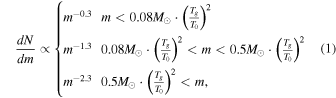
which matches a Galactic (Kroupa) IMF at Tg = T0 = 20 K. Other investigations of the relation between temperature and IMF produce a similar relationship, but with a slightly different temperature dependence (Jeans 1902; Hopkins 2012; Chabrier et al. 2014). Each of these sets of templates was used to fit photometric observations from the COSMOS2015 catalog (Laigle et al. 2016), and the best-fit among all of the template sets was taken as having the correct IMF and used to infer physical parameters.
However, as there are strong spectral covariance between changes in the IMF and changes in dust or metallicity, it was only possible to constrain the IMF for the ∼10% of the catalog with the highest signal-to-noise ratio in Sneppen et al. (2022). Further, the COSMOS catalog includes multiwavelength measurements in up to 30 bands. Thus, with a similar approach used on NIRCam photometry, with typically 4–5 bands exhibiting nonzero flux emitted by the most distant observable galaxies, it is not possible to observationally constrain the IMF. Rather, it will be necessary to simply choose an IMF (or, equivalently, extinction and metallicity) and assume it holds for all galaxies in the sample. Indeed, this is already being done by all template fitting codes, which assume that the high-redshift IMF is the same as the Galactic one.
An alternative might be to produce observational rather than synthetic templates. Using NIRSpec, it should be possible to take spectra of a number of these z ∼ 15 sources, and those with confirmed high redshifts can then be used as templates to fit others. A similar empirical approach is taken for one of the template sets in LePhare (Arnouts et al. 1999). However, the spectrum alone will not be able to constrain the IMF, and thus this approach cannot be used to infer properties such as stellar mass or star formation rate. If the sole goal is redshift determination, this may still be the best source of templates, as the templates will certainly correspond to at least some types of z ∼ 15 galaxies.
The remaining approach, then, is to simply assume a z ∼ 15 IMF and hope that the assumption is approximately correct. This is already being done with the assumption of a Galactic IMF, and the goal here is to improve upon that assumption. There are three key observational and theoretical indications validating a change of IMF in this ultra-high-redshift regime.
First, the best-fit IMFs for COSMOS galaxies exhibit several clear trends (Sneppen et al. 2022). Quiescent galaxies at all redshifts out to z ∼ 2 are well fit with approximately Galactic IMFs (Steinhardt et al. 2022b). However, for star-forming galaxies, there is a characteristic, best-fit IMF at each redshift, which becomes bottom-lighter toward high redshift (Steinhardt et al. 2022a). Inferred values of Tg rise from 25 K at low redshift to over 30 K by z = 4. An extrapolation of this characteristic Tg to z ∼ 15 produces an estimate of 35–40 K.
Second, a reasonable interpretation is that, in star-forming galaxies, the young stellar population is the dominant contribution to gas temperature in star-forming regions. If so, z ∼ 15 galaxies, which must have very high SFR in order to have formed so quickly, should have even higher Tg and even bottom-lighter IMFs. A closer examination of the first stages of star formation, taking place primarily in galactic centers, finds Tg values of 45–60 K (C. Steinhardt et al. 2023, in preparation), with 60 K characteristic of galaxies in their earliest stages of evolution.
Finally, at high redshift, the CMB temperature is an additional source of heating. At z ∼ 15, the CMB temperature is 44 K, and if those stars have been forming over the past ∼120 Myr, a typical age for galaxies on the star-forming main sequence, a luminosity-weighted CMB temperature at the time of star formation would be closer to 55 K. It is difficult to find mechanisms for star-forming clouds to cool well below the CMB temperature, so this should be a minimum possible value of Tg at high redshift.
All three of these estimates suggest that a reasonable value of Tg for galaxies at z ∼ 10 would be 40–50 K, and at z ∼ 15 it would be significantly higher. In this work, the choice is made to develop templates based on Tg = 60 K for use when modeling the highest-redshift galaxies in JWST at z > 12. This produces a significantly bottom-lighter IMF than in the Milky Way. An additional set of templates with Tg = 45 K is also provided, and this is likely a better model for galaxies at 8 < z < 12.
In summary, inferring properties from JWST observations creates somewhat of a quandary. Ultra-high-redshift galaxies with very young stellar population are simultaneously (1) the galaxies for which inferred properties are most sensitive to the choice of IMF, (2) the galaxies most likely to form stars under very different conditions than in our own galaxy today, and (3) the galaxies for which it will be most difficult—if not impossible—to constrain the IMF observationally.
Fortunately, measurements from large surveys at lower redshift do provide constraints on the IMF, and their measured IMFs are consistent with physical intuition. Thus, the choice made in this work is to use similar physical intuition to extrapolate to the most likely ultra-high-redshift IMF, and this is almost certainly a better approximation to the true IMF than a Galactic one. However, it would not be shocking to discover that this physical intuition breaks down under the extreme conditions in the earliest galaxies, and inferred properties such as stellar masses and star formation rates for ultra-high-redshift galaxies should be assumed to have systematic uncertainties well in excess of those produced using the same techniques at lower redshift.
3. Fits and Inferred Parameters
The IMFs described in this work are implemented for two different photometric template fitting codes: EAZY (Brammer et al. 2008) and LePhare (Arnouts et al. 1999). EAZY starts from a set of 560 model spectra generated using Flexible Stellar Population Synthesis (FSPS), which span a wide range of SFR, stellar population ages, metallicities, and extinctions, then condenses them into 12 basis vectors that approximately span the full space. 4 Within that limited basis, matrix inversion allows a rapid determination of the best-fit linear combination of those 12 templates to the observed photometry over a grid of redshifts. LePhare, instead, relies on a grid search. For a smaller number of star formation histories, a grid of ages, redshifts, and extinctions is compared against the observed photometry to produce the best fit. LePhare will therefore only consider physically reasonable models, although the grid search means that often only a coarse search is possible in a reasonable runtime, and the best-fit model might not be found. EAZY can find the best fit more quickly within the limited basis, but in principle the best-fit linear combination might be physically unreasonable if the true parameters lie well outside of that basis.
Implementation for a grid-based search such as LePhare is straightforward, as it merely requires generating templates for every combination under consideration at a variety of ages. Instructions for installing the template set in this work for use with EAZY (or other codes that use the same format, e.g., Stardust; Kokorev et al. 2021) and LePhare can be found in Appendices A and B, respectively. The remainder of this section focuses on the template sets produced for EAZY, which additionally require a reconsideration of the template basis.
3.1. Modifying the Standard Template Basis
The standard EAZY release includes a set of 12 basis templates with properties chosen to approximately span the full observed galaxy population in large photometric catalogs. A list of the templates and their properties can be found in Table 1. The standard EAZY templates are based on a Chabrier IMF, but the IMFs used here (Equation (1)) are instead equivalent to a Kroupa IMF at Tg = 20 K. Therefore, a set of templates using a standard Kroupa IMF is used for comparison in order to demonstrate the effects of varying the IMF on inferred properties.
Table 1. Properties of the Stellar Populations in the 12 Template Basis of EAZY
| ID | Age (Gyr) | AV | Z |
|---|---|---|---|
| 0 | 0.72 | 0.06 | 0.0066 |
| 1 | 3.15 | 0.11 | 0.0119 |
| 2 | 10.59 | 0.13 | 0.0140 |
| 3 | 13.83 | 0.12 | 0.0223 |
| 4 | 13.64 | 0.73 | 0.0237 |
| 5 | 15.12 | 2.88 | 0.0240 |
| 6 | 0.34 | 0.07 | 0.0154 |
| 7 | 0.62 | 0.27 | 0.0211 |
| 8 | 1.07 | 0.80 | 0.0216 |
| 9 | 1.30 | 1.37 | 0.0216 |
| 10 | 2.26 | 1.81 | 0.0217 |
| 11 | 2.44 | 2.94 | 0.0216 |
Note. The properties are nearly identical for different IMFs, as they are constructed from linear combinations of FSPS models with the same physical parameters.
Download table as: ASCIITypeset image
Each template is a specific linear combination of a broader set of 560 individual models. To produce templates at Tg = 45 K, each of the 560 individual models was run with a modified IMF as in Equation (1). Those templates were then combined into the 12 basis templates using the same coefficients. This produces a very similar set of luminosity-weighted average properties for each template (see Table 2). Because of the bottom-lighter IMF, the light in each template is dominated by slightly younger stars, which have produced a slightly higher extinction and metallicity than at Tg = 20 K.
Table 2. Physical Properties for the Best-fit Template Reconstruction of Three Galaxies in the SMACS0723 Field
| IMF | Template Set |

| SFR (M⊙ yr−1) | t (Gyr) | AV | z |
|---|---|---|---|---|---|---|
| SMACS 1 (07:22:44.85, −73:29:53.75) | ||||||
| Chabrier (20 K) | EAZY 12 |
 a
a
| 3.02 | 0.34 | 0.07 | 12.23 |
| Kroupa (20 K) | EAZY 12 |

| 4.28 | 0.38 | 0.07 | 12.41 |
| Kroupa (60 K) | EAZY 12 |

| 2.45 | 0.39 | 0.07 | 12.41 |
| Kroupa (60 K) | Modified 6 |

| 2.13 | 0.20 | 0.10 | 12.06 |
| SMACS 2 (07:22:51.93, −73:29:21.89) | ||||||
| Chabrier (20 K) | EAZY 12 |

| 3.47 | 0.34 | 0.07 | 13.48 |
| Kroupa (20 K) | EAZY 12 |

| 3.32 | 0.34 | 0.07 | 14.26 |
| Kroupa (60 K) | EAZY 12 |

| 1.54 | 0.33 | 0.07 | 14.30 |
| Kroupa (60 K) | Modified 6 |

| 1.78 | 0.13 | 0.13 | 13.69 |
| SMACS 3 (07:23:03.45, −73:28:47.01) | ||||||
| Chabrier (20 K) | EAZY 12 |

| 4.29 | 0.34 | 0.07 | 15.09 |
| Kroupa (20 K) | EAZY 12 |

| 4.25 | 0.34 | 0.07 | 15.77 |
| Kroupa (60 K) | EAZY 12 |

| 1.97 | 0.33 | 0.07 | 15.80 |
| Kroupa (60 K) | Modified 6 |

| 1.72 | 0.10 | 0.01 | 15.23 |
Notes. Four template sets are compared: (1) the standard EAZY basis, derived using a Chabrier IMF; (2) the same basis derived with a Kroupa IMF; (3) the same basis at Tg = 60 K; and (4) a new Tg = 60 basis with younger stellar populations and other properties tuned for ultra-high-redshift galaxies. All template bases agree that these sources lie at z > 12, but the inferred masses differ far more significantly. There is insufficient information to use a goodness-of-fit test to determine which of these template sets will fit best, so the approach recommended here instead relies on astrophysical assumptions about these galaxies.
a Uncertainties shown here are those reported from the EAZY covariance estimation. As described in Section 3.2, these fit uncertainties significantly underestimate the true uncertainties for reconstructions consisting only of one template. Thus, negligible uncertainties do not indicate a very well-constrained fit, but rather that the true SED lies well outside of the template basis.Download table as: ASCIITypeset image
For illustration, these templates have been used to fit three high-z candidates (z > 12) from the SMACS0723 cluster field (V. Kokorev 2023, et al. in preparation). These have been labeled as SMACS 1, 2, and 3. The data reduction of the raw images and the photometry extraction have been performed with the grizli pipeline (Brammer & Matharu 2021). The images have been additionally aligned to match the astrometric reference frame used for the ALMA Lensing Cluster Survey data reduction of HST data (Kokorev et al. 2022). The data reduction and the photometric catalog will be fully described in G. Brammer et al. (2022, in preparation). The best-fit redshifts using the standard EAZY templates are z = 12.23, 13.48, and 15.09, respectively. The 60 K Kroupa IMF templates produce a very similar redshift, which is not surprising given that these are dropout galaxies in the JWST F090W band and the redshift is primarily determined from the presumed location of the break. The fits themselves are also broadly similar, with typical differences of ≲2% in the reconstructed flux (Figure 1).
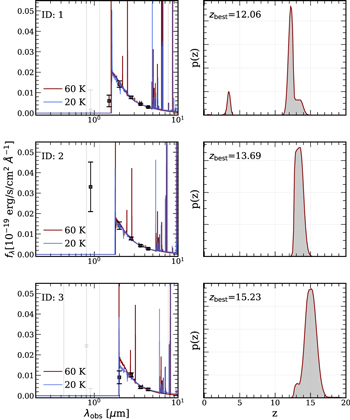
Figure 1. Best-fit reconstructed spectra (left) and redshift probability functions (right) for three galaxies in SMACS0723. The fits were performed with the standard EAZY Chabrier IMF at Tg = 20 K (blue) and with the Kroupa IMF at Tg = 60 K (maroon), with the latter fit expected to be a better description of galaxies at z > 12.
Download figure:
Standard image High-resolution imageThe physical properties exhibit a far greater difference (see Figure 2 or Table 2). In a star-forming galaxy, most of the light comes from the most massive stars, while most of the stellar mass lies in the least massive ones. Thus, a significantly bottom-lighter IMF will produce a much lower stellar mass and SFR.
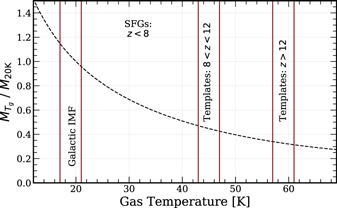
Figure 2. Expected change in inferred stellar masses using the IMFs in this work relative to Galactic IMF as a function of Tg . The dashed black line indicates the average shift based on the analytical integral while holding all other parameters fixed, which is a close match for the observed differences in fitting the three z > 12 candidates under the same conditions. The actual shift in stellar mass will combine this effect, the difference between Kroupa and Chabrier choices of Galactic IMF, and changes in stellar age and nebular emission lines, and it will typically exceed the analytical integral shown here.
Download figure:
Standard image High-resolution imageThe best-fit stellar masses are between 0.5 and 0.6 dex lower at Tg = 60 K than at Tg = 20 K. At lower redshifts, differences in the best-fit extinction and metallicity create a more complex relationship between Tg and the best-fit stellar mass (Sneppen et al. 2022; Steinhardt et al. 2022b). However, galaxies at z ∼ 15 have not had enough time to form as much dust. Thus, this change in stellar mass is very close to the difference in mass-to-light ratios for a single stellar population between Tg = 20 K and 60 K (Figure 2). A similar shift exists in the best-fit star formation rates.
3.2. Younger Stellar Templates for High-Redshift Galaxies
With either set of fits, the inferred specific star formation rates (sSFR, or SFR/M*) are ∼10−8 yr−1. 5 At that rate, the entire stellar population would form in 100 Myr. At z = 12.4, 14.3, and 15.7, the Universe is 350 Myr, 290 Myr, and 260 Myr old, respectively. Thus, 100 Myr is a plausible age for a stellar population in a z ∼ 15 galaxy.
However, every one of the basis templates corresponds to an older stellar population than in these high-redshift galaxies. The template with the youngest stellar population age, template 6 (see Table 1), has a luminosity-weighted age of 340 Myr. Nevertheless, as the youngest stellar population, it is the closest match. The best-fit linear combinations of the 12 EAZY templates are dominated by this single youngest template, with template 6 contributing at least ∼76% to the fits of object 1 and 100% to the other fits. The next-youngest template, template 7, contributes all of the remainder. The true SED very likely lies outside of the basis spanned by these 12 templates.
If the true SED lies well outside of the basis spanned by these 12 templates, the closest match will likely lie at an extreme edge of that basis. This is consistent with the EAZY best-fit reconstructions, which consist almost solely of a single template. If measurement uncertainties perturb the input photometry, it will still result in a galaxy younger than any of the basis templates, and so the best fit will still be dominated by the same single template. Thus, even a large uncertainty in photometry will result in a minimal change in the best-fit spectrum and parameters.
Because the uncertainties on EAZY fit parameters are derived from the uncertainty on the best fit within this 12 template basis, the estimated uncertainty on parameters such as stellar mass will also be unreasonably low. The EAZY uncertainty estimation in the stellar masses for the three SMACS galaxies uses the standard template basis breaks, as the covariance matrix cannot be calculated. The resulting reported zero uncertainties are not an indication of reliability in the masses, but rather of how far outside of the template basis the observed photometry apparently lies.
Here, a set of six additional templates is introduced to solve this problem. They include three different stellar population ages and two choices of extinction at each age, all of the same metallicity (Table 3). Two of these templates also have increased equivalent widths of emission lines to EW(Hβ + [O iii]λ5007) ≈ 1370 Å. Such extreme nebular emission, thought to be associated with the “IRAC excess” in galaxies at z > 7, was observed in IRAC photometry (e.g., Smit et al. 2014; Oesch et al. 2015; Roberts-Borsani et al. 2016), NIRCam photometry (Labbe et al. 2023), as well as NIRSpec spectra (Carnall et al. 2023). The six extended templates Tg = 45 K and 60 K are available online, with installation instructions in Appendix A.
Table 3. Properties of the Stellar Populations in the Six New FSPS Templates for EAZY at Tg = 45 K and 60 K
| ID | t45 (Gyr) | t60 (Gyr) | AV,45,60 | Z45,60 | Neb. Em. |
|---|---|---|---|---|---|
| 1 | 0.1 | 0.05 | 0.005 | 0.0012 | 1x (std.) |
| 2 | 0.1 | 0.05 | 0.5 | 0.0012 | 5x |
| 3 | 0.3 | 0.1 | 0.005 | 0.0012 | 1x (std.) |
| 4 | 0.3 | 0.1 | 0.5 | 0.0012 | 1x (std.) |
| 5 | 0.5 | 0.2 | 0.005 | 0.0012 | 1x (std.) |
| 6 | 0.5 | 0.2 | 0.5 | 0.0012 | 5x |
Notes. The templates all have young stellar populations with ages between 0.05 and 0.20 Gyr for 45 K and between 0.1 and 0.5 Gyr for 60 K. The low extinction and metallicity are expected to be typical of ultra-high-redshift galaxies. Because of the strong emission lines present in early NIRSpec observations (Carnall et al. 2022), two templates are included with strongly enhanced EW(Hβ + [O iii]λ5007) with respect to the standard FSPS setting of ∼274 Å.
Download table as: ASCIITypeset image
The two different values for extinction of the new templates are AV = 0.005 and AV = 0.5. Template 6, the dominant template in the fits with the standard EAZY basis with all three IMFs considered, has AV = 0.06, which is therefore the extinction fit for all three galaxies using those bases. Although the fits with the new six-template basis could produce extinction as high as AV = 0.5, all three SMACS objects are fit with much lower extinctions similar to Template 6.
Although large multiwavelength surveys can have as many as 30 photometric bands, which can be parameterized by a basis of 12 templates, these ultra-high-redshift candidates will typically will only have detections in 4–5 bands. Thus, the basis we advocate using for JWST objects is necessarily smaller than the full EAZY basis.
Finally, the ability of the new templates to accurately constrain redshift was cross-checked by fitting an object in the relevant redshift range detected spectroscopically with NIRSpec, which was first reported in Carnall et al. (2023) (object ID 4590 in the paper). The best-fit redshift at Tg = 45 K is zphot = 8.32, which agrees with zspec = 8.498 well within one σ of the zphot distribution.
4. Discussion
This paper presents a revised and improved basis for templates for fitting high-redshift galaxies with z > 8. While current synthetic templates are derived from stellar populations, which are impossibly old, have weaker emission lines than observations, and invoke an unphysical assumption of a Galactic IMF, the revised templates improve on all these accounts. Here, a new set of six templates optimized for the extreme conditions in the earliest galaxies is presented, along with instructions for use with EAZY and LePhare.
It should be noted that the addition of these templates to the standard 12 EAZY basis templates will provide additional degrees of freedom, and JWST observations alone will typically not provide enough information to constrain the best fit within a combined, 18 template basis. Further, the inclusion of very young stellar populations might allow spurious fits for some lower-redshift galaxies, since in combination with dusty or quiescent templates, it allows matching the blue and red ends of the SED nearly independently. For similar reasons, deriving a best-fit IMF for each individual source is not possible, so it is instead necessary to select a single set of templates based on the expected astrophysics of typical very high-redshift galaxies.
Therefore, to avoid improving high-z fits and properties at the cost of degrading low-z objects, we recommend a two-stage procedure. First, the standard EAZY template basis should be used to fit all sources, since it is well optimized for the local objects in a photometric survey, which constitute the vast majority. Then, the objects with best-fit z > 8 should be refit with these new templates: the template set at Tg = 45 K at 8 < z < 12 and with Tg = 60K at z > 12. The latter fits should produce better estimates of the physical parameters for these galaxies, which are robustly fitted at the highest redshifts. The new templates introduced are intended as a first-order improvement to current low-redshift derived templates, but are certainly not a complete solution. Future spectroscopy at z > 12 may provide improved properties for template fitting at these redshifts.
4.1. Effects on Redshift Determination
For galaxies at z < 4 in COSMOS, a change in IMF had negligible effect on the best-fit redshifts (Sneppen et al. 2022). Most objects have detected flux on both sides of the Balmer break, often from narrow bands, and therefore the location of the break was well constrained. However, the highest-redshift JWST galaxies are instead found as dropouts in NIRCam photometry, with no narrow bands to further constrain the location of the break. The bluest bands will have no detection, the reddest bands will have clear detections, and one band in between (F200W at z ∼ 15) will typically have a fainter detection, combining part of the spectrum above the Lyman break with negligible flux at shorter wavelengths. The strongest constraint on the best-fit redshift comes from essentially calculating the equivalent width for that partial detection and determining what fraction of this band has nonzero flux. Thus, a change in the UV slope near the Lyman break will change that equivalent width, and unlike the case at z < 4, the corresponding best-fit redshift will be sensitive to the IMF.
For example, with everything else held constant, the switch from a Chabrier IMF to a Kroupa IMF within the standard EAZY template basis yields a higher best-fit redshift. Because the best-fit models with this 12 template basis are solely composed of the same single template with both IMFs, a higher redshift is found for each SMACS source. These changes in redshift are still within the estimated redshift probability density function, which describes the statistical uncertainty. However, they are not statistical, but rather a systematic offset between the redshifts calculated from each template set, due to the smaller equivalent widths obtained with a Kroupa IMF.
With the six-template basis proposed in this work, a more complex dependence is possible. In addition to a change in IMF, the additional templates allow galaxies to be fit with different metallicities and extinction values than using the standard EAZY basis. Thus, in total, the UV slope of the reconstructed spectrum could be either steeper or shallower, and thus the redshift could change in either direction.
4.2. Impossibly Early Galaxies
The strongest effect will be on the inferred stellar masses. The change between a Chabrier and a Kroupa IMF can produce a difference of 0.2–0.3 dex in stellar mass, but the effect of a high Tg is far stronger, with variations of ∼0.5–1 dex.
This change is particularly relevant at very high redshift, because the inferred stellar masses from standard template libraries are high enough to challenge the standard ΛCDM paradigm. Prior to JWST, the most massive, highest-redshift galaxies in large photometric surveys were already difficult to reconcile with ΛCDM halo mass functions (Steinhardt et al. 2016; Behroozi & Silk 2018), an effect described as the impossibly early galaxy problem (Steinhardt et al. 2016). One possible solution would be an increase in the stellar baryon fraction (Finkelstein et al. 2015; Behroozi et al. 2020), which would allow halos of the same mass to contain galaxies with greater stellar masses at high redshift. However, the estimated masses of JWST galaxies at z = 10 (Labbe et al. 2023) are high enough that even this is no longer a solution: if the inferred stellar masses and redshifts are correct, the stellar masses would exceed the full baryon masses within halos at z = 10 (Boylan-Kolchin 2023).
The Tg = 45 K templates should provide better fits for z = 10 galaxies than templates with a Galactic IMF. However, these templates cannot satisfactorily match the observed photometry, given that these z = 10 candidates were selected because they appear to exhibit strong Balmer breaks. None of the templates in the six-template basis have sufficiently strong Balmer breaks, which take ≳300 Myr to develop for a single stellar population and ≳500 Myr for any of the more realistic star formation histories used in these templates. The age of the Universe at z = 10 is less than 500 Myr. Labbe et al. (2023) solve this problem by using an older and dustier stellar population than the Tg = 45 K template set to produce a strong Balmer break. This reconstructed stellar population is significantly older than 500 Myr and thus physically impossible. Given current models, it is not possible to produce as strong of a Balmer break at z = 10 as exists in the reported photometry.
Perhaps the most likely explanation is that improved zero-point corrections will significantly reduce the strength of the break. Another possibility is that these are very dusty, much lower-redshift sources. Constraining the redshifts to assume these are truly z ∼ 10 sources and using the Tg = 45 K templates, the stellar masses for typical z = 10 galaxies drop by 1.6 dex. This large difference comes from a combination of several effects: (1) a bottom-lighter IMF; (2) the difference between Kroupa and Chabrier IMFs; (3) a younger stellar population; (4) lower extinction; and (5) enhanced nebular emission lines producing a fainter continuum.
This last effect could provide an alternative explanation for the apparent Balmer breaks in these z = 10 galaxies. NIRSpec observations find stronger emission lines at z > 7.5 (Carnall et al. 2023; Harikane et al. 2023) than are present in FSPS templates (Conroy et al. 2009; Conroy & Gunn 2010) derived from lower-redshift observations. Sufficiently strong emission lines might even mimic a spectral break. If so, follow-up spectroscopy of these massive z ∼ 10 candidates might instead find very strong emission lines but no discernible Balmer break. This would be consistent both with theoretical expectations for a stellar population when the Universe is less than 500 Myr old and with the observed combination of strong emission lines without Balmer breaks in the Carnall et al. (2023) NIRSpec spectroscopy.
Although the Galactic IMF-derived stellar masses are inconsistent with ΛCDM, the Tg = 45 K masses can still be reconciled with theoretical mass functions (Figure 3). More generally, the high-luminosity tail of the luminosity function at very high redshift would no longer necessarily correspond to stellar masses as high as at more moderate redshifts. As selection improves, it is possible that additional massive objects will be discovered, and the stellar mass densities estimated at present might be underestimated. If so, a complete survey might still find tension between theoretical models for halo formation and observed high-redshift galaxies. However, at present the impossibly early galaxy problem can be solved solely with a change to a template basis consistent with CMB heating.
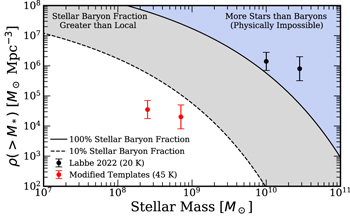
Figure 3. A switch from the standard template basis to the ones developed in this work reduces the best-fit stellar masses. Using stellar masses derived by Labbe et al. (2023) from modified Tg = 20 K EAZY templates (black), Boylan-Kolchin (2023) find that z = 10 galaxies are too massive to have been produced with a ΛCDM cosmology (this figure is reproduced from Figure 2 in Boylan-Kolchin 2023). However, the lower masses from templates optimized for high-redshift galaxies (red) can still be consistent with halo formation under the standard cosmological paradigm, even with a similar stellar baryon fraction to the local Universe.
Download figure:
Standard image High-resolution imageSpectroscopy and improved modeling will ultimately be needed in order to determine whether these galaxies are truly at the stellar masses inferred from template fitting with any of these bases. Currently, however, one must assume an IMF in order to determine physical parameters, which are essential in order to use JWST observations to test fundamental astrophysics and cosmology. Given the extreme conditions at very high redshifts, it is necessary to use templates derived from a physically motivated IMF rather than one derived from local observations under conditions that are physically impossible at high redshift.
Acknowledgments
The authors would like to thank Michael Boylan-Kolchin, Gabriel Brammer, Andreas Faisst, Johan Fynbo, Kate Gould, Bahram Mobasher, Sune Toft, and Darach Watson for helpful comments. The Cosmic Dawn Center (DAWN) is funded by the Danish National Research Foundation under grant No. 140.
Appendix A: Installing Templates in EAZY
EAZY templates constructed for high-redshift studies consist of two sets of six templates. Each set has the IMF corresponding to gas temperatures Tg = 45 and 60 K. They were produced using FSPS (Conroy et al. 2009; Conroy & Gunn 2010), with the six new templates representing stellar populations younger and more metal-poor than in the standard 12 basis EAZY set, and with stronger nebular emission (see Table 3).
For more detailed information on usage and further resources, refer to the Github repository at https://github.com/e-m-garcia/hot-templates or Zenodo at doi: 10.5281/zenodo.7196779. EAZY with the standard set of templates is available at https://github.com/gbrammer/eazy-py.
Appendix B: Installing Templates in LePhare
The set of templates produced for usage consist of four templates at 45 K and 60 K each of varying star formation histories at a z = 0.0012 metallicity. These are reconstructed in FSPS (Conroy et al. 2009; Conroy & Gunn 2010), which allows for replacing the original Chabrier IMF (Chabrier 2003) with a temperature-dependent Kroupa IMF (Kroupa 2001; Jermyn et al. 2018). The templates are written into a BC03 ASCII file format such that LePhare can read them.
To use the templates, simply include the given templates in the galaxy template directory in LePhare, and use the young stellar age list included. It is also recommended to start from parameters associated with the existing 12 BC03 templates used for COSMOS when reading the templates, constructing the magnitude grid, and estimating redshifts and properties, although these can be modified to fit the needs of the fitting (such as different filters). For more detailed information on usage and further resources, refer to the Github at https://github.com/e-m-garcia/hot-templates and the LePhare repository at https://gitlab.lam.fr/Galaxies/LEPHARE.
Footnotes
- 4
For some catalogs, additional templates are added to produce an expanded basis.
- 5
In the standard EAZY basis, a higher sSFR cannot be inferred, because none of the 12 basis templates has an sSFR over ∼10−8 yr−1.