Abstract
We present the discovery of a 421 s long period transient using the CHIME telescope, CHIME J0630+25. The source is localized to R.A. = 06:30:38.4  decl. = 25:26:23
  using voltage data acquired with the CHIME baseband system. A timing analysis shows that a model including a glitch is preferred over a nonglitch model with dF/F = 1.3 × 10⁻⁶, consistent with other glitching neutron stars. The timing model suggests a surface magnetic field of ∼1.5 × 10¹⁵ G and a characteristic age of ∼1.28 × 10⁶ yr. A separate line of evidence to support a strong local magnetic field is an abnormally high rotation measure of RM = −347.8(6) rad m−2 relative to CHIME J0630+25’s modest dispersion measure of 22(1) pc cm−2, implying a dense local magneto-ionic structure. As a result, we believe that CHIME J0630+25 is a magnetized, slowly spinning, isolated neutron star. This marks CHIME J0630+25 as the longest period neutron star and the second-longest period neutron star with an inferred magnetar-like field. Based on dispersion measure models and comparison with pulsars with distance measurements, CHIME J0630+25 is located at a nearby distance of 170
 pc (95.4%), making it an ideal candidate for follow-up studies.
Original content from this work may be used under the terms of the Creative Commons Attribution 4.0 licence. Any further distribution of this work must maintain attribution to the author(s) and the title of the work, journal citation and DOI.
1. Introduction
Recently, a new class of radio-emitting objects known as long-period transients (LPTs)26 has been discovered. LPTs are characterized by their exceptionally long periods, wide burst widths (up to 60 s), and complex temporal and spectral microstructure. Two types of sources, white dwarfs (WDs) and neutron stars, have emerged as the favored models for LPTs due to their emission characteristics and rotation periods.
Radio pulsars are the most common form of detectable neutron stars. They are remarkably accurate celestial clocks. By carefully measuring pulse times of arrival (TOAs), we can fully account for every rotation of a pulsar through a process called pulsar timing. The complex temporal and spectral structure of LPT radio emission is similar to that of magnetars, a subset of high-magnetic-field neutron stars that share many similarities with radio pulsars. Some have argued that this favors a neutron-star model for LPTs (e.g., P. Beniamini et al. 2023). The longest-period pulsars, PSR J0250+5854 and J0311+1402, have rotational periods of 23.5 and 40.9 s, respectively (C. M. Tan et al. 2018; Y. Wang et al. 2025). In addition, there is one 76 s neutron star with magnetar-like field strength, PSR J0901–4046 (M. Caleb et al. 2022). Some consider PSR J0901–4046 an LPT. Finally, there is one magnetar candidate, 1E 161348-5055, with a period of 6.67 hr at the center of supernova remnant RCW103 (A. De Luca et al. 2006). However, only high-energy emission has been detected from 1E 161348-5055 (E. V. Gotthelf et al. 1997; A. D’Aì et al. 2016).
LPTs range from minute (M. Caleb et al. 2022) to hour timescales (e.g., N. Hurley-Walker et al. 2023; D. Li et al. 2024; Z. Wang et al. 2025; I. de Ruiter et al. 2025). Some have been identified to be WD-MD binaries via optical spectroscopy, like ILT J1101+5521 (I. de Ruiter et al. 2025) and GLEAM-X J0704-37 (N. Hurley-Walker et al. 2024; A. C. Rodriguez 2025). On the other hand, as previously mentioned, PSR J0901–4046 is a confirmed neutron-star LPT. This is supported by the low timing residuals (rms residual of 7.5 × 10⁻⁵ in phase units) and its apparent isolated nature when pulsar timing techniques are used. Isolated WDs have never been observed to emit coherent pulsed radio emission. Furthermore, the quasiperiodic substructure of the PSR J0901–4046 bursts directly aligns it with other neutron stars in a universal quasiperiod–period relationship proposed by M. Kramer et al. (2024).
This study details the discovery of CHIME J0630+25, a nearby 421 s LPT. Section 2 details the observations made. Section 3 details the timing methodology and results. Section 4 details the polarization analysis. Finally, Section 5 provides a discussion of the main results of this study.
2. Observations
The CHIME Fast Radio Burst (FRB) is a trigger-based FRB-detection instrument on the CHIME telescope (CHIME Collaboration et al. 2022) that constantly scans the overhead sky with 1024 fast Fourier transformed beams between 400 and 800 MHz and a field of view of approximately 2∘ in R.A. and 100∘ in decl. (CHIME/FRB Collaboration et al. 2018). The instrument triggers on impulsive signals (CHIME/FRB Collaboration et al. 2018). Then, machine learning software will determine if the incoming signal is terrestrial or astrophysical. Data are then saved to disk if a certain signal-to-noise ratio (S/N) threshold (currently 8.5) is met. Due to the substantial data volume, data for sources within the Milky Way were not saved by CHIME/FRB until 2022 October. However, metadata were saved for each “event” regardless of origin. The metadata contain real-time pipeline-derived information such as the R.A., decl., dispersion measure (DM), TOA, and S/N. We used the CHIME Metadata Clustering Analysis to identify CHIME J0630+25 (see F. A. Dong et al. 2023, for a full description). A cluster was identified with the first burst on MJD 58772. On MJD 60463, we made a detection with the CHIME/FRB system with channelized raw voltage (baseband) data. This allows for improved localization and polarization analysis (D. Michilli et al. 2021; CHIME/FRB Collaboration et al. 2024). The best-fit localization of CHIME J0630+25 with baseband data is R.A. = 06:30:38.4  decl. = 25:26:23
  . By comparing the DMs to other pulsars in the ATNF pulsar catalog and the YMW16 electron density model (J. M. Yao et al. 2017), we determined the distance to CHIME J0630+25 to be 170
 pc. The YMW16 model was used instead of NE2001 (J. M. Cordes & T. J. W. Lazio 2002) as it has been shown that YMW16 is better for nearby pulsars (D. C. Price et al. 2021). Details regarding the distance determination procedure are given in Appendix A.
The CHIME/Pulsar instrument forms 10 steerable phased array tracking beams to track sources as they pass through the CHIME field of view. It produces high-time resolution spectra, packaged as conventional SigProc-style filterbank data.27 CHIME/Pulsar can also correct for intrachannel dispersion smearing through coherent dedispersion and can record data at significantly higher time resolutions than CHIME/FRB. These advantages contribute to increased sensitivity for CHIME/Pulsar compared to CHIME/FRB. Follow-up observations were conducted nearly daily, consisting of about ∼10 minutes per scan. These observations remain ongoing. With CHIME/FRB, we detected eight bursts above S/N 8.5, where one burst had baseband voltage data saved and the rest had only metadata. With CHIME/Pulsar, we detected 15 bursts with Stokes-I intensity data showing extended widths and complex structures. Due to two same-day detections from CHIME/Pulsar, we determined an initial period of ∼421 s. All bursts are detailed in Table 1. The dynamic spectra for the CHIME/Pulsar detections are shown in Figure 1 and Appendix C. We confirmed the CHIME/FRB bursts with only metadata to be real astrophysical events, as the arrival time is consistent with the rotation period of CHIME J0630+25.
Table 1. Detection Details for Each Burst
| Burst | Instrument | TOA | Weff | F | α | DM |
|---|---|---|---|---|---|---|
| MJD | (ms) | (Jy ms) | (pc cm−3) | |||
| 58772Aa | CHIME/FRB | 58772.538085(12) | ⋯ | ⋯ | ⋯ | 23(3) |
| 58855Aa | CHIME/FRB | 58855.307944(12) | ⋯ | ⋯ | ⋯ | 23(3) |
| 58860Aa | CHIME/FRB | 58860.296981(12) | ⋯ | ⋯ | ⋯ | 24(3) |
| 58871Aa | CHIME/FRB | 58871.265266(12) | ⋯ | ⋯ | ⋯ | 24(3) |
| 59167Aa | CHIME/FRB | 59167.453835(12) | ⋯ | ⋯ | ⋯ | 24(3) |
| 59341A | CHIME/Pulsar | 59341.973144(12) | 600(230) | 800(240) | −1.2(3) | 20(3) |
| 59341B | CHIME/Pulsar | 59341.978026(12) | 150(90) | 60(20) | −0.05(30) | 23(3) |
| 59456A | CHIME/Pulsar | 59456.659903(12) | 100(100) | 60(20) | −1.4(3) | 23(3) |
| 59456B | CHIME/Pulsar | 59456.664743(12) | 180(120) | 90(30) | −2.0(3) | 23(3) |
| 59460Ab | CHIME/Pulsar | 59460.648754(12) | 210(90) | 400(120) | −2.7(3) | 20(3) |
| 59463A | CHIME/Pulsar | 59463.642824(36) | 950(270) | 680(200) | −2.5(3) | 22(6) |
| 59548A | CHIME/Pulsar | 59548.413841(12) | 370(140) | 190(60) | −3.9(3) | 20(3) |
| 59553Ab | CHIME/Pulsar | 59553.397700(12) | 330(140) | 430(130) | −3.4(3) | 20(7) |
| 59563A | CHIME/Pulsar | 59563.370419(12) | 600(200) | 500(150) | −2.6(3) | 23(3) |
| 59565A | CHIME/Pulsar | 59565.364998(12) | 250(60) | 130(40) | −2.9(3) | 21(3) |
| 59574A | CHIME/Pulsar | 59574.343036(12) | 650(60) | 370(100) | −2.5(3) | 25(4) |
| 60173A | CHIME/Pulsar | 60173.696625(12) | 30(10) | 40(10) | −2.9(3) | 25(4) |
| 60372A | CHIME/Pulsar | 60372.156479(12) | 23(10) | 12(8) | −5.2(3) | 25(4) |
| 60376A | CHIME/Pulsar | 60376.146068(12) | 230(60) | 300(100) | −1.5(3) | 25(4) |
| 60463Ab c | CHIME/Pulsar | 60463.906535(12) | 190(200) | 240(70) | −5.4(3) | 23(3) |
Notes. The TOAs are given in the topocentric reference frame at CHIME. aThese detections are metadata only. bThese pulses were simultaneously detected with both the CHIME/Pulsar and CHIME/FRB systems. cThis burst had raw voltage baseband data saved.
Download table as: ASCIITypeset image
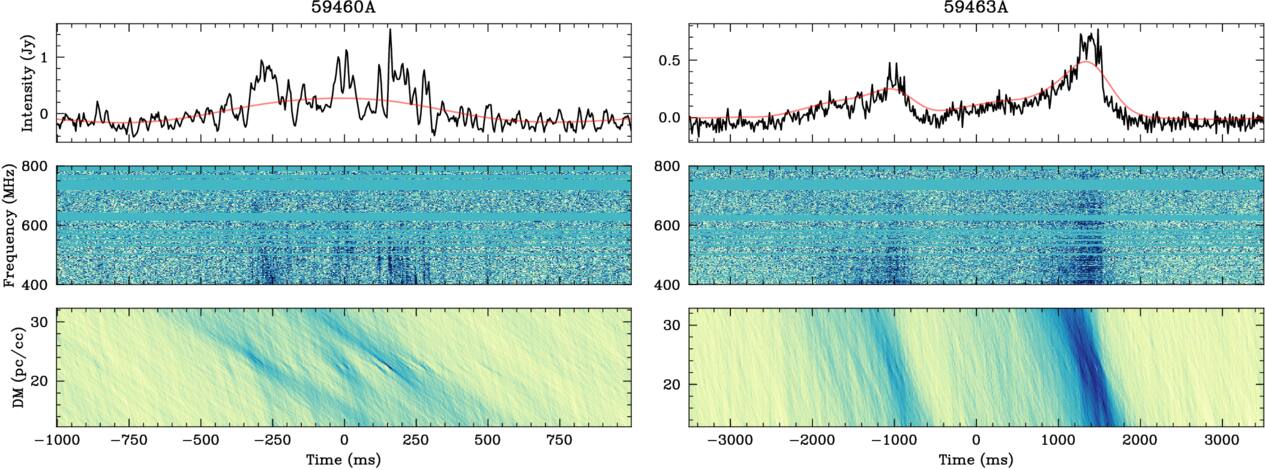
Figure 1. Two pulses from CHIME J0630+25 detected by CHIME/Pulsar. The top panel for each burst contains frequency-averaged and dedispersed time series. The red line is the smoothed profile. The plots are not necessarily centered on the extracted TOA; rather, the center is chosen to best show the burst morphology. The second panel shows the dynamic spectrum of each burst, and the bottom panel shows the dedispersion heat map for each burst. The dedispersion heat map shows the power for many different DM trials. All astrophysical pulses of CHIME J0630+25 center on DM ≈ 22pc cm−3.
Download figure:
Standard image High-resolution imageWe flux calibrate the CHIME/Pulsar data using observations of 3C 133. These calibration observations serve to determine the system equivalent flux density (SEFD) of the telescope at the decl. of CHIME J0630+25. As CHIME/Pulsar observations can have a varying baseline on timescales of seconds, we attempt to subtract off the baseline with a fit to the nonbursting segment of the data. We then integrate the burst over its duration to obtain the fluence, F. The effective width, Weff, is defined as the fluence divided by the peak flux density. The spectral index is calculated by fitting a power law of the form S(ν) = Aνα to the spectrum of the burst, where S(ν) is the flux density, ν is the frequency, and A is the amplitude parameter. A detailed discussion of the calibration routines is given in Appendix B.
In addition, we observed the source location with the Green Bank Telescope (GBT) for 16 hr and the upgraded Giant Metrewave Radio Telescope (uGMRT) for 12 hr. Unfortunately, the uGMRT data were unusable due to radio frequency interference. Furthermore, we also searched archival Very Large Array Low-band Ionosphere and Transient Experiment (VLITE) data. No additional bursts were detected. We also monitored the source location of CHIME J0630+25 using the Niels Geherels Swift Telescope for 32 ks. No sources were detected within the 3σ baseband localization region of CHIME J0630+25. We place a 3σ unabsorbed flux upper limit of 1.2 × 10⁻¹⁴ erg cm−2 s−1 and 3.2 × 10⁻¹⁴ erg cm−2 s−1 for a blackbody and power-law spectrum, respectively. Finally, an optical counterpart was searched for with periods around 421 s. Unfortunately, there were ∼150 marginal candidates. Visual inspection of the light curves reveals that the data are noisy and likely contain mostly false positives. Details regarding these observations are provided in Appendix C.
3. Timing
TOA extraction is vital for period determination and pulsar timing. This is necessary for both the CHIME/FRB and CHIME/Pulsar data sets. Unfortunately, for most of the CHIME/FRB detections, the only data products saved were the metadata. These contain a timestamp for the pulse peak but no total intensity data, and therefore, it is difficult to know if the system triggered on one of the microstructure peaks. Therefore, we took a conservative TOA error of 1 s for all metadata-only detections. The CHIME/FRB TOAs are referenced at the bottom of the CHIME band at 400 MHz. For the CHIME/Pulsar detections where the total intensity data are recorded, we followed the prescription outlined in N. Hurley-Walker et al. (2023). In particular, we smoothed the bursts’ pulse profile using a variable Gaussian kernel. The maximum of the smoothed profile is taken as the TOA, and the FWHM is taken as the uncertainty of the TOA. Furthermore, we set a lower limit of 1 s on the errors due to the variability of the pulse shapes. We note that there can be other ways to determine the TOA; for example, one could consider using the effective width or an S/N weighted TOA. However, as the pulse-to-pulse variability is large, we believe that the smoothed FWHM provides a conservative estimate of the TOA. As shown in Table 2, the reduced χ2 suggests that the jitter is only slightly larger than the pulse width (about a factor of 1.61), which is expected for a single-pulse timing analysis. We find no obvious systematic or secular changes in the pulse shape. The CHIME/Pulsar TOAs are referenced at the top of the CHIME band at 800 MHz.
Our initial period guess was ∼421 s due to the two days where we detected two consecutive bursts, 59341A, B, and 59456A, B. We then used Astropy to correct the TOAs to the reference frame of the solar system barycentre and used the rrat_period module of PRESTO to confirm that the most likely period for CHIME J0630+25 is indeed ∼421 s.
Table 2. Timing Solution for J0630+25
| Property | Glitch | No Glitch | Post Glitch Fit a |
|---|---|---|---|
| R.A. (hh:mm:ss) | 06h30m38 40 40 | 06h30m38 40 40 | 06h30m38 40 40 |
| Decl. (dd:mm:ss) | 25∘26′23" | 25∘26′23" | 25∘26′23" |
| P (s) | 421.35584(8) | 421.355420(6) | 421.3551(2) |

| 52(11) | –7.8(1.4) | 80(64) |

| –1.1(5) | ⋯ | –0.9(8) |
| GLEP | 59354(14) | ⋯ | ⋯ |
| GLF0 10−9 Hz | 3.08(56) | ⋯ | ⋯ |
| NTOA | 23 | 23 | 16 |
| JUMP | 0.4(4) | 0.4(4) | 0.4(4) |
| Rms Residuals (s) | 1.42 | 2.73 | 1.6 |
| Rms Residuals (phase) | 0.0034 | 0.0065 | 0.0038 |
 b
b
| 2.6 | 8.2 | 3.5 |
| Derived Values | |||
| Galactic Longitude (deg) | 187.92 | 187.92 | 187.92 |
| Galactic Latitude (deg) | 7.07 | 7.07 | 7.07 |
| τ (×106 yr) | 1.28 | ⋯ | 0.8 |
| Bsurface (×1015 G) | 1.5 | ⋯ | 1.8 |
 (×1027 erg s−1) (×1027 erg s−1) | 2.76 | ⋯ | 4.1 |
Notes. We do not fit for the R.A. or the decl. as they are fixed at the baseband localized coordinates. We do not fit F2 for the “No Glitch” solution as it does not improve the fit. The errors provided are all given with an EFAC of 1.6, thereby reducing the χreduced = 1. aHere, we fit only the data after the glitch epoch. All of these TOAs are derived from total intensity. bHere, we are providing the raw  without any EFAC for comparison purposes. For all errors in the timing solution, we set EFAC = 1.6, commensurate with a
  for the glitch solution.
Download table as: ASCIITypeset image
We created a timing ephemeris by taking the 421 s periodicity as the starting point. Compared to TOAs of a pulsar, the data are sparsely sampled due to the sporadic nature of CHIME J0630+25. However, we note that the period of CHIME J0630+25 is ∼400 times larger than standard “slow” pulsars and even greater for millisecond pulsars. Therefore, phase-coherent timing can be much more forgiving of data gaps, as there will have been many fewer rotations within the gaps when compared to pulsars. For perspective, a data gap of 1 yr for CHIME J0630+25 is equivalent to a data gap of 0.87 days for a 1 s pulsar. We included a fixed 0.452 s JUMP during the timing fit between the CHIME/FRB and CHIME/Pulsar TOAs. This was determined by two bursts simultaneously detected by both instruments, as shown in Table 1. We tested the validity of the phase jump between the two instruments by performing the same TOA extraction procedure described above on a slow pulsar, namely, PSR J0012+54, and found the jump to be largely consistent. We provide the timing residuals of J0012+54 in Appendix E. We then used PINT28 and TEMPO229 (R. T. Edwards et al. 2006) to perform a least squares fit to all the TOAs of CHIME J0630+25, holding the position fixed at the baseband localized value. To test the robustness of this solution, we perform a large-scale grid search over the frequency and frequency derivative. We find no other minimums other than the one identified by the least squares fitting routine. This is shown in Appendix D.
Our preferred solution incorporates a glitch—an abrupt increase in the pulsar spin frequency—near epoch MJD 59354. In the glitch fit, we left the glitch epoch and glitch frequency as free parameters with initial conditions near the beginning of the secular downward drift beginning at burst 59341 A, B. If we were to fit only around or after the glitch epoch, we obtain a timing solution consistent with only the glitch model, with similar χreduced. That is, a timing solution with a spinning-down  , as expected for an isolated pulsar. This rules out a situation like that of small-orbit WDs (M. R. Schreiber et al. 2021), where the central engine is accreting angular momentum from a companion. Of course, due to the reduction in data and timing baseline, the significance of the detection is reduced. The fractional glitch amplitude |dF/F| = 1.3 × 10⁻⁶ is consistent with the range observed in other pulsars from 10−9 to 10−3 (J. W. McKee et al. 2016; M. M. Serim et al. 2017). The results for the fit are provided in Table 2, and the residuals are provided in Figure 2. Figure 2 shows, for comparison, fits to the entire data set without a glitch (b), and a fit to only the pre-MJD-59354 data (c).
The nonglitch model has much larger residual scatter, with rms values of 1.45 s versus 2.74 s for the glitch and nonglitch models, respectively. The nonglitch timing solution includes a negative  . However, we note that a negative
  is only unphysical for isolated objects; for example, clear counterexamples are cataclysmic binaries (e.g., J. A. Paice et al. 2024) and the recent discovery of CHIME/ILT J1634+44 (S. Bloot et al. 2025; F. A. Dong et al. 2025). Furthermore, the nonglitch timing solution has significant residual structure. In contrast, the timing solution with a glitch has a positive
  and random residuals. We show the structure in panel (d) of Figure 2. We further test the significance of the structure with the Pearson correlation coefficient. The nonglitch model has a correlation coefficient of −0.913 with a p-value of 8 × 10⁻⁵, i.e., the trend in Figure 2(d) is significant. For the same data with the glitch model, we obtain a correlation coefficient of −0.11 with a p-value of 0.73, i.e., any trend in the data is insignificant. Therefore, the glitch model has produced the desired outcome of random residuals, while the nonglitch model has not.
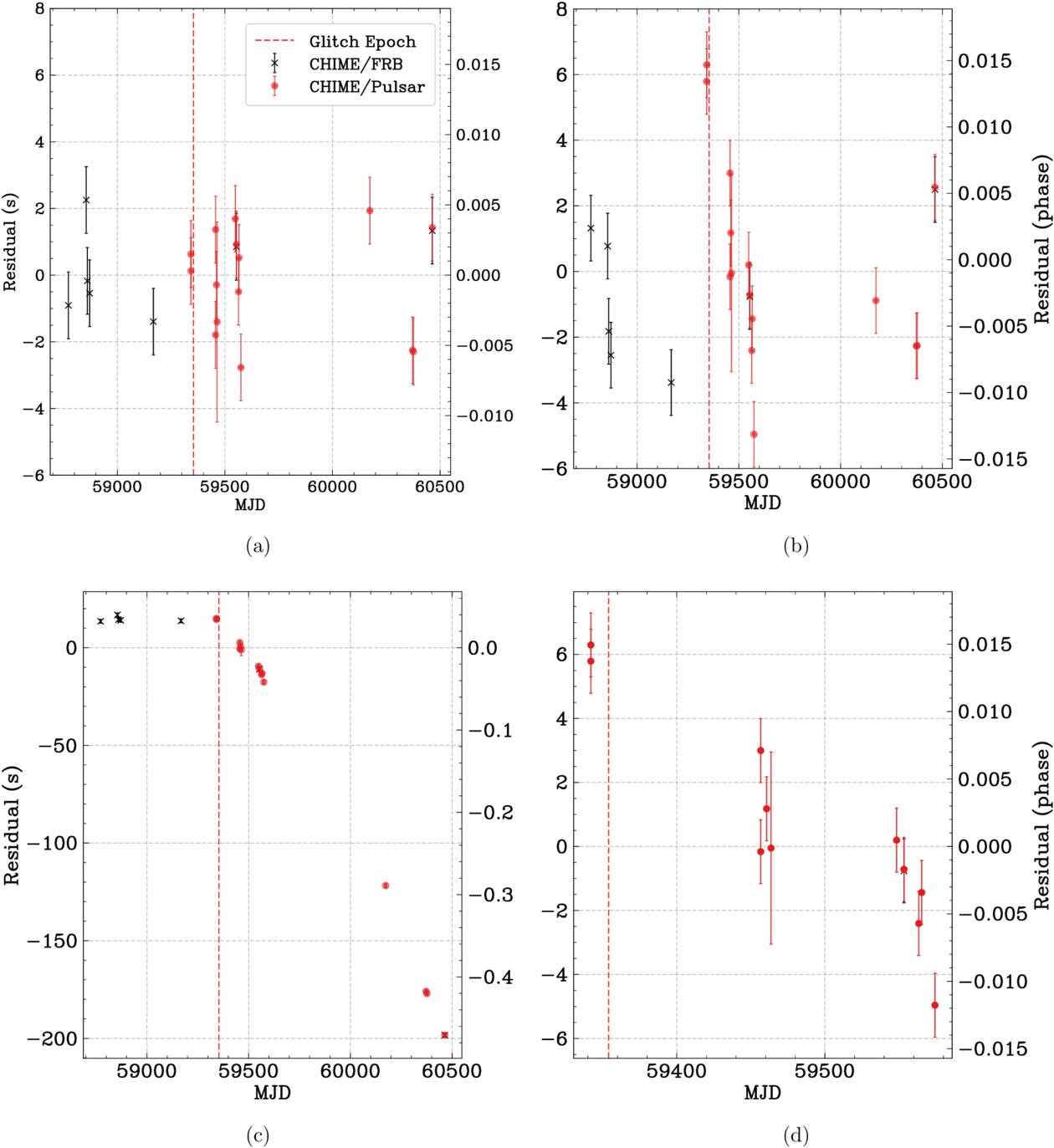
Figure 2. No EFACs were included in any of the timing residual plots. (a) Timing residuals using the glitch model. (b) Timing residuals using the nonglitch model. (c) Timing residuals obtained by fitting only to the bursts before the glitch epoch. (d) Zoomed in timing residuals of panel (b) showing a clear downward sloping structure.
Download figure:
Standard image High-resolution imageTo test the significance of the glitch model, we performed an F-test for the glitch epoch (GLEP), glitch frequency (GLF0), and the second frequency derivative (F2) parameters. This resulted in a highly significant F-statistic value of 4.9 × 10⁻⁵. A glitch model with only GLEP and GLF0 and no second frequency derivative resulted in a significant F-test statistic of 7.6 × 10⁻⁵ relative to the nonglitch model. This suggests that, regardless of whether F2 is included, the glitch model is significantly preferred over the nonglitch model. To test the significance of the F2 parameter, we performed an F-test using the glitch model with and without the F2 parameter. This resulted in an F-test statistic of 0.0069. This suggests that the F2 parameter is preferred for the glitch model.
Finally, as previously discussed, we performed a fit to only the TOAs after the glitch epoch. This resulted in a timing solution consistent with the glitch model, with a positive  , albeit at lower significance. We note that if we opt not to fit F2, the significance increases drastically and is only consistent with the glitch model; however, we opt to keep F2 for comparison purposes.
In summary, a glitch model is preferred for four reasons:
- 1.The nonglitch model has a factor of 2 larger rms residuals.
- 2.The nonglitch model contains a significant downward sloping structure in the residuals, while the glitch model is randomly scattered.
- 3.The F-test statistic is significant for the glitch epoch and glitch frequency parameters.
- 4.Fitting a standard nonglitch model to data only before or after the glitch results in a spinning down (positive
 ), with a similar inferred field strength as the glitch model.

Our best-fit timing solution marginally prefers a  . In principle, this second-order variation can arise from several mechanisms, including stochastic variations due to “timing noise” (M. Antonelli et al. 2023) and/or orbital motion (K. J. Joshi & F. A. Rasio 1997). However, the marginal estimate of
  prevents a clear interpretation. Additional observations will meaningfully constrain the likely sources of rotational evolution beyond spin-down. Our timing solution results in a surface magnetic field of Bsurface = 1.5 × 10¹⁵ G, and a characteristic age of τ = 1.3 × 10⁶ yr. This is consistent with a long-lived magnetar model.
4. Polarization
Only a single burst from CHIME J0630+25 had baseband raw voltage data saved. We analyzed the polarized signal using methods/routines commonly applied to studying FRBs detected through the CHIME/FRB backend (R. Mckinven et al. 2023a, 2023b). First, we converted the raw, beamformed data into the four Stokes parameters—I (total intensity), Q and U (linear polarization components), and V (circular polarization)—using standard techniques (R. Mckinven et al. 2021). These polarization spectra were extracted by temporally integrating the signal over the brightest subcomponent of the signal.
To measure how the polarized signal was affected by magnetized plasma along its path, a phenomenon known as Faraday rotation, we applied a parametric QU fitting technique. This technique enables astrophysical signals to be effectively parsed from contaminant signals from the instrument (R. Mckinven et al. 2021). An RM = −347.8 ± 0.6 rad m−2 was found to be consistent with the value obtained independently using the Faraday dispersion function (FDF), a complementary technique based on Fourier analysis of the polarized signal. Figure 3 (left panel) summarizes the RM detection, displaying the FDF of the burst where a significant peak (S/N ≳ 12) is visible at the nominal RM of the event. While instrumental effects are known to produce artefacts in the FDF, polarimetric monitoring of known pulsars and repeating FRB sources has demonstrated that these artifacts in CHIME observations tend to be subdominant and usually appear near 0 rad m−2.
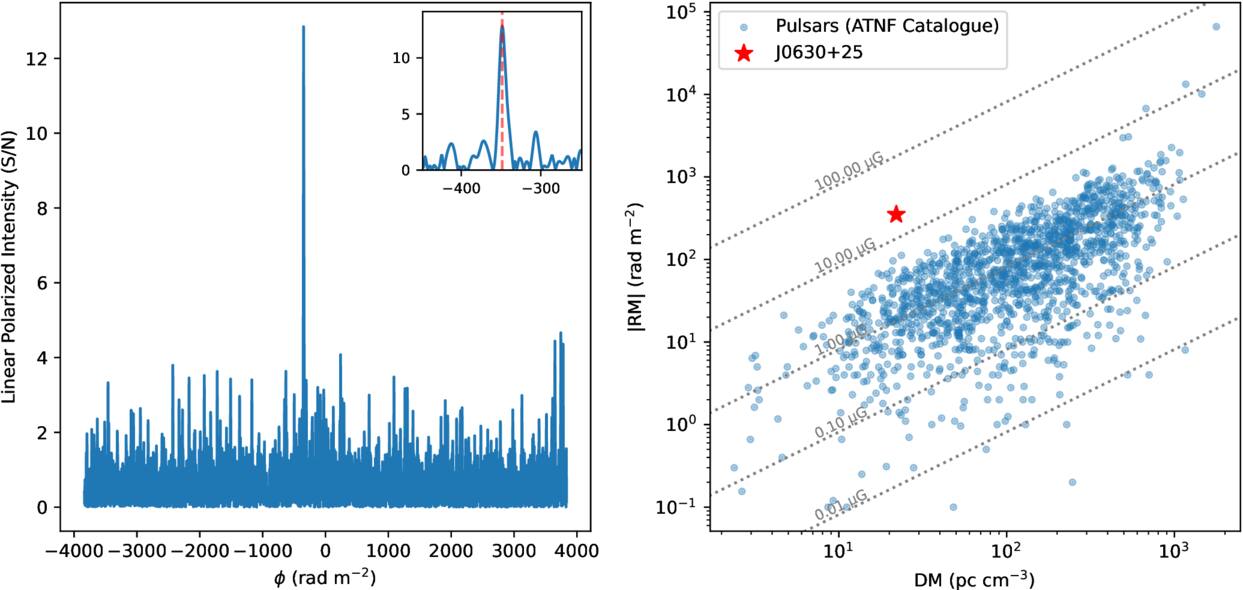
Figure 3. Left: FDF of the single polarized detection of CHIME J0630+25 showing linear polarized intensity as a function of the trial Faraday depths, ϕ. Inset plot highlights the FDF peak near an RM ∼ −350 rad m−2. Right: DM–∣RM∣ distribution of the Galactic pulsar sample (blue points; ATNF Catalog) vs. the equivalent measurement from CHIME J0630+25 (red star). Diagonal gray lines indicate different magnetic field strengths (0.01,0.1,1,10,100 μG) determined from the relation,  .
.
Download figure:
Standard image High-resolution imageThe maximum Galactic RM contribution, RMMW = 50 ± 24 rad m−2, is estimated along the sightline of CHIME J0630+25 from the Faraday all-sky map of S. Hutschenreuter et al. (2022). This is a map of RMMW using RM measurements of 55,190 polarized extragalactic sources. The discrepancy between the observed RM and RMMW is anomalous, particularly when considering the proximity of CHIME J0630+25 as inferred by its modest DM. There are no obvious structures (e.g., H II, Hα regions) that could give rise to large RM contributions. Instead, it seems plausible that a significant fraction of the observed RM is contributed by a magneto-ionic structure near the source, with the structure perhaps relating to the progenitor system. Figure 3 summarizes this result, showing the CHIME J0630+25 position in DM–RM space relative to the Galactic pulsar sample. Pulsars with comparable ∣RM∣ to CHIME J0630+25 typically have measured DMs that are ∼10 times larger than those measured by CHIME J0630+25. We note that a separate interpretation where a massive companion is contributing to the local RM is another scenario that could occur, such as in the case of PSR J1259-63 and PSR J1744-24A (S. Johnston et al. 2001; D. Li et al. 2023). However, as we see no evidence of binarity in the timing data and we infer a magnetar-like field, we believe that an isolated strongly magnetized source scenario is more plausible. Given the proximity of the source, it is somewhat surprising that no associated structure is identified. Using the equation, 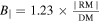 yields a lower limit of 20 μG. However, the true magnetization of the Faraday active medium may be several orders of magnitude larger, given that the DM contribution of this medium is likely a fraction of the source’s total DM.
5. Discussion and Conclusions
Here, we discuss the potential sources of CHIME J0630+25. First, we consider whether the object could be a WD, either isolated or in a binary system. There is no evidence of an abrupt glitch-like spin-up event in a WD to date. In an intermediate polar system (WD and main-sequence binary), the WD often exhibits a smooth spin-up due to mass accretion (e.g., J. A. Paice et al. 2024). We do not observe any evidence of a smooth spin-up or binarity in CHIME J0630+25, though it is possible that the large TOA uncertainties and sporadic pulses mask a short-period orbit with a semimajor axis on the order of 1 light second. A similar type of object, WD pulsars, are WD binaries, which are known to emit radio bursts with higher duty cycles and lower luminosities than CHIME J0630+25 (AR Scorpii and J191213.72–441045.1 T. R. Marsh et al. 2016; D. A. H. Buckley et al. 2017; I. Pelisoli et al. 2023). The low duty cycle of CHIME J0630+25, of 0.4%–0.8%, suggests a tighter beam, like those seen in pulsars. However, this may be complicated by recent discoveries of two LPTs with WDs, ILT J1101+5521 and GLEAM-X J0704-37, with duty cycles between 0.3% and 2% (N. Hurley-Walker et al. 2024; I. de Ruiter et al. 2025; A. C. Rodriguez 2025). In those cases, the radio period and the orbital period of the WD–M dwarf binary are locked. This seems unlikely in the case of CHIME J0630+25 due to a much shorter period. Therefore, we conclude that CHIME J0630+25 is unlikely to be a WD.
Comparing the glitch magnitude of CHIME J0630+25 with those known in neutron stars, we find that it is generally consistent with the magnitudes expected. As mentioned in Section 3, the fractional glitch amplitude is ∣dF/F∣ = 1.3 × 10⁻⁶, within the range found in other pulsars from 10−9 to 10−3 (J. W. McKee et al. 2016; M. M. Serim et al. 2017). When comparing to magnetars, which have been shown to glitch and antiglitch (rapid spin-down), we again find general agreement with the glitch amplitudes. For example, SGR 1935+2154 was shown to have a spin-down glitch with an absolute fractional glitch amplitude of ∣dF/F∣ = 5.8 × 10⁻⁶ (G. Younes et al. 2023), and 1E 2259+586 was found to have both a spin-up and spin-down of ∣dF/F∣ = 1.24 × 10⁻⁶ and ∣dF/F∣ = 5.8 × 10⁻⁷, respectively (G. Younes et al. 2020). Magnetars are known to show dramatic changes to pulse profile, fluence, and other properties following a glitch. Unfortunately, we have little data with total intensity before the glitch, and we are unable to constrain the changes. We do, however, observe a period of relatively higher activity around and after the glitch epoch (MJD 59341-59574).
Many objects exhibit periodic radio emission at  , an order of magnitude longer than seen in CHIME J0630+25. These include flaring ultracool dwarfs, like TLV 513-46546 (1.96 hr), main-sequence stars like CU Virginis (12.5 hr; V. Ravi et al. 2010), and sources of unknown origin like the Galactic Center Radio Transients, GCRT J1745–3009 (1.3 hr; S. D. Hyman et al. 2002) and GCRT J1742–3001 (no period; S. D. Hyman et al. 2009). For ultracool dwarfs, it has been suggested that the limit to their spin periods cannot be much less than ∼1 hr due to rotational breakup (M. E. Tannock et al. 2021). A similar argument can be given for main-sequence stars at about a ∼10 hr rotational period. GCRTs are pulsing radio sources toward the Milky Way Center. Like LPTs, their nature remains mysterious. The pulse widths of GCRT J1745–3009 are ∼11 minutes wide and much longer than CHIME J0630+25 or any LPT (S. D. Hyman et al. 2002). Similarly, GCRT J1742–3001’s flares have widths on timescales of months, again much longer than any LPT (S. D. Hyman et al. 2009). Therefore, we conclude that none of the known source types with hour-long periods can explain the properties of CHIME J0630+25.
We have successfully created a phase-connected timing solution for CHIME J0630+25 with the detected single pulses. We were able to measure a robust spin-down due to a long timing baseline of ∼4.6 yr and high time resolution paired with the relatively narrow pulse widths of CHIME J0630+25.
The timing properties of CHIME J0630+25 strongly suggest a neutron star model. To date, no other periodic coherent burst emitter has exhibited a sudden spin-up of its pulse period apart from neutron stars. Neutron star models for LPTs often invoke an old magnetar. Indeed, PSR J0901–4046 has a period of ∼76 s and an inferred magnetar-strength magnetic field of 1.3 × 10¹⁴ G (M. Caleb et al. 2022). Magnetars are theorized to be the early stage of neutron star evolution, and their strong magnetic fields are predicted to decay on a timescale of ∼104 yr (P. Beniamini et al. 2019). From spin-down alone, the maximum period that a magnetar can reach is ∼13 s (P. Beniamini et al. 2019). Therefore, it has been theorized that magnetars can only reach longer periods via another mechanism, such as angular momentum kicks via giant flares (P. Beniamini et al. 2020). Such a mechanism would be needed to explain CHIME J0630+25, given that its inferred magnetic field is ∼1.5 × 10¹⁵ G, which is into the magnetar regime. We show CHIME J0630+25’s place among all other neutron stars and comparable sources in Figure 4.30 Furthermore, the burst structure, as seen in 59460A, is reminiscent of known magnetars like XTE 1810-197 (Y. Maan et al. 2019). An independent line of evidence from the polarization of CHIME J0630+25 shows that the RM is well above the expected value for this line of sight, and compared to other pulsars, suggesting a strong local magneto-ionic environment and supporting a magnetized neutron star origin.
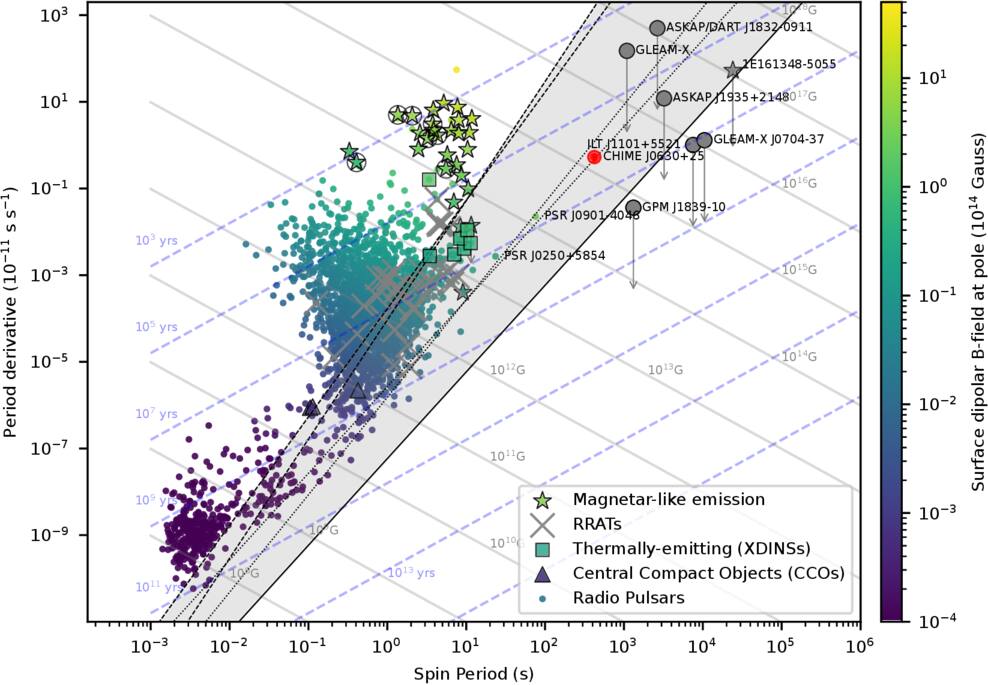
Figure 4.
 diagram. 1E161348–5055, a central compact object that shows evidence of magnetar-like emission, is shown with a gray star (A. D’Aì et al. 2016). The longest-period pulsars PSR J2050+5854 and LPT PSR J0901–4046 are shown by the colored dots and labeled as such. The gray-shaded region shows the death valley for coherent pulsed radio emission. The black dashed line corresponds to a pure dipole, dotted lines to a twisted dipole, and solid lines to a twisted multipole configuration (K. Chen & M. Ruderman 1993; B. Zhang et al. 2000). The blue dashed lines correspond to lines of constant age, and the gray solid lines correspond to lines of constant magnetic field. All downward-facing arrows correspond to upper limits and are at the 1σ level.
Download figure:
Standard image High-resolution imageThe majority of our observations resulted in nondetections. We believe that this is due to the intrinsic sporadic nature of CHIME J0630+25. This is not uncommon among pulsars, especially ones found by CHIME/FRB (F. A. Dong et al. 2023). CHIME/FRB is biased toward finding sporadic sources because of the large exposure time paired with a single-pulse detection pipeline (CHIME/FRB Collaboration et al. 2018). Furthermore, magnetars such as SGR 1935+2154 are known to be sporadic in radio and X-rays (C. D. Bochenek et al. 2020; CHIME/FRB Collaboration et al. 2020; M. Tavani et al. 2021). With the sporadic nature of CHIME J0630+25 bursts, it is not unexpected that our X-ray observations resulted in nondetections. Our X-ray observations were conducted between MJD 60253 and 60383. Unfortunately, this was far removed from the glitch epoch so that no constraints could be placed on the postglitch X-ray activity.
In conclusion, we have discovered a new LPT, CHIME J0630+25. From timing, we find a glitch and infer that the surface magnetic field is ∼1.5 × 10¹⁵ G. An independent line of evidence shows that the rotation measure is much higher than expected for this line of sight and for pulsars with similar dispersion measures. We find no evidence of binarity and speculate that CHIME J0630+25 is a highly magnetized, slowly spinning neutron star. Future multiwavelength follow-ups will require arc-second localization, likely achievable by triggered observations with an interferometric radio telescope like the Karl Jansky Very Large Array.
Acknowledgments
We acknowledge that CHIME is located on the traditional, ancestral, and unceded territory of the Syilx/Okanagan people. We are grateful to the staff of the Dominion Radio Astrophysical Observatory, which is operated by the National Research Council of Canada. CHIME is funded by a grant from the Canada Foundation for Innovation (CFI) 2012 Leading Edge Fund (Project 31170) and by contributions from the provinces of British Columbia, Quebec, and Ontario. The CHIME/FRB Project, which enabled development in common with the CHIME/Pulsar instrument, is funded by a grant from the CFI 2015 Innovation Fund (Project 33213) and by contributions from the provinces of British Columbia and Quebec, and by the Dunlap Institute for Astronomy and Astrophysics at the University of Toronto. Additional support was provided by the Canadian Institute for Advanced Research (CIFAR), McGill University, and the McGill Space Institute, thanks to the Trottier Family Foundation, and the University of British Columbia. The CHIME/Pulsar instrument hardware was funded by an NSERC RTI-1 grant EQPEQ 458893-2014.
This research was enabled in part by support provided by the BC Digital Research Infrastructure Group and the Digital Research Alliance of Canada (alliancecan.ca).
The National Radio Astronomy Observatory and Green Bank Observatory are facilities of the U.S. National Science Foundation operated under cooperative agreement by Associated Universities, Inc.
F.A.D. was supported by the U.B.C. Four-Year Fellowship and is now an NRAO Jansky Fellow. Basic research in radio astronomy at the U.S. Naval Research Laboratory is supported by 6.1 Base funding. Construction and installation of VLITE was supported by the NRL Sustainment Restoration and Maintenance fund. A.P.C. is a Vanier Canada Graduate Scholar. Pulsar and FRB research at UBC is supported by an NSERC Discovery Grant and by the Canadian Institute for Advanced Research. E.F., I.S., S.C., and S.M.R. are members of the NANOGrav Physics Frontiers Center, supported by the NSF award 2020265. A.M.C. is funded by an NSERC Doctoral Postgraduate Scholarship. E.F. is supported by the NSF under grant No. AST-2407399. The Dunlap Institute is funded through an endowment established by the David Dunlap family and the University of Toronto. B.M.G. acknowledges the support of the Natural Sciences and Engineering Research Council of Canada (NSERC) through grant RGPIN-2022-03163, and of the Canada Research Chairs program. V.M.K. holds the Lorne Trottier Chair in Astrophysics & Cosmology, a Distinguished James McGill Professorship, and receives support from an NSERC Discovery grant (RGPIN 228738-13), from an R. Howard Webster Foundation Fellowship from CIFAR, and from the FRQNT CRAQ. K.W.M. holds the Adam J. Burgasser Chair in Astrophysics. A.B.P. is a Banting Fellow, a McGill Space Institute (MSI) Fellow, and a Fonds de Recherche du Quebec—Nature et Technologies (FRQNT) postdoctoral fellow. S.M.R. is a CIFAR Fellow. P.S. acknowledges the support of an NSERC Discovery Grant (RGPIN-2024-06266). K.S. is supported by the NSF Graduate Research Fellowship Program.
Facilities: Swift - Swift Gamma-Ray Burst Mission (XRT and UVOT), CHIME - , GBT - Green Bank Telescope, GMRT - Giant Meter-wave Radio Telescope.
Software: astropy (Astropy Collaboration et al. 2013, 2018, 2022), PRESTO (S. M. Ransom 2001), sigpyproc.
Appendix A: Dispersion Measure and Distance Estimate
DM is a frequency-dependent delay from the ionized component of the interstellar medium affecting all radio pulses. We measured the DM of each pulse using DM_phase,30 which is a brute force algorithm that maximizes the coherent power across the bandwidth by trying many different DMs. Due to the wide burst widths, the DM uncertainty for each pulse is large; this is exemplified in Figure 1 by the large hot spot that the dedispersion panel covers. For the distance determination, the dispersion measure used is the error-weighted average of all the CHIME/Pulsar detections. The resultant DM value is 22(1) pc cm−3.
With a model of the interstellar electron density, we can use the DM to estimate the distances to the radio source. There exist two models for the Galactic electron density, NE2001 (J. M. Cordes & T. J. W. Lazio 2002) and YMW16 (J. M. Yao et al. 2017). Analyses of Galactic interstellar medium models have shown that the YMW16 model is better than the NE2001 electron density model (J. M. Cordes & T. J. W. Lazio 2002) for nearby pulsars and is likely accurate to a factor of ∼1.5 of the YMW16 estimate (S. Chatterjee et al. 2009; D. C. Price et al. 2021). Therefore, we used the YMW16 model exclusively.
The distance was determined by the YMW16 electron density model (J. M. Yao et al. 2017) to be 170 pc. To find the uncertainties associated with CHIME J0630+25, we queried the ATNF pulsar catalog and applied a series of cuts to the full catalog. First, we isolated those pulsars with similar Galactic latitudes as the b = 7∘ of CHIME J0630+25. We selected pulsars with b > 4∘ and b < 10∘. We then limited the DM of these sources to be less than 100 pc cm−3. Finally, we only considered pulsars with an independent distance measure, such as parallax or globular cluster associations. In total, 13 pulsars met these criteria. To set the uncertainty on the YMW16 value, we found the mean and standard deviation of the ratio between the YMW16 value and the independently derived distance measurements. These are 1.6 and 0.6, respectively. Therefore, we set asymmetric errors about the YMW16 value at 170 (95.4% confidence). We note that this method may be biased low, as it is easier to obtain parallax for nearby pulsars.
Appendix B: Flux Density and Spectral Index
Using the total intensity data obtained by CHIME/Pulsar, we measured some essential characteristics such as effective pulse width, fluence, and DM. For the bursts detected from CHIME J0630+25, the fluence is defined by the integrated flux density over the duration of the burst, and the effective width is calculated via Weff = F/Speak, where F is the fluence and Speak is the peak flux density. CHIME/Pulsar has decl.-dependent sensitivity. Therefore, we used 3C 133 as a calibrator source to determine the SEFD. The SEFD is calibrated by fitting the telescope temperature and is defined in the following way

where Tsky is obtained from the Haslam 408 MHz all-sky map (C. G. T. Haslam et al. 1982; M. Remazeilles et al. 2015), G is the telescope gain, and Ttelescope is the system temperature of all telescope components (i.e., receiver, structure, ground, etc.). The flux density of a source is given by

where S(ν) is the flux density. Ton and Toff are the temperatures of the calibrator source and a blank patch of nearby sky, respectively. Ttelescope is an unknown. Thus, we performed a maximum likelihood reduced χ2 fit of the CHIME/Pulsar measured 3C 133 spectrum against the cataloged flux density measurements of 3C 133. We used the VLA calibrator list31 for the catalog values. We found that the best functional form of Ttelescope is a fifth-order polynomial. Refer to F. Dong (2024) for more details.
Using the total intensity data for the CHIME/Pulsar bursts, we measured the spectral index of CHIME J0630+25. First, we calibrated the flux density of the bursts using the method described above. This process will also serve to calibrate the spectrum of CHIME J0630+25. Then, each burst is integrated over its duration to obtain a spectrum. Maximum likelihood is used to fit the spectra with a power-law model of the form

where α is the spectral index, and A is the amplitude parameter. Both α and A are fit parameters. The spectral indices are provided in Table 1.
To place an uncertainty on the fit, we measured the spectral index of 23 other calibrator sources with known spectral indices using the same technique. We found that the mean uncertainty on the spectral index calibrated in this way is 0.3.
Appendix C: Follow-up of CHIME J0630+25
To process all the CHIME/Pulsar data, we have employed the CHIME/Pulsar Single-pulse PIPEline (CHIPSPIPE),32 an automated single-pulse search pipeline designed to handle the large data volume of CHIME/Pulsar. The pipeline is based on PRESTO (S. M. Ransom 2001). It further utilizes SPEGID (D. Pang et al. 2018) and FETCH (D. Agarwal et al. 2020) to filter out spurious candidates. Finally, the pulses that are graded as astrophysical by FETCH are examined by a human. For a detailed discussion of CHIPSPIPE, refer to F. A. Dong et al. (2023). For all the bursts that passed the human check, we manually removed the radio frequency interference (RFI)-contaminated channels and generated the dynamic spectrum, pulse profile, and dedispersion-time plot for each burst using the Your (K. Aggarwal et al. 2020) package. CHIPSPIPE has limited sensitivity to wider pulses. Therefore, we visually inspected the dynamic spectrum and pulse profile around each detected pulse within a 10 s window. This manual inspection aims to identify additional subpulses missed by CHIPSPIPE that may provide evidence of quasiperiodicity. 59460A, 59463A, 59553A, 59563A, and 59574A exhibited distinct second peaks not flagged by the initial CHIPSPIPE detection. We show additional bursts in Figures 5–7.
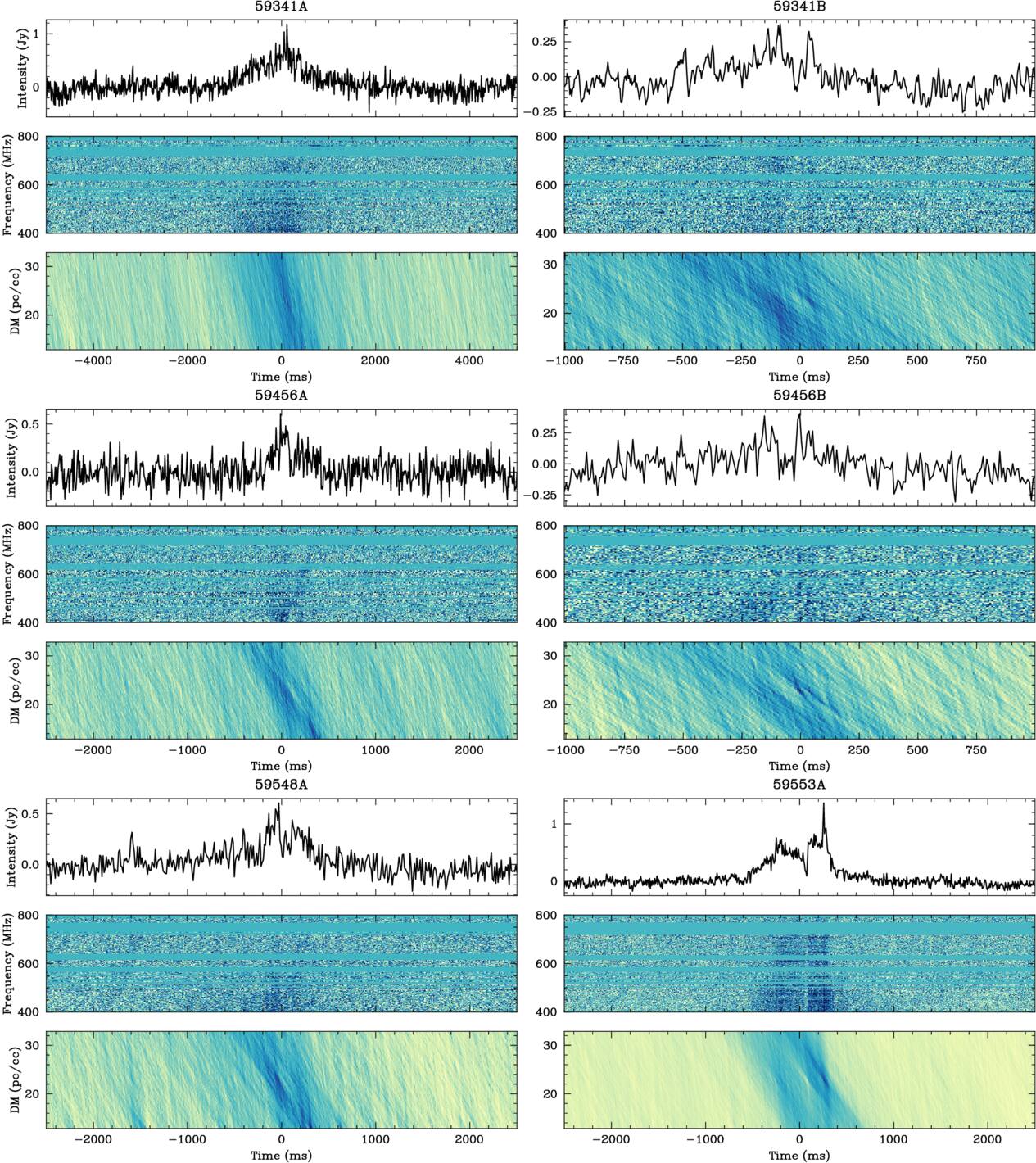
Figure 5. Additional dynamic spectra analogous to Figure 1.
Download figure:
Standard image High-resolution image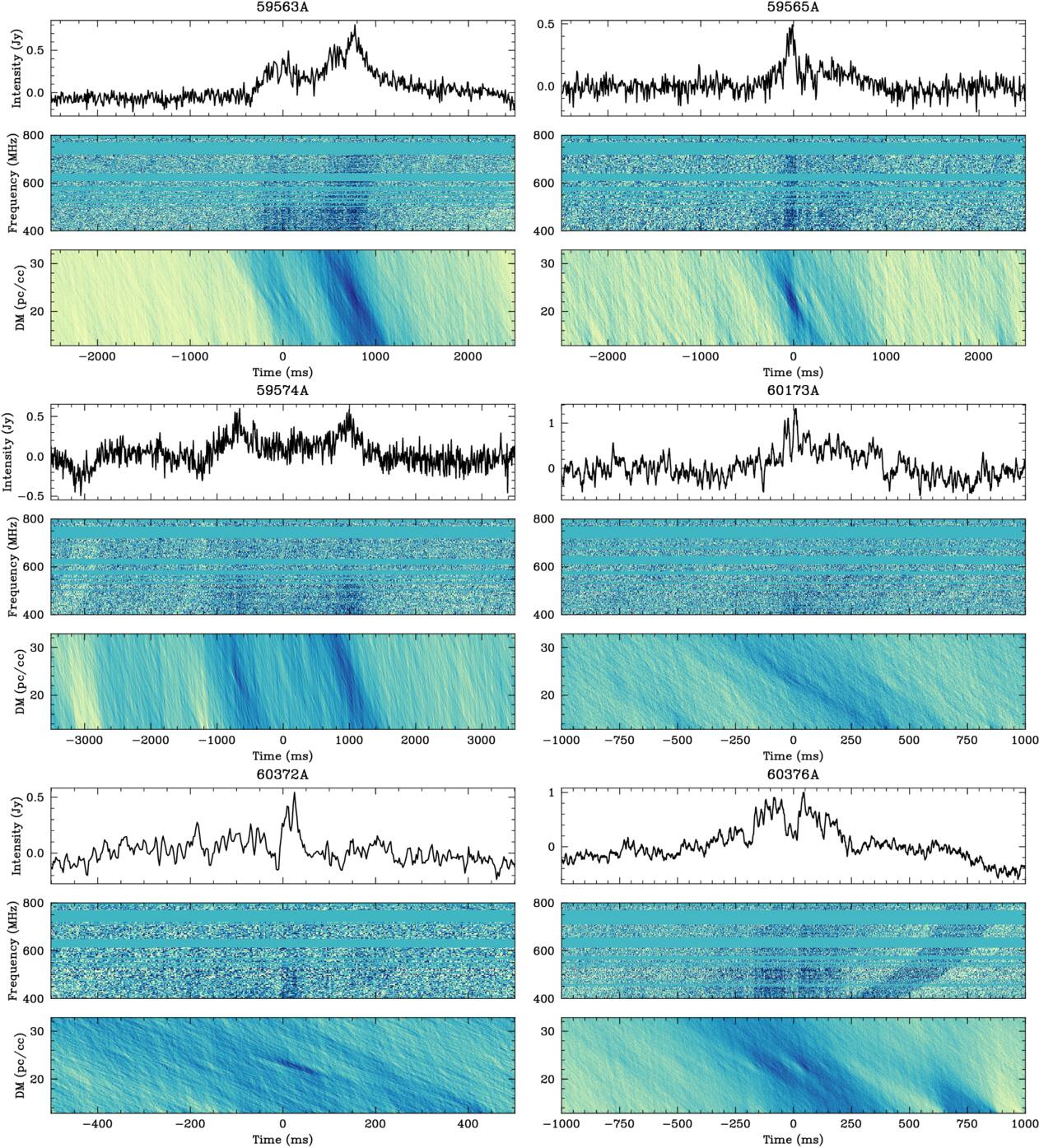
Figure 6. Continued.
Download figure:
Standard image High-resolution image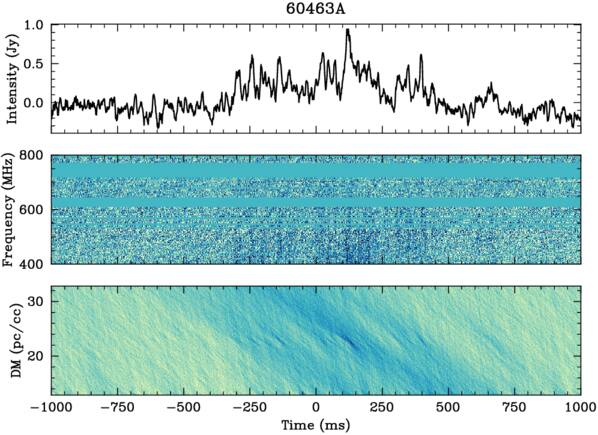
Figure 7. Continued.
Download figure:
Standard image High-resolution imageWe use data from both archival observations near CHIME J0630+25 and targeted follow-up campaigns to explore CHIME J0630+25 across many wavelengths. In the radio band, we used the GBT because of its increased sensitivity and longer observation tracks compared to CHIME. We also used the uGMRT and archival VLITE data. Pulsars and magnetars are known to emit X-rays. Therefore, we also performed targeted observations with the Neil Gehrels Swift Observatory’s X-Ray Telescope (XRT). Some magnetars are soft γ-ray repeaters. Thus, we also searched the known γ-ray archives for as-of-yet-unknown magnetar candidates. As new observations have also revealed that some LPTs are binary systems with optical counterparts (N. Hurley-Walker et al. 2024; I. de Ruiter et al. 2025), we search through archival optical data for a possible time-domain optical counterpart to CHIME J0630+25 as well.
With the GBT, we used the VEGAS back end at 20.48 μs time resolution and coherently dedispersed to 22.5 pc cm−3. The observations were taken between MJD 59861 and 59914. The Stokes I data were processed using CHIPSPIPE to search for single pulses. No pulses were detected. With the single pulse radiometer equation,

we are able to estimate the minimum fluence. Where S is the flux, S/N = 6 is the minimum signal to noise, Ssys ≈ 15 Jy is the system equivalent flux density including the Galactic background, β = 1 is the telescope degredation factor, η = 0.868 is a Gaussian pulse shape approximation, np = 2 is the number of polarizations, W = 2 s is an estimate of the pulse width, and Δν = 0.24 GHz is the bandwidth of the 800 MHz Prime Focus receiver. The derived minimum fluence for a 2 s burst is ∼7 Jy ms. We caution, however, that the actual value may be higher. Our detection pipeline preferentially detects bursts which are “spikey” with an easily detectable DM hotspot. The quantification of this is difficult and will require an intensive campaign of synthetic burst injection and retrieval, which is out of the scope of this study.
With the uGMRT, we performed the observations between MJD 59700 and 59837 from 950 MHz to 1460 MHz. These had an integration time of 0.67 s in incoherent array mode. Unfortunately, due to the variable baseline and the high levels of RFI, we were not able to make use of the uGMRT data. Finally, we searched through archival data from VLITE (T. Clarke et al. 2018)33 for high-resolution observations (∼5") at 340 MHz covering the region of interest. We identified two observations where CHIME J0630+25 was located within 2∘ of the phase center and made short-time interval images at the VLITE sample time of 2 s. The short VLITE images were cataloged using PyBDSF,34 and components associated with all persistent radio sources were eliminated. The remaining cataloged sources were low-S/N (S/N ∼ 4), and visual inspection revealed these remaining candidates were likely associated with poorly cleaned sidelobes in the images. As the CHIME/FRB localization is large compared to the VLITE resolution, the chance coincidence for a low S/N candidate is large. Therefore, it is difficult to associate any low-S/N VLITE candidates with CHIME J0630+25. Unfortunately, VLITE’s highest time resolution is 2 s, and so bursts from CHIME J0630+25 are predominantly less than one bin long, resulting in low S/N. This makes it challenging to differentiate potential CHIME J0630+25 bursts in VLITE data from remaining uncleaned sidelobe structures.
Our X-ray observations of CHIME J0630+25 consisted of 32 ks of Swift XRT time under target IDs 97140 and 97203. To process the data, we used the tools provided by the UK Swift Science Data Center35 to create the images. Then, we used Ximage36 to detect the sources and provide S/N estimates. No sources were detected within the 3σ error region of CHIME J0630+25. Therefore, we use the Swift XRT data to place a flux limit on the source location. With a background count rate of 4.6 × 10⁻⁴ counts s−1, we place a 3σ unabsorbed flux upper limit of 1.2 × 10⁻¹⁴ erg cm−2 s−1 and 3.2 × 10⁻¹⁴ erg cm−2 s−1 for a blackbody and power-law spectrum, respectively. This corresponds to 4–16 × 1028 erg s−2. If, however, one assumes the 95% upper limit on the distance, 520 pc, then the upper limits are 3.9–15 × 1029 erg s−1. The blackbody spectrum is assumed to have a temperature of 0.3 keV, and the power-law spectrum is assumed to have a photon index of 1.0. The flux limits are calculated using WebPIMMS.37 Comparing the median limits to other objects from Figure 10 in A. Anumarlapudi et al. (2025), we find that the X-ray luminosity constraint is ∼1–2 orders of magnitude lower than the next brightest LPT, ASKAP J1935+2148 (M. Caleb et al. 2024), and ASKAP J1448-6856 (A. Anumarlapudi et al. 2025). Furthermore, CHIME J0630+25 is ∼1 order of magnitude lower than the least luminous X-ray bright pulsar. However, many pulsars are not detectable in X-rays.
We also searched for possible as-of-yet unknown soft γ-ray repeater counterparts to CHIME J0630+25. These would reside in the same databases as γ-ray bursts (GRB), albeit with an unknown classification. We first crossmatch the coordinates and times of arrivals of CHIME J0630+25 with all γ-ray sources reported in GRBWeb.38
We limit the GRBWeb triggers to those that are well localized (e.g., 1σ spatial error <1°), as it is challenging to claim significant spatial coincidences for triggers with either unknown or large uncertainty regions. In our crossmatch, we conservatively assume a 1σ positional error in R.A. of 1° and a 1σ positional error in decl. of 0 5 for CHIME J0630+25. We then crossmatch the localization region of CHIME J0630+25 with that of all known sources in GRBWeb, requiring the localizations to be consistent within the 3σ uncertainties. Within one week of each burst, we did not find any sources to be coincident with CHIME J0630+25. However, given GRBWeb’s focus on cosmological GRBs and not Galactic γ-ray sources such as soft γ repeaters, we also crossmatch the position of CHIME J0630+25 and its bursts with all triggers reported in the γ-ray Coordination Network39
circulars. We again limit our search to well-localized triggers, e.g., (σ < 1°), and do not find any trigger-burst pairs with the given criteria. When considering solely spatial coincidence, however, we find one trigger spatially coincident with CHIME J0630+25. The trigger is GRB 110414A, which was detected long before CHIME was built.
5 for CHIME J0630+25. We then crossmatch the localization region of CHIME J0630+25 with that of all known sources in GRBWeb, requiring the localizations to be consistent within the 3σ uncertainties. Within one week of each burst, we did not find any sources to be coincident with CHIME J0630+25. However, given GRBWeb’s focus on cosmological GRBs and not Galactic γ-ray sources such as soft γ repeaters, we also crossmatch the position of CHIME J0630+25 and its bursts with all triggers reported in the γ-ray Coordination Network39
circulars. We again limit our search to well-localized triggers, e.g., (σ < 1°), and do not find any trigger-burst pairs with the given criteria. When considering solely spatial coincidence, however, we find one trigger spatially coincident with CHIME J0630+25. The trigger is GRB 110414A, which was detected long before CHIME was built.
However, as noted in A. P. Curtin et al. (2023), there is a high probability of finding spatial coincidences given CHIME’s current localization capabilities. Accordingly, we conclude that no significant coincidences exist between CHIME J0630+25 and any known γ-ray triggers.
The two known optical counterparts to LPTs (ILT J1101+5521, GLEAM-X J0704−37) are detached WD + M dwarf binary systems, establishing that magnetic WDs are linked to at least some LPTs. In those systems, the radio pulsations are phase-aligned with the orbital period (N. Hurley-Walker et al. 2024; I. de Ruiter et al. 2025; A. C. Rodriguez 2025). While for CHIME J0630+25, P ∼ 7 minutes is far too short an orbital period for a binary system involving a main-sequence star, such a period can be indicative of other possibilities, e.g., the radio pulsations reflecting the spin period of a WD in an intermediate polar system. Thus, even though we believe CHIME J0630+25 is unlikely to be a WD (Section 5), we search for a time-domain optical counterpart to CHIME J0630+25.
To conduct this search, we use results from a bulk periodicity search (K. B. Burdge et al. 2020) on data from the Zwicky Transient Facility (E. C. Bellm et al. 2019; M. J. Graham et al. 2019). We restrict the results of the search for periodic time-variable sources within a conservative 5σ localization uncertainty region of CHIME J0630+25. We also restrict our search to be within a period of 421 ± 120 s in order to encompass the possibility of slightly misaligned optical and radio frequencies (e.g., beat frequencies, as is observed in intermediate polars and WD pulsars; A. J. Norton et al. 2002; T. R. Marsh et al. 2016; I. Pelisoli et al. 2023). We find ∼150 marginal sources exhibiting periodicity at marginal significance, 2 of which have a blindly identified period within ∼1 s of that of CHIME J0630+25. However, visual identification of the light curves of the sources folded to their identified periods shows that the data are noisy, and that most of these marginal candidates (including the two candidates with close identified periods) are likely false positives.
Due to the relatively low galactic latitude (∣b∣ ∼ 7∘), we note that many optical sources are visible in the localization region of CHIME J0630+25. There is also E(B − V) ≈ 0.3 mag of dust extinction toward CHIME J0630+25 that can obscure fainter optical sources, for which infrared observations may reveal even more sources. While spectrophotometric follow-up of the identified marginal candidates can confirm or refute the significance of the identified periodicities, the current density of sources in the localization region will make it difficult to robustly identify an optical counterpart to CHIME J0630+25 without a more refined localization.
Appendix D: F0–F1 Grid Search
To test whether the nonglitch solution converged on a local minimum via PINT’s downhill weighted least-squares algorithm, we performed a full grid search over frequency (F0) and frequency derivative (F1) parameters, keeping R.A. and decl. fixed. We searched over a large parameter range from −3 × 10⁻⁹ < F − Fnoglitch < 3 × 10⁹ and  with 10,000 trials in the grid. We find no other minimums apart from the one identified by our timing solution in Table 2. We show the χ2 contour of the minimum in Figure 8.
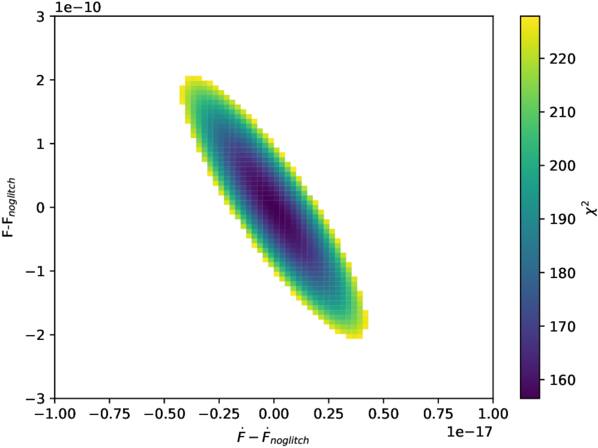
Figure 8. We show only the minimum when we perform a grid search over frequency and frequency derivative parameters. The χ2 increases rapidly as we deviate away from the optimum parameters; therefore, we choose to zoom in on the minimum.
Download figure:
Standard image High-resolution imageAppendix E: Metadata Time of Arrival Test
We test the robustness of the TOAs derived from metadata only by timing a bright “regular” pulsar, PSR J0012+5431, via single pulses. PSR J0012+5431 is a rotating radio transient and shows stable timing properties when timed via single pulses in F. A. Dong et al. (2023). We show the residuals in Figure 9. We start with the timing solution presented in F. A. Dong et al. (2023), and we determine that ∼20 ms errors on each TOA are sufficient to produce a  . Therefore, the upper limit on errors of each metadata TOA is ∼20 ms as the noise budget of the timing of PSR J0012+5431 is a combination of the TOA error and pulse-to-pulse jitter. This is much lower than the 1 s errors, which we assign to CHIME J0630+25 metadata detections. Furthermore, to explore if there are any systematic/secular deviations between the metadata and the CHIME/Pulsar intensity data, we perform a combined fit between the two data sets with a jump as discussed in Section 3. We do not find any evidence of any systematic/secular deviations. From this, we conclude three things: our assumption that TOA errors are dominated by the pulse shape is valid, the metadata TOAs are sufficiently accurate for the timing of CHIME J0630+25, and the combination of metadata and intensity data shows no systematics apart from the known jump.
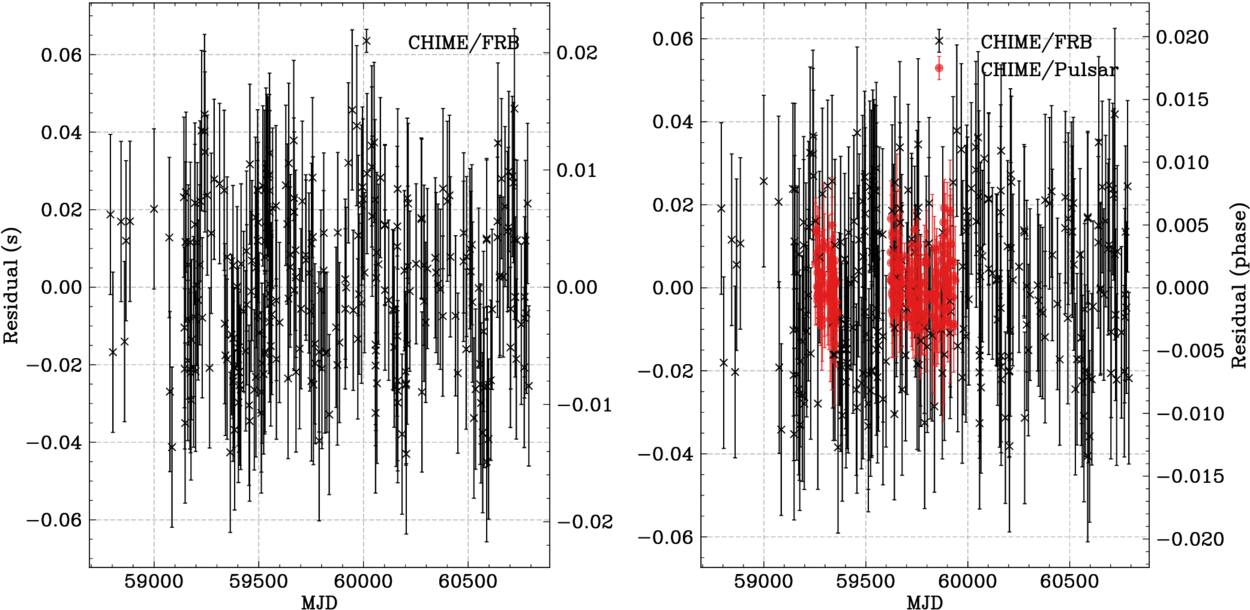
Figure 9. Timing residuals for PSR J0012+5431. On the left, we show timing residuals fit with only using CHIME/FRB metadata; on the right, we show a combination of CHIME/Pulsar intensity data and CHIME/FRB metadata.
Download figure:
Standard image High-resolution imageFootnotes
- 26
Note that these sources have also been given some other names in the literature, such as ultra-long-period transients. In this study, we use the term long-period transient throughout.
- 27
- 28
- 29
- 30
The code to create this plot was adapted from (N. Hurley-Walker et al. 2023) (https://github.com/nhurleywalker/GPMTransient) with more source categories (i.e., millisecond pulsars and RRATs). The RRATs were retrieved from (https://rratalog.github.io/rratalog/) and the pulsars from the ATNF Pulsar Catalog V 2.4.0 (https://www.atnf.csiro.au/research/pulsar/psrcat/ R. N. Manchester et al. 2005)
- 30
- 31
- 32
- 33
- 34
- 35
- 36
- 37
- 38
- 39