Abstract
We employed recent Gaia/DR2 data to investigate the dynamical status of the nearby (300 pc), old (2.5 Gyr) open cluster Ruprecht 147. We found prominent leading and trailing tails of stars along the cluster orbit, which demonstrates that Ruprecht 147 is losing stars at fast pace. Star counts indicate the cluster has a core radius of 33.3 arcmin and a tidal radius of 137.5 arcmin. The cluster also possesses an extended corona, which cannot be reproduced by a simple King model. We computed the present-day cluster mass using its luminosity and mass function, and derived an estimate of 234 ± 52 M⊙. We also estimated the cluster original mass using available recipes extracted from N-body simulations obtaining a mass at birth of 50,000 ± 6500 M⊙. Therefore dynamical mass loss, mostly caused by tidal interaction with the Milky Way, reduced the cluster mass by about 99%. We then conclude that Ruprecht 147 is rapidly dissolving into the general Galactic disk.
1. Introduction
The vast majority of Galactic open clusters do not survive longer than a few hundredth million years (Wielen 1971; Binney & Tremaine 1987). Stars escape from the parent cluster because of a variety of processes. They can be divided into internal, like two-body relaxation and stellar evolution (Lamers et al. 2005; Dalessandro et al. 2015), and external, like tidal interaction and encounters with molecular clouds (Danilov & Seleznev 1994; Gieles et al. 2006; Gieles & Baumgardt 2008). The birth place and initial mass also play an important role (Boutloukos & Lamers 2003). Signatures of dissolution can be seen in many Galactic open clusters in the form of truncated main sequences (MSs) in the cluster color–magnitude diagram (CMD; Patat & Carraro 1995; Piotto & Zoccali 1999), which, in turn, produces mass functions (MFs) peaked close to high mass stars. Also, the stars distribution on the plane of the sky appears in many cases elongated or distorted. In other stellar systems, like globular clusters or dwarf galaxies in the Local Group, one can also identify extra-tidal tail stars in the surface density profile and/or tidal tails, mainly due to the tidal interaction with the Milky Way (MW; Odenkirchen et al. 2003; Carraro et al. 2007). These features are not routinely seen in Galactic open clusters where the low stellar density contrast makes it difficult to identify tidal escapers against the general Galactic field without performing a proper membership analysis. We report in this study the discovery of tidal features around the Galactic cluster Ruprecht 147. This is a nearby (300 pc), old (2.5 Gyr), and solar metallicity ([Fe/H] = 0.08 ± 0.07) open cluster (Curtis et al. 2013; Bragaglia et al. 2018). Due to its proximity, accurate membership data (radial velocity and proper motion components) are available, which allow one to describe its dynamical status with unprecedented details. In this work we extract astrometric and spectroscopic data from Gaia/DR2 and provide evidence of significant tidal structures around the cluster. We suggest that these structures are indicating that the cluster suffered a conspicuous mass loss in the past.
The layout of the paper is as follows. In Section 2 we describe data selection, and provide a list of kinematically selected members. Section 3 is dedicated to the calculation of the cluster orbit and its relation with the tidal features. We calculate the cluster present-day mass in Section 4, while in Section 5 we provide an estimate of the cluster mass at birth. Section 6, finally, summarizes our results.
2. Data Selection
In order to select kinematical members of Ruprecht 147, we considered stars within 20° from the cluster’s center (R.A. (2000.0) = 19:16:40, decl. (2000.0) = −16:17:59) having radial velocity measurements and within 500 pc from the Sun from the Gaia/DR2 archive. We imposed some conditions to ensure that all of the stars analyzed had a good solution from Gaia. In particular we considered stars whose relative parallax error was smaller than 20% that were observed multiple times from Gaia (visibility_periods > 8) and with astrometric_chi2_al/(astrometric_n_good_obs_al-5) < 1.44 × greatest(1, exp(−0.4 × (G-19.5))) as reported in Gaia Collaboration et al. (2018). This search returned 53343 stars.
We then narrowed down the selection to stars having proper motions within 2.5 mas yr−1 from the cluster’s mean proper motion (μα = −1 mas yr−1 and μδ = −27 mas yr−1) and within 7 km s−1 from the cluster’s mean radial velocity (42 km s−1) as shown by the dashed lines in Figure 1. In these plots solid lines (and symbols) denote stars that simultaneously satisfy proper motion and radial velocity selection criteria, in total 106 stars, while the light gray symbols denote all other stars (proper motions were constrained between ![$-6\lt {\mu }_{\alpha }[\mathrm{mas}\,{\mathrm{yr}}^{-1}]\lt 4$](https://content.cld.iop.org/journals/1538-3881/157/3/115/revision1/ajaaff6cieqn1.gif) and
and ![$-21\lt {\mu }_{\delta }[\mathrm{mas}\,{\mathrm{yr}}^{-1}]\lt -31$](https://content.cld.iop.org/journals/1538-3881/157/3/115/revision1/ajaaff6cieqn2.gif) ).
).
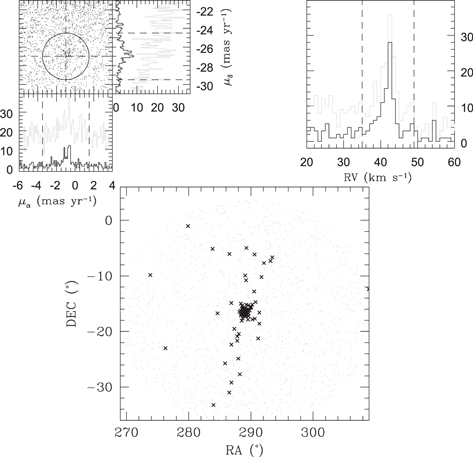
Figure 1. Selection of proper motion and radial velocity members. Light gray histograms represent all of the stars, while solid histograms represent only stars satisfying radial velocity constraints (upper left) and proper motion constraints (upper right).
Download figure:
Standard image High-resolution imageWe calculated then the heliocentric Galactic velocities and further restricted the sample to stars having velocity within 3 km s−1 from the mean cluster’s velocity (see Table 1 and Figure 2) as denoted by the dashed lines in Figure 3. Stars that do not satisfy this kinematic criterion are indicated by the red open squares in the bottom panels of Figure 3. We also clipped stars whose colors and magnitudes appeared inconsistent with cluster’s membership (as shown by the open circles in the bottom panels of Figure 3). Stars that survived these selection criteria are indicated by the crosses in the same figure, where magenta crosses indicate stars beyond 3° from the cluster’s center. After these selections we obtained a sample of 69 candidate members. Figure 4 shows different tridimensional spatial projections of the selected members.
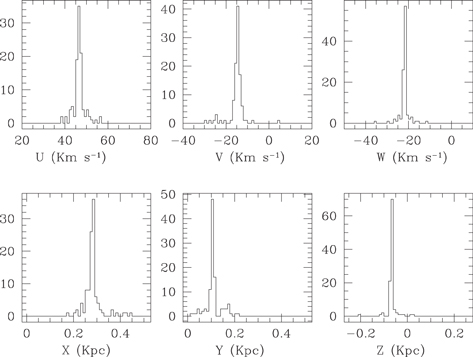
Figure 2. Histograms of heliocentric Galactic coordinates and velocities of proper motions and radial velocity selected members.
Download figure:
Standard image High-resolution image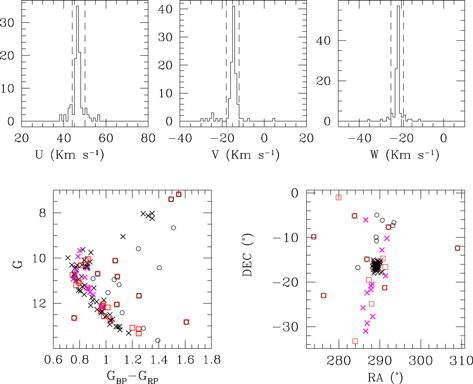
Figure 3. Selection of cluster members based on heliocentric Galactic velocities, colors, and magnitudes. Crosses indicate candidate members satisfying kinematic selection criteria and with photometry consistent with cluster membership. Magenta crosses indicate in particular candidate members beyond 3° from the cluster center. Red open squares or black open circles are candidate non-members based on their photometry (circles) or kinematics (squares).
Download figure:
Standard image High-resolution image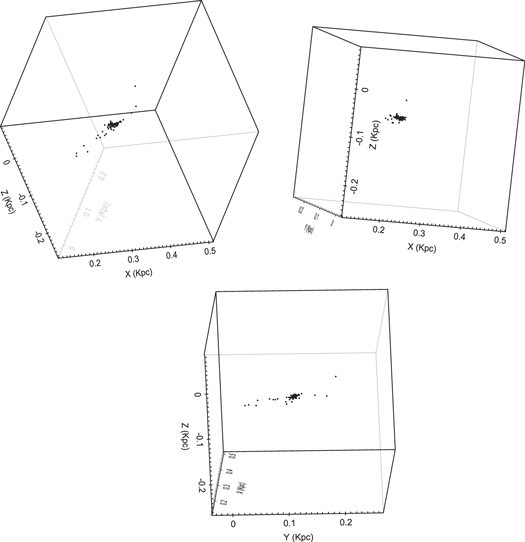
Figure 4. Different tridimensional projections of the selected members.
Download figure:
Standard image High-resolution imageTable 1. Mean Heliocentric Galactic Coordinates and Velocities
| X | Y | Z | U | V | W |
|---|---|---|---|---|---|
| (kpc) | (kpc) | (kpc) | (km s−1) | (km s−1) | (km s−1) |
| 0.28 ± 0.04 | 0.11 ± 0.04 | −0.07 ± 0.02 | 47 ± 3 | −15 ± 4 | −22 ± 2 |
Download table as: ASCIITypeset image
A close inspection of Figure 3 (lower right panel) indicates that the cluster is made of a central concentration of stars, roughly elongated in the decl. direction, and of two sparse, similarly elongated structures, which resemble a leading and a trailing tidal tail. These two tails (showed by magenta crosses) are mostly made by MS stars, as one can appreciate looking at the cluster CMD in the lower left panel. These are therefore photometric and astrometric cluster members, which beyond any reasonable doubt, are leaving the cluster.
3. Cluster Orbit
A further confirmation of the tidal origin of these structures would be to show that they are located along the cluster present-day orbit. To this purpose, we take from Table 1 the Cartesian velocity components U, V, and W, which we shifted to the local standard of rest and corrected for solar motion. We then compute the orbit of Ruprecht 147 using test particle simulations in a fixed potential. This is justified by the fact that the integration is short in time and essentially aimed at deriving the present-day orbit and orbital parameters. The details of the orbit integration and the original code parameters are in Carraro et al. (2002). Briefly, to integrate the orbit of Ruprecht 147 we adopted a modified Allen & Santillan (1991) model for the MW gravitational potential. This potential is time-independent, axisymmetric, fully analytic, and mathematically very simple. We normalized the assumed densities for the bulge, disk, and halo so that the combined gravitational force fits a rotation curve consistent with the most recent observations, and Galacto-centric distance and rotation velocity for the Sun (Reid et al. 2014; Bland-Hawthorn & Gerhard 2016). For this simple exercise, we did not include any time-dependent component, like bar or spiral arms, which we believe are not very important for an object located so close to the Sun. Besides, it is reasonable to believe that the Galactic potential did not change much over about a Galactic rotation time (∼250 Myr), which is more than enough for the purpose of deriving the present-day orbit of Ruprecht 147. The orbit-integration routine consists of a fifteenth-order symmetric, symplectic Runge–Kutta method, using the Radau scheme (Everhart 1985). This guarantees conservation of energy and momentum at a level of 10−12 and 10−9, respectively, over the whole orbit integration. The orbit, integrated back in time for 200 Myr, is shown in Figure 5. This figure clearly shows that the tidal features associated to Ruprecht 147 distribute along the cluster orbit. The projection where tails are closer to the cluster’s orbit seems to be the Y–Z. This confirms recent results obtained by Roser et al. (2018) and Meingast et al. (2018) for the Hyades star cluster.
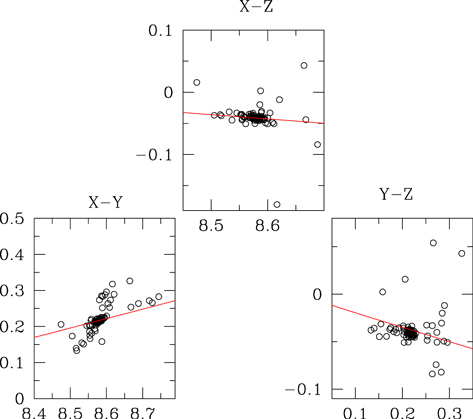
Figure 5. Different tridimensional projections of the selected members. The solid red line is the actual orbit of the cluster. The axes are in kiloparsecs.
Download figure:
Standard image High-resolution image4. Present-day Mass Estimate
The alignment of tidal tails along the cluster orbit indicates that Ruprecht 147 is losing mass due to tidal interaction with the MW gravitational potential. Additional indications of mass loss should be hardcoded in the cluster MF, since it is very well known that clusters in advanced stages of dynamical evolution routinely possess MSs which appear to be depleted of low-mass stars (see, e.g., Patat & Carraro 1995; Piotto & Zoccali 1999). In order to obtain a reliable estimate of the cluster present-day mass we relaxed the magnitude and radial velocity constraints and performed star counts using stars brighter than G = 18 mag within a larger field (40° from the cluster center) and having proper motion components within 2.5 mas from the means (see Section 2), and, finally, parallaxes between 2 and 4.5. In this way we obtained a sample of 3739 stars.
From this sample we computed a surface density map using a kernel density estimator technique with a kernel density halfwidth of 40 arcmin following the method detailed in Carraro & Seleznev (2012) and in Seleznev (2016b). The resulting density map is shown in Figure 6. By closely inspecting this map one can notice that the densest part of the cluster is slightly elongated in the north–south direction thus indicating some tidal deformation. Also, the stellar density outside the densest part of the cluster reveals the same elongated structure which coincides with the cluster tidal tails (see previous sections).
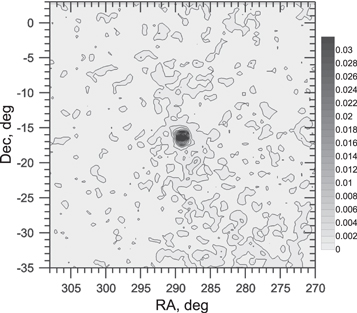
Figure 6. Surface density map in a region of 40° on a side around Ruprecht 147.
Download figure:
Standard image High-resolution imageThe corresponding linear and logarithmic radial density profile are shown in Figure 7, where the red solid line indicates the level of the background. On the other hand, the dashed lines indicate the 2σ uncertainty in the star counts. The cluster structure shows a well-defined King-like cluster central concentration (see the right panel) having a radius of about 100 arcmin, and an extended cluster corona, up to roughly 450 arcmin from the center (see also the left panel). The corona consists of stars that left the cluster but are still moving in its vicinity (Danilov et al. 2014). Following the approach described in Seleznev (2016a) we can estimate the mean density of the field stars as  and the cluster corona radius as Rc = 450 ± 10 arcmin.
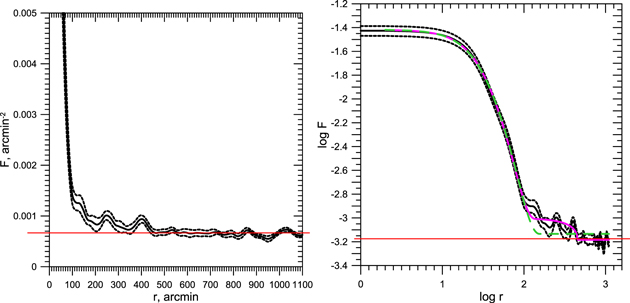
Figure 7. Linear (left panel) and logarithmic (right panel) radial surface density profile in a region of 20° around Ruprecht 147.
Download figure:
Standard image High-resolution imageIn the right panel of Figure 7 we perform a fit with a King (1962) model (green dashed line) and with a modified King model (Seleznev 2016a) which takes into account the presence of a corona around the cluster (magenta solid line). Clearly, the simple King model does not reproduce the cluster corona. In the case of the modified King model we found that the cluster has a core radius of rc = 33.3 ± 0.2 arcmin and a tidal radius of rt = 137.5 ± 1.7 arcmin. With these estimates the King (1962) concentration parameter would be c = 0.62.
The integration of the density profile yields an estimate of the cluster star number of Ncluster = 280 ± 100, while the star number within 100 arcmin is Ncore = 160 ± 20.
The luminosity function (LF) of the cluster was then estimated following Seleznev (1998) and Seleznev et al. (2000). A ring around the cluster with the same area as the cluster was taken as a reference field. The LF is shown in Figure 8. The solid black line shows the field star subtracted cluster LF. Dashed lines, as before, indicate the 2σ uncertainty in the star counts. For a better understanding we also show the whole cluster LF (in blue) and the equal area comparison field LF (in purple).
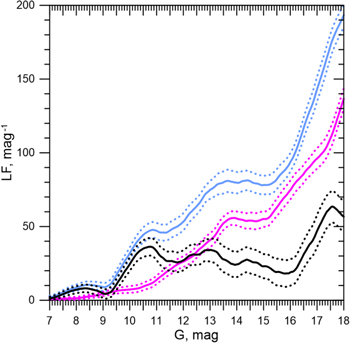
Figure 8. Luminosity functions of Ruprecht 147 and the surrounding stellar field.
Download figure:
Standard image High-resolution imageThe corresponding cluster MF was then computed following Seleznev et al. (2017). The linear and logarithmic MFs are shown in Figure 9. The mass range corresponds to stars with G ∈ [9.76; 18.0] magnitudes, and the bright evolved cluster stars are excluded due to the complicated mass–luminosity relation for this kind of star. As usual, the dashed lines indicate the 2σ uncertainty. Finally, the MFs of the whole cluster (in black), the cluster core (in red), and the cluster corona (in green) normalized to unity are then shown in Figure 10. This figure clearly highlights mass segregation, namely the central region has a deficiency in the low-mass stars compared to the cluster and its corona.
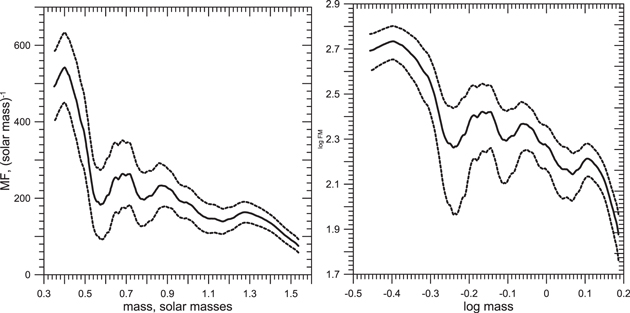
Figure 9. Linear (left panel) and logarithmic (right panel) mass function of Ruprecht 147.
Download figure:
Standard image High-resolution image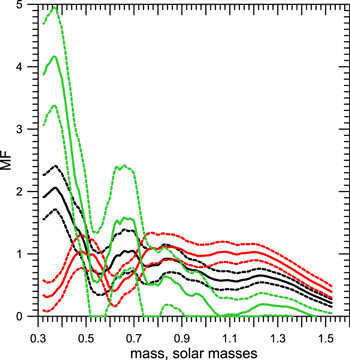
Figure 10. Mass functions of Ruprecht 147. See the text for details.
Download figure:
Standard image High-resolution imageThe cluster present-day mass was finally inferred by integrating the MF. The number of stars with G ∈ [7.0; 9.76] magnitudes was estimated via the cluster and the cluster core LF integration in this magnitude range. They amount to be 18 ± 7 for the whole cluster (the cluster core and the cluster corona) and 19 ± 6 for the cluster core (it basically means that all bright stars are inside the cluster core). The mean mass of these stars can be estimated as 1.55 solar masses by the theoretical isochrone table (Bressan et al. 2012) for the age of 2.5 ± 0.5 Gyr (Curtis et al. 2013; Bragaglia et al. 2018). Finally, we obtained estimates of the cluster star number Ncluster = 280 ± 66 and the cluster mass Mcluster = 234 ± 52 M⊙ (the cluster core and corona). The same estimates for the cluster central region are Nc = 159 ± 32 and Mc = 163 ± 28 M⊙. These anyway have to be considered as lower limits, since we did not take into account stars fainter than G = 18, invisible remnants of evolved massive stars, and unresolved binary or multiple stars.
The mass we would obtain by considering only cluster members selected as in Section 2 is about 110 M⊙.
5. Initial Mass Estimate
The observational evidences presented in the previous sections reveal that Ruprecht 147 might have lost a significant fraction of its original mass due to environmental effects (like tidal shocks due to close interactions with giant molecular clouds, spiral arms, the Galactic disk, and, in general, to the interactions with the Galactic tidal field) or internal dynamical effects (like two-body relaxation or stellar evolution). In this section, we attempt to estimate the total mass lost by Ruprecht 147 during its evolution and derive its original mass. We adopted here the approach described by Lamers et al. (2005) and already used by Dalessandro et al. (2015) to derive the initial mass of the star cluster NGC 6791. This method has the advantage of describing the way the mass of a cluster decreases with time by means of relatively simple analytic expressions, extracted from a large suite of N-body models. The initial mass can be estimated by (see Dalessandro et al. 2015)

where t is the cluster age and M its present-day mass. The function qev(t) describes the mass loss produced by stellar evolution, and essentially depends on metallicity. For a mildly super-solar star cluster ([Fe/H] = 0.08 ± 0.07; see Bragaglia et al. 2018), from Lamers et al. (2005) we read

Finally, the index γ and to depend on model cluster initial profiles and the tidal field, which are taken to be King-like (King 1962). Following again Dalessandro et al. (2015) and Lamers et al. (2005) we adopt here γ = 0.62 and to = 3.3 Myr. In fact, as described in Dalessandro et al. (2015), to is a constant depending on the strength of the tidal field. In other words, it does not depend on a particular cluster model. Since Ruprecht 147 lies at the same Galacto-centric distance of both the Sun and NGC 6791, this seems a reasonable assumption. As for γ, we adopted 0.62 because this is a typical value for Galactic open clusters (Baumgardt & Makino 2003).
By inserting all of the numerical values we obtain from Equation (1) an estimate of the cluster initial mass of M ∼ 50,000 ± 6500 M⊙, where the reported uncertainty has been derived through propagation of age and actual mass errors. This would imply that the cluster lost about 99% of its original mass over its life.
6. Conclusions
In this study we made use of from the literature to investigate the dynamical state of the nearby, old, open cluster Ruprecht 147. We started from the evidence that the spatial distribution of star cluster members indicate the presence of prominent tidal features. We found that these features are aligned with the cluster orbit, which we calculated using a simple Galactic model. Due to the short integration time this is entirely reasonable.
From a sample of 3739 proper motion and parallax selected members we obtained an estimate of the actual cluster mass of 234 ± 52 M⊙, and compared it with an estimate of the cluster initial mass of ∼50,000 ± 6500 M⊙, derived from analytical interpolations of N-body simulation results. The evidence emerges that Ruprecht 47 lost more than 99% of its original mass over its lifetime. Given the presence of significant tidal tails we suggest that most of this mass loss is of tidal origin, and that the cluster is undergoing fast dissolution into the general Galactic disk.
F.C.Y. acknowledges the European Union founded Astromundus program (https://www.uibk.ac.at/astromundus/), under which she could spend the 2018 spring semester in Padova. The comments of the anonymous referee are deeply acknowledged. The work of A.F.S. was supported by the Ministry of Science and Higher Education (the basic part of the State assignment, RK No. AAAA-A17-117030310283-7) and by the act no 211 of the Government of the Russian Federation, agreement No. 02.A03.21.0006.
Facility: Gaia. -