Abstract
We obtained new spectra of Kepler-34 and Kepler-35 with Keck-HIRES—nearly a decade after these systems were originally characterized with this spectrograph and other instruments—to search for radial velocity (RV) trends from a potential third stellar-mass companion at long periods. For Kepler-34, we rule out coplanar stellar masses as low as 0.12M⊙ at an orbital period of ≲52 yr. For Kepler-35, we rule out stellar masses of 0.13M⊙ at orbital periods of ≲55 yr. Highly stable, extreme precision RV instruments, as well as improved methodologies in characterizing double-lined spectroscopic binaries that come with these new instruments, will provide an opportunity to push these mass limits lower in the future.
Original content from this work may be used under the terms of the Creative Commons Attribution 4.0 licence. Any further distribution of this work must maintain attribution to the author(s) and the title of the work, journal citation and DOI.
1. Introduction
Circumbinary planets orbit around both stars of a stellar system. The first confirmed detection of a transiting circumbinary planet, Kepler-16b (L. R. Doyle et al. 2011), was based on photometry from the NASA Kepler mission. Since then, a total of 14 circumbinary planets have been detected from Kepler photometry. Notably, the transiting circumbinary planets have provided the majority of circumbinary planet detections that form the basis of our understanding of their demographics (D. J. Armstrong et al. 2014; D. V. Martin & A. H. M. J. Triaud 2014; G. Li et al. 2016).
Radial velocities (RVs) have the potential to further our understanding of circumbinary planets. RV curves of double-lined spectra allow for a detailed characterization of the orbital properties and masses of both the primary and secondary star. In principle, with sufficient RV precision, the planetary signal in RV curves of circumbinary host stars directly probe the planet's mass. However, in practice, this type of measurement is exceptionally challenging, particularly for double-lined spectroscopic binaries. Although the RV method has proven to be a highly effective way to detect planets around single stars, it has been challenging to obtain the radial velocity precision necessary to detect circumbinary planets. The spectra of double-lined binaries are both composite and time-variable and thus, traditional methods of RV determination with an iodine absorption cell cannot be applied (G. W. Marcy & R. P. Butler 1992). Previous RV searches of double-lined spectroscopic binaries (e,g., TATOOINE; M. Konacki et al. 2009, 2010) were able to rule out regions of mass-period parameter space of circumbinary planets but did not yield any detections. Recently, spectroscopic studies targeting single-lined, low-mass eclipsing binaries, such as those conducted by the BEBOP RV survey (D. V. Martin et al. 2019), have led to the radial velocity detection of Kepler-16 b (A. H. M. J. Triaud et al. 2022) and TOI-1338/BEBOP-1 c (M. R. Standing et al. 2023).
Nonetheless, long-term RV monitoring of double-lined spectroscopic binary planet hosts can provide unique constraints on the stellar and planetary system architectures. In this work, we revisit the Kepler-34 and Kepler-35 systems, both of which are double-lined spectroscopic binaries with a transiting planet (W. F. Welsh et al. 2012). Our motivation to return to these systems is to establish a decade-long baseline with additional RV measurements from Keck-HIRES. We rereduce and analyze all existing HIRES spectra to search for RV trends from a potential third stellar-mass or substellar mass companion at long periods. In Section 2, we present a comprehensive analysis of spectra, primary stellar RVs, and secondary stellar RVs for both systems. In Section 3 we derive upper limits on putative companions at large separations. We conclude with a discussion of how future observations can improve our characterization of the architectures of Kepler-34 and Kepler-35 in Section 4.
2. Methodology
2.1. Radial Velocity Measurements
Our analysis makes use of 22 previously obtained spectra of Kepler-34 and 13 spectra of Kepler-35 (W. F. Welsh et al. 2012). Each spectrum yields radial velocities for both the primary and secondary star. For the Kepler-34 spectra, four come from the HIRES spectrograph on Keck I, eleven are from the Tull Coude spectrograph on the 2.7 m Harlan J. Smith Telescope, and seven are from the HRS spectrograph on the Hobby–Eberly Telescope. For the Kepler-35 spectra, seven come from the HIRES spectrograph, three are from the FIES spectrograph on the Nordic Optical Telescope, and three are from HRS. These observations all occurred between 2011 September and October.
We obtained two new spectra of Kepler-34 in 2019 and 2021, and one of Kepler-35 in 2021, from the HIRES spectrograph on Keck I. To measure the RVs of both stellar components on those dates, we used the broadening-function (BF) technique in the publicly available code, SAPHIRES (S. M. Rucinski 2002; B. M. Tofflemire 2019). To ensure consistency between the new and old HIRES RVs, we also reanalyzed the previously obtained HIRES spectra from 2011. We prepared the spectra for the BF analysis by trimming the edges from each order and resampled the spectra to a logarithmically spaced wavelength scale. We selected HD 182488 as our template star with a radial velocity of −21.508 km s−1, for consistency with W. F. Welsh et al. (2012). The BF is calculated separately for each order and subsequently combined into a single BF. This combined BF is then weighted according to the standard deviation of the BF edges, where there is no stellar signal. The uncertainty in the BF profile is assessed using a bootstrap Monte Carlo method, which generates 10,000 combined BFs through random sampling with replacement of the BF values determined from individual orders. All RV measurements for Kepler-34 and Kepler-35 are provided in the Appendix, in Tables 3 and 4, respectively.
Figures 1 and 2 show the SAPHIRES-determined BF for all six and eight HIRES spectra of Kepler-34 and Kepler-35. We fit Gaussian profiles to the peaks of the BF to determine the observatory-frame RVs of the primary (colored blue) and secondary star (colored orange). We then applied the appropriate barycentric RV corrections to obtain the RV time series of each star in the barycentric frame of reference. The reanalyzed HIRES RVs are consistent with the values previously obtained by W. F. Welsh et al. (2012).
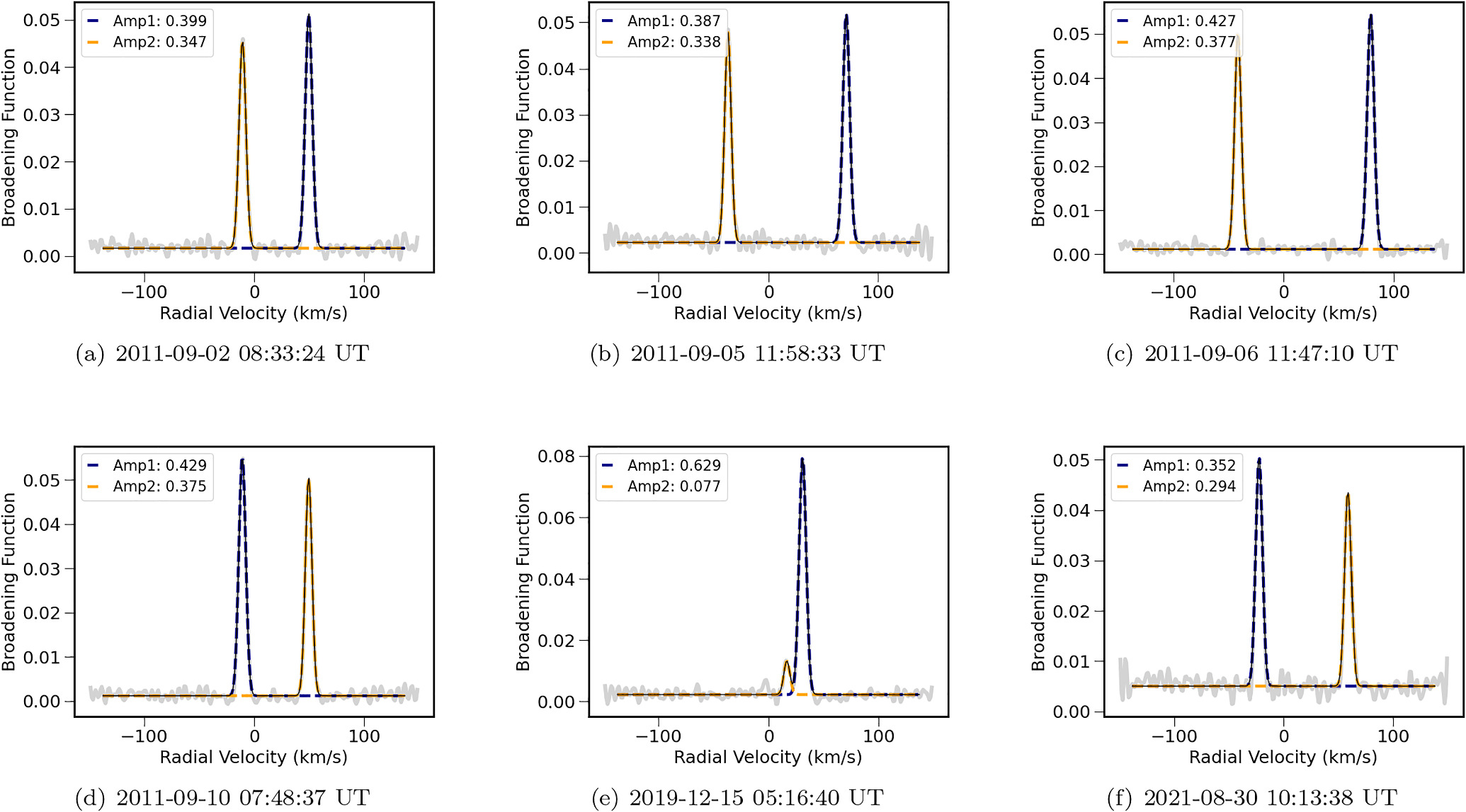
Figure 1. Broadening function of HIRES spectra of Kepler-34 obtained in six unique observations. Gaussian profiles are fitted to the peaks in the broadening function at the RVs associated with the primary star (blue) and secondary star (orange). The area underneath the Gaussian profiles for each star are provided in the legend.
Download figure:
Standard image High-resolution image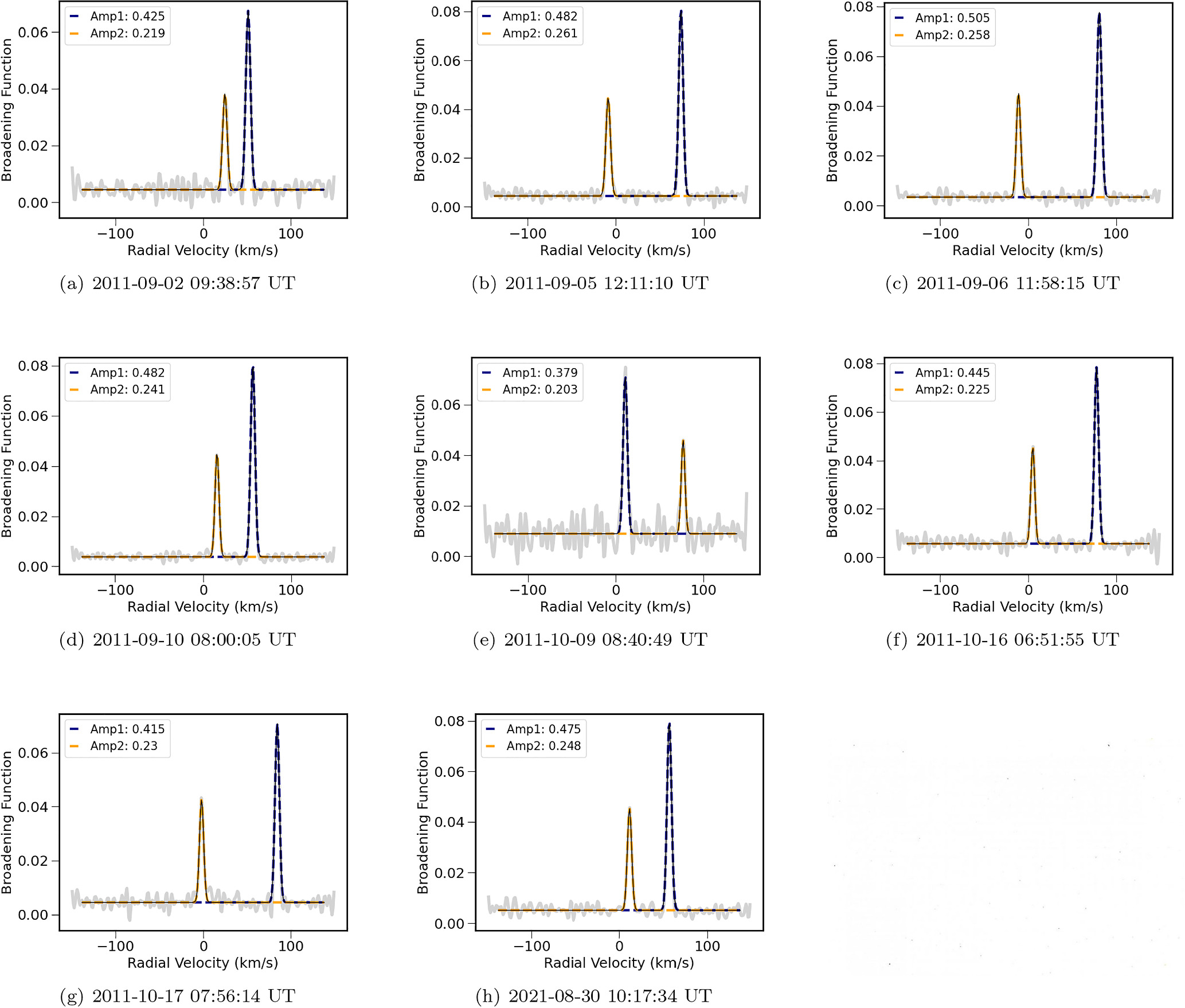
Figure 2. Broadening function of the HIRES spectra of Kepler-35 obtained in eight unique observations. Gaussian profiles are fitted to the peaks in the broadening function at the RVs associated with the primary star (blue) and secondary star (orange). The area underneath the Gaussian profiles for each star are provided in the legend.
Download figure:
Standard image High-resolution imageThe new HIRES RVs obtained for Kepler-34 in 2019 have atypically large uncertainties, and a large RV residual. As seen in Figure 1 in panel (e), only a singular peak was unambiguously identified from the spectrum's broadening function. Although a secondary peak is weakly identified by SAPHIRES, the centroid location of this peak varied significantly between the various echelle orders that contributed to the BF. It is more likely that the second identified peak is noise and that both stellar components are nearly perfectly blended, making a precise RV measurement of both components challenging. The 2019 observation also coincides with the secondary eclipse of Kepler-34, and so the spectral profile is also likely affected by the Rossiter–Mclaughlin effect (D. B. McLaughlin 1924; R. A. Rossiter 1924). We report the RV values measured on this date in Table 3, but due to the poor quality of the spectrum and the blended nature of the BF peaks, we exclude this date in all subsequent analysis.
A challenge in combining spectra from multiple instruments is that, for a given instrument, it is generally easier to measure a differential RV than an absolute RV. To compensate for possible systematic errors between the instruments, we allow a zero-point offset for each instrument as part of our modeling (Section 2.2). However, one might wonder to what extent our analysis hinges on the inclusion of spectra from heterogeneous instruments, and possible variations in their quality (for instance one HET and one HJST RV measurement for Kepler-34 were also obtained near a secondary transit event). To address this, we also performed our analysis on just the HIRES spectra, and found that the value of the RV slope was unaffected for Kepler-34, and decreased by ~10% for Kepler-35. Throughout the remainder of the paper, we include all HIRES and non-HIRES RVs available to us, provided the RV quality is sufficient (see Tables 3 and 4).
2.2. RV Curve Modeling
W. F. Welsh et al. (2012) obtained precise measurements of the stellar and planetary orbital parameters for Kepler-34 and Kepler-35 by combining stellar spectra, transit-timing variations, and photodynamical modeling of the systems.
Initially we adopted all orbital parameters reported in W. F. Welsh et al. (2012) to model the RV curves of the primary and secondary star in each system with Radvel (B. J. Fulton et al. 2018). The times of periastron were not reported in the main tables of the paper, but were mistakenly labeled in the captions of Figures 1 and 2. However, adopting the reported times of periastron resulted in large residual structures to the RVs. We later determined that the times reported in Figures 1 and 2 of W. F. Welsh et al. (2012) are actually the times of conjunction (primary mideclipse times), not the times of periastron. To correct for this error, we independently re-determined the best-fitting time of periastron for Kepler-34 b and Kepler-35 b from the RVs, finding Tp = 2455007.125 days and Tp = 2455007.161 days, respectively.
For each instrument, we introduce a constant offset to correct for zero-point velocity offsets between the spectrographs and the systemic radial velocity of the system. We also introduce a free parameter,  , that captures long-term trends in the RVs potentially introduced by a stellar or substellar companion at orbital periods longer than the baseline of the RV measurements.
We fit for zero-point velocity offsets for each spectrograph, and a single value of  fixed to zero, by maximizing the log-likelihood function:

where RVi is the ith RV measurement, RVmodel(ti) is the two-body Keplerian modeled RV at time ti and σRV,i is the uncertainity on the ith RV measurement. For completeness, our RV model is:

where V0 is the barycentric radial velocity, and j = 1, 2 for the primary and secondary star, respectively. The modeled RV curves of Kepler-34 and Kepler-35 are generated using RadVel with the orbital parameters from Table 1. Figures 3 and 4 display the RV curves and associated RV measurements for Kepler-34 and Kepler-35.
Table 1. The Orbital Parameters Input into Radvel for the Two-body Keplerian Models of Kepler-34 and Kepler-35
| Systems | ||
|---|---|---|
| Orbital Parameters | Kepler-34 | Kepler-35 |
| Mass of Star A, MA (M⊙) | 1.0479 | 0.8877 |
| Mass of Star B, MB, (M⊙) | 1.0208 | 0.8094 |
| Period, P (days) | 27.7958103 | 20.733666 |
| Eccentricity, e | 0.52087 | 0.1421 |
| Inclination, i, (degrees) | 89.8584 | 90.4238 |
| Semimajor axis, a (au) | 0.22882 | 0.17617 |
| Time of Periastron, (days) Tp | 2455007.125 | 2455007.161 |
| Argument of Periapsis, ω (radians) | 1.2468 | 1.5058 |
Note. Time of periastron is determined in this analysis (Section 2.2), whereas all other values are adopted from (W. F. Welsh et al. 2012).
Download table as: ASCIITypeset image
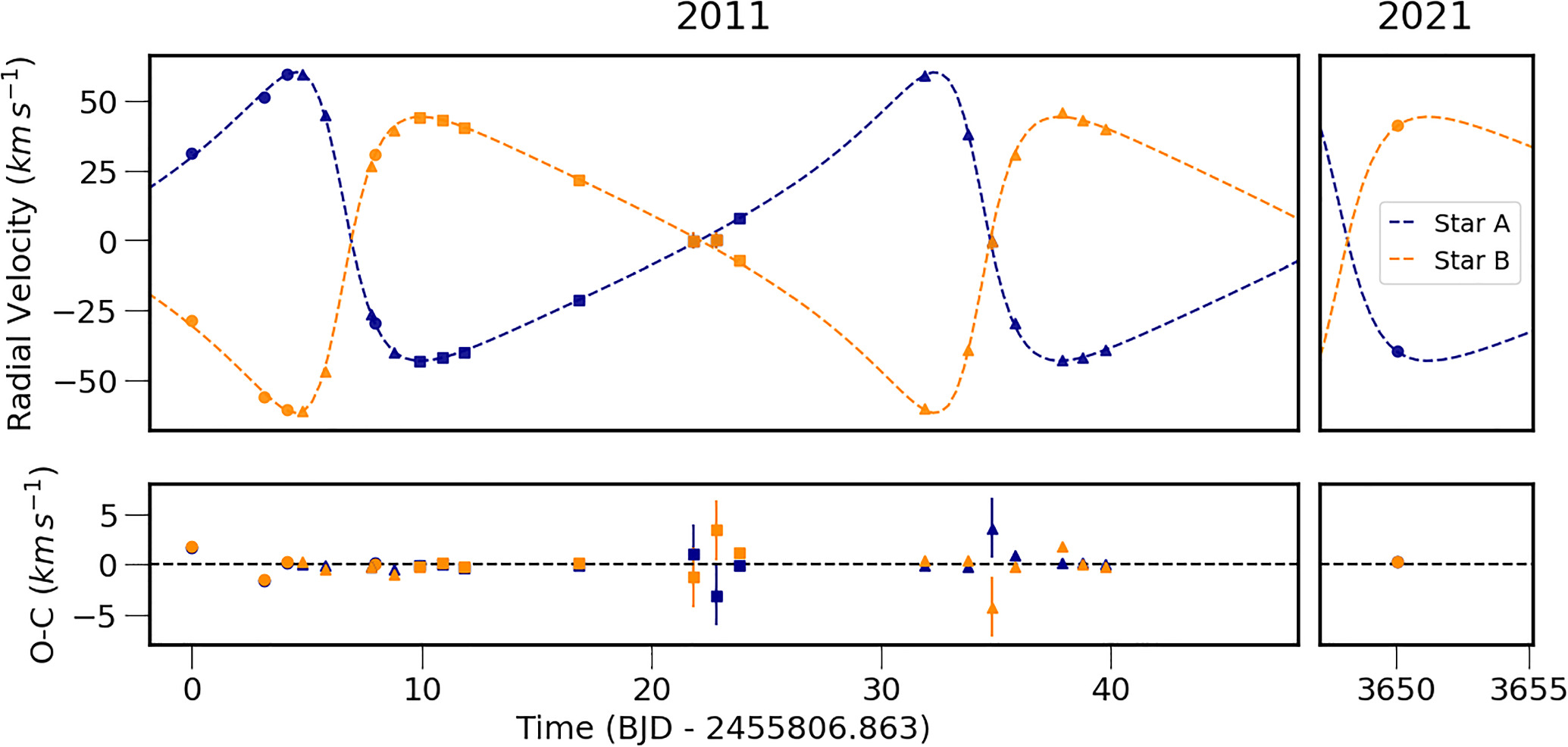
Figure 3. Top panels: radial velocities for Kepler-34 spanning over a decade (solid points). The 1σ error bars are typically smaller than the point size. The Keplerian orbital parameters to generate the model of the RVs are listed in Table 1. Note the significant temporal gap between the 2011 observations (left) and 2021 observation (right). The RV measurements from the low-quality observation in 2019 are not shown, but were consistent with the lack of RV trend. Bottom panels: the residuals. Circular markers denote Keck-HIRES RVs, square markers denote HET HRS RVs, and triangle markers denote HJST Tull RVs.
Download figure:
Standard image High-resolution image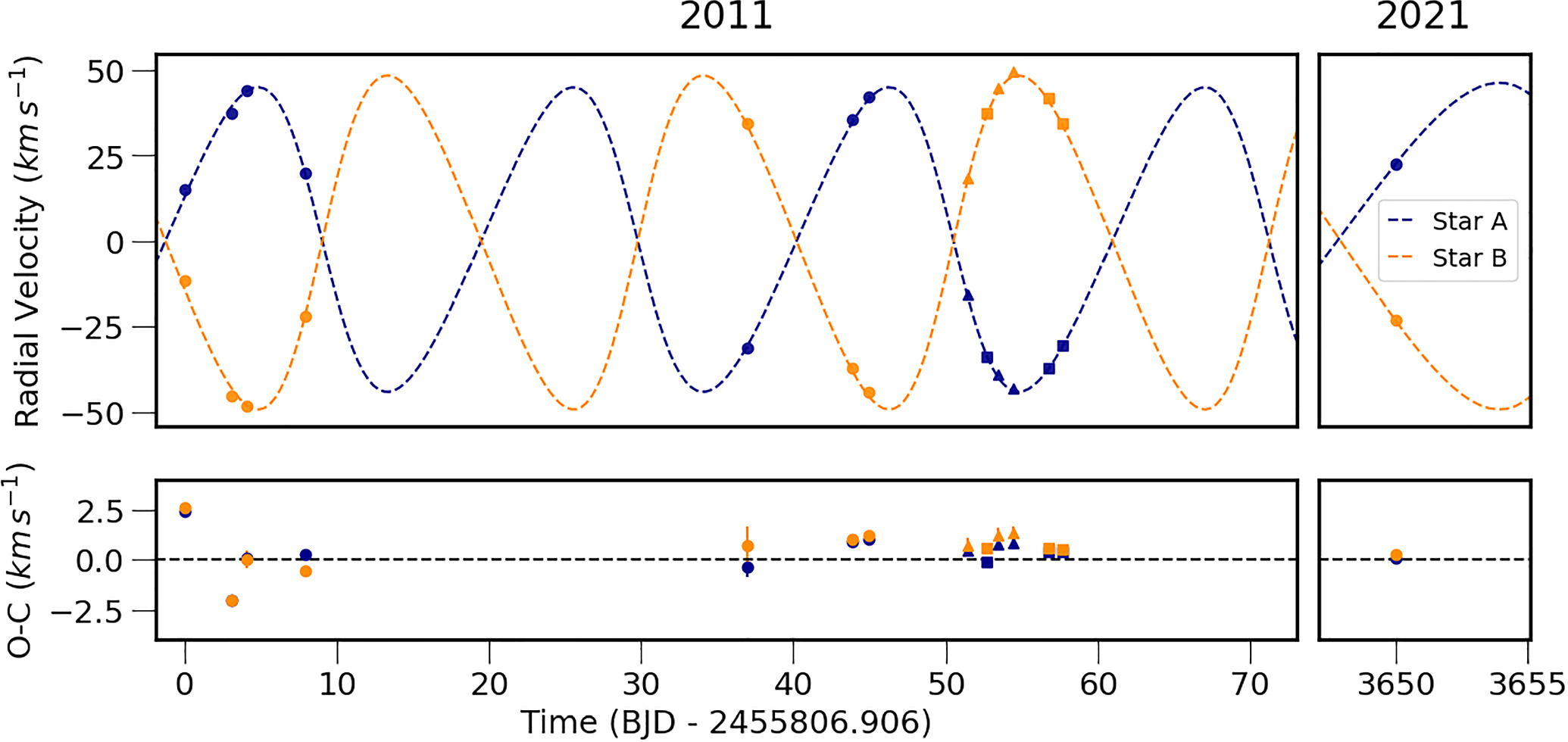
Figure 4. Top panels: same as Figure 3, but for Kepler-35. Bottom panels: the residuals. Circular markers denote Keck HIRES RVs, square markers denote HET HRS RVs, and triangle markers denote NOT FIES RVs.
Download figure:
Standard image High-resolution image2.3. Lomb–Scargle Periodogram of the RV Residuals
To search for periodic signals in the RVs at orbital periods commensurate with our observational baseline and shorter, we computed a Lomb–Scargle periodogram of the RV residuals. This analysis reveals a lack of a significant peak detection that can be indicative of a companion. This outcome was anticipated, given the incorporation of only one additional RV measurement over our 10 yr baseline. A more meaningful Lomb–Scargle periodogram could be obtained with an increased number of RV observations in the future.
2.4. Modeling Long-term Trends in the RVs
Companions with orbital periods significantly longer than the baseline scale were searched for by modeling a constant acceleration acting on the barycenter of the binary. We fixed the zero-point-velocity offsets for all RV measurements in our data, allowing  to be the only remaining free parameter. We also included the effects of apsidal precession, but on the timescale of our observations, the change in RV from apsidal precession (~0.04) km s−1 is smaller than our typical error (~1) km s−1. Thus any deviation of the most recently obtained RVs from the modeled RV curves can be attributed to acceleration from a third body. A significant detection of
  could potentially correspond to a companion in the system with degeneracy between the semimajor axis and mass. A nondetection of
  can be used to place upper limits on putative, hidden companions. We estimated the uncertainty in our parameters with a Markov chain Monte Carlo analysis (MCMC), implemented via the python package emcee (D. Foreman-Mackey et al. 2013). Our uncertainty in
  is driven by the uncertainty on the individual HIRES RV measurements, which have a root mean square error (RMSE) of 1 km s−1 with respect to the best fit (Table 2).
Table 2. Best-fit Parameters from the MCMC Analysis, Including the Radial Velocity Trend, Zero-point Offsets, the Systemic Radial Velocities, and Root Mean Squared Errors for the Kepler-34 and Kepler-35 Systems
| Systems | ||
|---|---|---|
| Best-fit Values and Errors | Kepler-34 | Kepler-35 |
 (km s−1 yr−1) (km s−1 yr−1) |

|

|
| HIRES Zero-Point (km s−1) |

|

|
| HRS Zero-Point (km s−1) |

|

|
| TULL Zero-Point (km s−1) |

| ⋯ |
| FIES Zero-Point (km s−1) | ⋯ |

|
| Barycentric RV (km s−1) |

|

|
| RMSE of Star A (km s−1) | 1.17 | 0.99 |
| RMSE of Star B (km s−1) | 1.40 | 1.16 |
| RMSE of Star A [HIRES] (km s−1) | 1.04 | 1.23 |
| RMSE of Star B [HIRES] (km s−1) | 1.05 | 1.32 |
Download table as: ASCIITypeset image
3. Mass-period Constraints on Companions
As a proof of concept, we assume a companion on a circular orbit around the barycenter of the binary stars. (We restrict companions to circular orbits because allowing the eccentricity to float would introduce two additional free parameters, which is not substantiated by a single additional RV for each star.) The mass of the posited companion “C” can be calculated by dividing the gravitational force by its acceleration on the barycenter of the binary system, yielding:

where ac is the semimajor axis of the companion , i is the inclination, and G is the gravitational constant. Our linearization makes this analysis applicable only to companions with orbital periods much greater than the span of the RV measurements (i.e., ac > 15 au). Possible companions with orbital periods on a scale of less than a decade will average the direction of the RV change, so this approach is only suitable for placing upper limits on masses at long periods.
Equation (3) allows for solutions where C is massive and at a large separation. If the tertiary were very bright, we would likely see it, either in direct imaging follow-up or in the spectrum itself. At distances of ~1500 pc and ~1650 pc, Kepler-34 and Kepler-35 companions would only be resolvable (at 0 75) at separations of >103 au, which is much wider than the parameter space we are inherently probing with our 10 yr time baseline. In high-resolution spectra of apparently single primary stars, R. Kolbl et al. (2015) found that companions with at least 1% of the primary star's flux and a velocity difference of 10 km s−1 are detectable. Although this work has not been extended to finding companions in SB2s (three convolved stellar spectra), we adopt a mass limit corresponding to a 1% flux ratio as the upper limit for companions in our search. A detailed investigation of the contamination produced by the spectrum of a tertiary star would aid the search for companions between ~102 and ~103 au, but it is beyond the scope of this paper.
3.1. Kepler-34
In Figure 5, we illustrate an upper limit for the mass of a companion in the Kepler-34 system, derived from  . The mass limit obtained from the mean value of
  is shown as a dashed gray curve, while the shaded gray region represents the ±3σ interval. The uncertainty on the tertiary mass limit arises solely from the uncertainty on
  . Stellar companions with
  and aC < 34 au are ruled out by the new RV data. However, M-type stars or substellar objects at ~30 au are consistent with the RV measurements, as are massive (but low-luminosity) objects beyond 34 au.
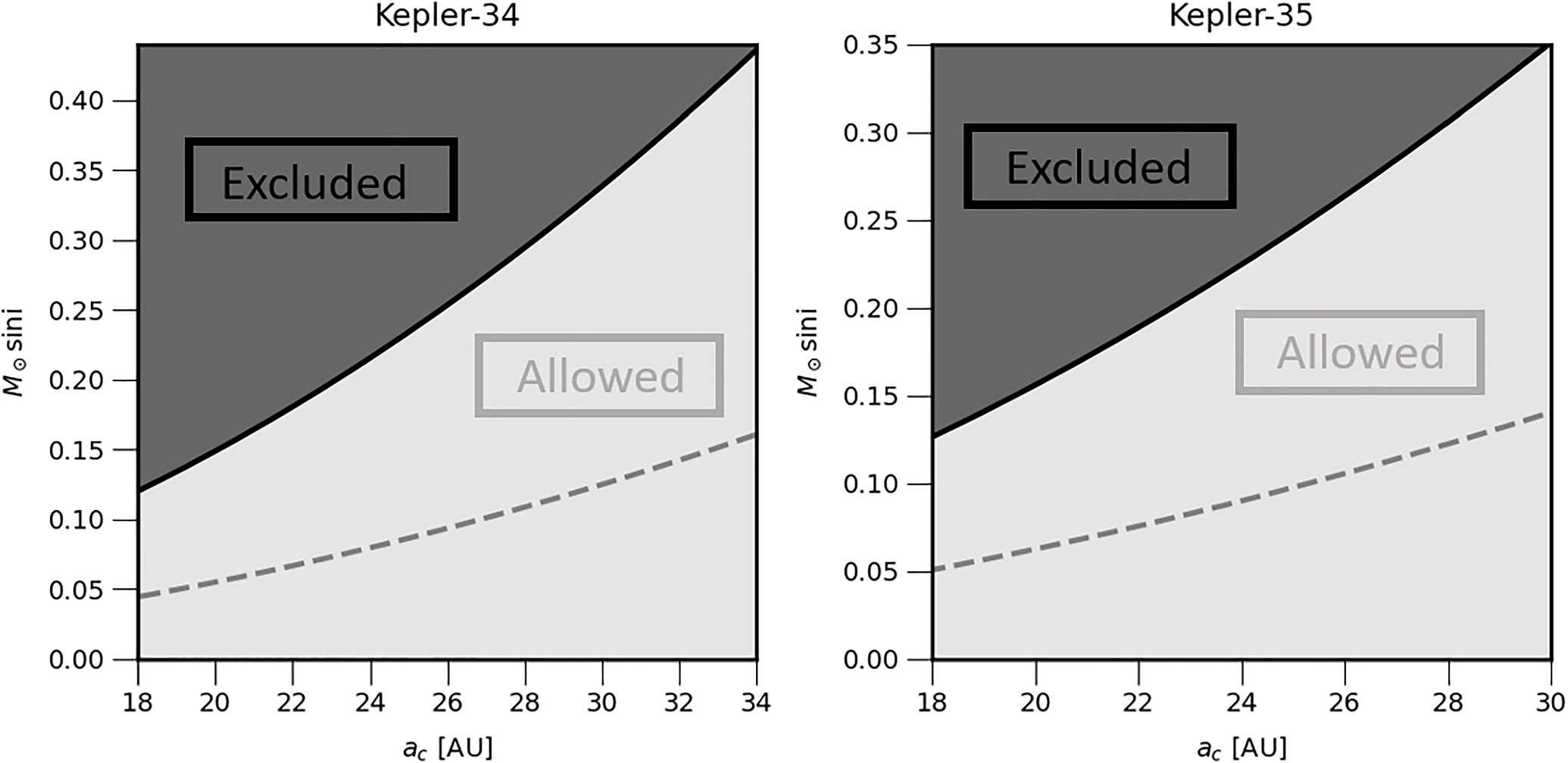
Figure 5. Upper limits on a proposed companion in the Kepler-34 and Kepler-35 system as a function of companion mass and semimajor axis. The dashed gray curve is obtained from the mean value of  and the light gray region is the ±3σ interval. The dark gray region corresponds to masses above our 3σ upper limit.
Download figure:
Standard image High-resolution image3.2. Kepler-35
In Figure 5, we also illustrate the upper limit for the mass of a companion in the Kepler-35 system, derived from  . Stellar companions with
  and a < 30 au are ruled out. As with Kepler-34, M-type stars or substellar objects at ~30 au are consistent with the RV measurements, as are massive (but low-luminosity) objects beyond 30 au. Continual monitoring of both the Kepler-34 and Kepler-35 systems to extend the RV baseline would further constrain the parameter space of a putative tertiary companion.
4. Discussion and Conclusion
We searched for RV trends over a decade-long baseline in the Kepler-34 and Kepler-35 systems, as such trends may be indicative of tertiary companions. We reanalyzed both the previous and newly obtained HIRES RVs with a broadening function. Fitting these RVs (and other literature RVs) for both Kepler-34 and Kepler-35, we found orbital parameters and masses of the stars consistent with W. F. Welsh et al. (2012), except for the times of periastron, which were reported erroneously in the previous publication. We determined that the best-fitting time of periastron for Kepler-34 and Kepler-35 from the RVs, are Tp = 2455007.125 days and Tp = 2455007.161 days, respectively. For putative teriatry companions on circular orbits, we obtained mass upper limits based on the nondetection of a substantial RV trend over the decade-long RV baseline. For Kepler-34, a tertiary  upper limit ranges from 0.12 M⊙ at an orbital distance of 18 au to 0.44 M⊙ at 34 au from the barycenter of the stellar binary (3σ conf.). For Kepler-35, a tertiary
  upper limit ranges from 0.13 M⊙ at 18 au to 0.35 M⊙ at 30 au from the barycenter of the stellar binary (3σ conf.).
The major factor limiting our ability to decrease the mass upper limit of long-period companions are errors in the RVs of order 0.1 km s−1 that arise from the challenges of characterizing double-lined spectra. This challenge has been noted in previous studies of double-lined binaries, (M. Konacki et al. 2009, 2010). In contrast, recent spectroscopic studies that have focused on single-lined, low-mass eclipsing binaries (BEBOP; D. V. Martin et al. 2019) are sensitive to Saturn-mass circumbinary planets within orbital periods of 1000 days (M. R. Standing et al. 2022), leading to the RV detection of Kepler-16 b (A. H. M. J. Triaud et al. 2022) and TOI-1338/BEBOP-1 c (M. R. Standing et al. 2023).
Several advancements are promising for improving the mass sensitivity in the search for third objects around double-lined spectroscopic binaries. L. Sairam et al. (2024) used Gaussian processes to reduce their velocity errors by a factor of 2, leading to the detection a low-mass, circumbinary planet in the TIC 172900988 system with high-cadence spectra obtained from the SOPHIE spectrograph. Our science goal (identifying a long-term trend in RVs) and data products (low-cadence spectra) were not well suited to a GP analysis of this nature. However, such a GP approach, when combined with sufficiently high-cadence double-lined spectra, might be a promising avenue for future RV characterization.
Extreme-precision RV instruments, featuring hardware advancements that provide an ultrastable point-spread function (PSF) for starlight entering the spectrograph, have recently come online or will do so in the near future. Several examples include the Keck Planet Finder (S. R. Gibson et al. 2018), iLocator (J. R. Crepp et al. 2016), EXPRES (C. Jurgenson et al. 2016; R. R. Petersburg et al. 2020), and NEID (C. Schwab et al. 2016). These instruments all are temperature-stabilized to within a few mK, vacuum-sealed, and fed by optical fibers that scramble and/or reduce the modal noise of the PSF. These designs will reduce the errors that arise from changes in the stellar PSF. Together, these advancements in hardware, observing strategy, and analysis suggest a bright future for the characterization of circumbinary planets and their host star environments.
Acknowledgments
We would like to thank the anonymous referee for their feedback and efforts toward improving the manuscript. This material was carried out at The University of Notre Dame, with support from the National Science Foundation REU Program (grant PHY-2050527). L.M.W. acknowledges support from the NASA Exoplanet Research Program through grant 80NSSC23K0269 and from NASA-Keck Key Stragetic Mission Support grant No. 80NSSC19K1475.
Appendix
Tables 3 and 4 provide the RV measurements for Kepler-34 and Kepler-35, respectively.
Table 3. Radial Velocities for Kepler-34
| Date | BJD | RVA | RVB | Telescope/ | Flag |
|---|---|---|---|---|---|
| YYYY-MM-DD | (2,400,000+) | (km s−1) | (km s−1) | Spectrograph | |
| 2011-09-02 | 55806.862608 | 35.129 ± 0.0683 | −25.236 ± 0.0934 | Keck HIRES | … |
| 2011-09-05 | 55810.004147 | 55.253 ± 0.0553 | −52.495 ± 0.0943 | Keck HIRES | … |
| 2011-09-06 | 55810.996812 | 63.306 ± 0.0670 | −57.188 ± 0.0844 | Keck HIRES | … |
| 2011-09-07 | 55811.6711428 | 65.097 ± 0.165 | −56.06 ± 0.174 | HJST TULL | … |
| 2011-09-08 | 55812.6440094 | 50.196 ± 0.183 | −41.578 ± 0.222 | HJST TULL | … |
| 2011-09-10 | 55814.6489276 | −21.195 ± 0.164 | 31.873 ± 0.207 | HJST TULL | … |
| 2011-09-10 | 55814.831011 | −26.138 ± 0.0515 | 34.299 ± 0.0595 | Keck HIRES | … |
| 2011-09-11 | 55815.6410401 | −34.959 ± 0.189 | 44.982 ± 0.254 | HJST TULL | … |
| 2011-09-12 | 55816.7766219 | −39.052 ± 0.3 | 48.293 ± 0.275 | HET HRS | … |
| 2011-09-13 | 55817.7719168 | −37.806 ± 0.155 | 47.505 ± 0.184 | HET HRS | … |
| 2011-09-14 | 55818.7297401 | −35.704 ± 0.2 | 44.505 ± 0.255 | HET HRS | … |
| 2011-09-19 | 55823.7296067 | −17.16 ± 0.075 | 26.103 ± 0.086 | HET HRS | … |
| 2011-09-24 | 55828.7105309 | 4.077 ± 3.000 | 4.077 ± 3.000 | HET HRS | … |
| 2011-09-25 | 55829.6967155 | 4.309 ± 3.000 | 4.309 ± 3.000 | HET HRS | … |
| 2011-09-26 | 55830.7056930 | 12.076 ± 0.090 | −2.822 ± 0.205 | HET HRS | … |
| 2011-10-04 | 55838.7132290 | 64.332 ± 0.129 | −55.151 ± 0.149 | HJST TULL | … |
| 2011-10-06 | 55840.6464517 | 43.603 ± 0.186 | −33.956 ± 0.198 | HJST TULL | … |
| 2011-10-7 | 55841.6997478 | 4.945 ± 3.000 | 4.945 ± 3.000 | HJST TULL | … |
| 2011-10-8 | 55842.6488201 | −24.218 ± 0.253 | 36.07 ± 0.456 | HJST TULL | … |
| 2011-10-10 | 55844.7159536 | −37.802 ± 0.298 | 51.318 ± 0.287 | HJST TULL | … |
| 2011-10-11 | 55845.6407652 | −36.539 ± 0.205 | 48.268 ± 0.22 | HJST TULL | … |
| 2011-10-12 | 55846.6382723 | −33.893 ± 0.185 | 45.189 ± 0.232 | HJST TULL | … |
| 2019-12-15 | 58832.723406 | 11.706 ± 0.0872 | 11.706 ± 0.0872 | Keck HIRES | ! |
| 2021-08-30 | 59456.929329 | −36.132 ± 0.211 | 44.948 ± 0.184 | Keck HIRES | … |
Note. The Flag column indicates RV quality, with “!” marking RV measurement issues related to blending or transit effects that are excluded from the analysis.
Download table as: ASCIITypeset image
Table 4. Radial Velocities for Kepler-35
| Date | BJD | RVA | RVB | Telescope/ | Flag |
|---|---|---|---|---|---|
| YYYY-MM-DD | (2,400,000+) | (km s−1) | (km s−1) | Spectrograph | |
| 2011-09-02 | 55806.906958 | 36.859 ± 0.166 | 10.176 ± 0.226 | Keck HIRES | … |
| 2011-09-05 | 55810.012586 | 58.966 ± 0.085 | −23.5288 ± 0.179 | Keck HIRES | … |
| 2011-09-06 | 55811.004419 | 65.542 ± 0.086 | −26.487 ± 0.439 | Keck HIRES | … |
| 2011-09-10 | 55814.838820 | 41.413 ± 0.059 | −0.332 ± 0.139 | Keck HIRES | … |
| 2011-10-09 | 55843.864476 | −9.559 ± 0.493 | 56.098 ± 0.960 | Keck HIRES | … |
| 2011-10-16 | 55850.788613 | 57.209 ± 0.189 | −15.385 ± 0.222 | Keck HIRES | … |
| 2011-10-17 | 55851.833203 | 63.960 ± 0.064 | −22.450 ± 0.286 | Keck HIRES | … |
| 2011-10-23 | 55858.3392335 | 7.137 ± 0.176 | 41.105 ± 0.352 | NOT FIES | … |
| 2011-10-25 | 55859.6190952 | −10.447 ± 0.093 | 60.846 ± 0.202 | HET HRS | … |
| 2011-10-25 | 55860.3451372 | −16.345 ± 0.224 | 67.745 ± 0.387 | NOT FIES | … |
| 2011-10-26 | 55861.3429667 | −20.278 ± 0.189 | 72.235 ± 0.334 | NOT FIES | … |
| 2011-10-29 | 55863.6344314 | −13.903 ± 0.131 | 65.182 ± 0.246 | HET HRS | … |
| 2011-10-30 | 55864.6017025 | −7.053 ± 0.128 | 57.578 ± 0.218 | HET HRS | … |
| 2021-08-30 | 59456.93268 | 43.35076 ± 0.210 | −1.82994 ± 0.219 | Keck HIRES | … |
Download table as: ASCIITypeset image