Abstract
We report the search of RR Lyrae in the vicinity of a newly discovered ultrafaint dwarf galaxy, Aquarius III. Based on the known RR Lyrae catalogs and gri-band light curves retrieved from public archives, we identified a RR Lyrae with distance, metallicity, and proper motion consistent with Aquarius III. Therefore, this RR Lyrae is the first variable star identified to be associated with Aquarius III, despite its projected distance is more than 15 times the half-light radius of Aquarius III. On the other hand, a dedicated time-series monitoring of the central part of Aquarius III, out to a projected radius of approximately four half-light radius, revealed there is no RR Lyrae in this region. We ran a set of synthetic color–magnitude diagrams with properties similar to Aquarius III, and found a nonnegligible probability that Aquarius III could have (at least one) RR Lyrae. We have also identified a RR Lyrae candidate but most likely it is a background halo star.
Original content from this work may be used under the terms of the Creative Commons Attribution 4.0 licence. Any further distribution of this work must maintain attribution to the author(s) and the title of the work, journal citation and DOI.
1. Introduction
It is of great interest to discover pulsating stars, especially RR Lyrae, in the dwarf galaxies and the ultrafaint dwarf galaxies (UFDs; for a review of UFD, see J. D. Simon 2019), because they serve as distance, metallicity, and age indicators, and constrain properties of old stellar populations in their host galaxies. For recent reviews on the importance of pulsating stars for the studies of dwarf and UFD galaxies, see M. Monelli & G. Fiorentino (2022) and C. E. Martìnez-Vázquez (2023).
A new UFD, Aquarius III, was discovered by W. Cerny et al. (2025) using the DECam Local Volume Exploration (A. Drlica-Wagner et al. 2021) survey data. Some of the properties of this UFD, summarized in Table 1, suggest that it is remarkably similar to Virgo III (D. Homma et al. 2024) in terms of their stellar mass, half-light radius (rh), and absolute V-band magnitude (MV). Based on the empirical relation between the expected number of RR Lyrae and MV presented in C. E. Martìnez-Vázquez (2023), both Virgo III and Aquarius III are expected to have 1 ± 1 RR Lyrae. Indeed, C.-C. Ngeow & A. Bhardwaj (2024) discovered not one, but three RR Lyrae associated with Virgo III. Therefore, detection or nondetection of RR Lyrae in Aquarius III would be useful for the study of such old pulsating stars in the UFD, especially those with MV ≳ −5.0 mag.
Table 1. Comparison of Virgo III and Aquarius III
| Property | Unit | Virgo III | Aquarius III |
|---|---|---|---|
| Reference | ⋯ | D. Homma et al. (2024) | W. Cerny et al. (2025) |
| D | kpc |

| 85 ± 4 |
| ⋯ |

|

| |
| MV | mag |

|

|
| rh | pc |

|

|
| M* | M⊙ |

|

|
| NBHB | ⋯ | 3 | 1 |
| τa | Gyr | 13 | 13.5 |
| [M/H] or [Fe/H] | dex | −2.2a | −2.61 ± 0.21 |
Notes. D = heliocentric distance; = ellipticity; MV = absolute V-band magnitude; rh = half-light radius; M* = Stellar mass; NBHB = number of blue horizontal-branch (BHB) stars; τ = age; [M/H] or [Fe/H] = metallicity. aAssumed or fixed during the isochrone fitting to the observed CMD.
Download table as: ASCIITypeset image
In Section 2, we present our search results of RR Lyrae in Aquarius III. We further evaluate the detectability of RR Lyrae in UFD with properties similar to Aquarius III and Virgo III, using a set of synthetic color–magnitude diagrams (CMDs), in Section 3, followed by the conclusion of this work in Section 4.
2. A Search of RR Lyrae Variable in Aquarius III
2.1. Based on Photometric Monitoring with LOT
We carried out time-series observations, using the Lulin One-meter Telescope (LOT), on Aquarius III from 2024 November 6 to December 7. In total, we collected 64 r-band images with 600 s exposure time. The image reduction and the photometric calibration of these LOT images were identical to C.-C. Ngeow & A. Bhardwaj (2024), interested readers are advised to refer to C.-C. Ngeow & A. Bhardwaj (2024) for more details. The median seeing of these images is 1 26, reaching a depth of r ∼ 22.0 mag. A major difference between this run of observations and in C.-C. Ngeow & A. Bhardwaj (2024) was that our observations were carried out using the Princeton Instruments SOPHIA 2048B CCD camera, resulting a slightly larger field-of-view (FOV) of
  , with a pixel scale of 0
 385 pixel−1.
We cross-matched the detected sources in these LOT image with stars classified in the Sloan Digital Sky Survey (SDSS) Data Release 16 (DR16) catalog (R. Ahumada et al. 2020), and there are about 230 stars located within the LOT images. After calibrating the instrumental point-spread-function magnitudes for these stars to the Pan-STARRS1 (PS1; K. C. Chambers et al. 2016; H. A. Flewelling et al. 2020) AB photometric system, we constructed their r-band light curves and searched for potential variable stars using the χ2 × MAD metric (for more details, see C.-C. Ngeow & A. Bhardwaj 2024). From Figure 1, we identified a candidate variable star at r ∼ 21.5 mag. Its location with respect to Aquarius III is shown in Figure 2, which is ∼4rh away from the center of Aquarius III.
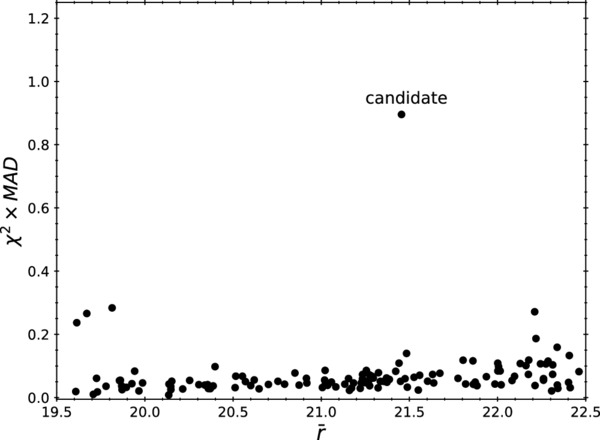
Figure 1. The values of χ2 × MAD as a function of mean r-band magnitudes for the SDSS DR16 stars with more than 10 data points on the LOT r-band light curves. A variable star candidate clearly stands out against the constant stars with χ2 × MAD ∼ 0.05. Three bright stars with  mag and χ2 × MAD ∼ 0.25 appear to be low-amplitude variable stars. However, based on their light curves and locations on the CMD, they are clearly not RR Lyrae, nor the interest of this work.
Download figure:
Standard image High-resolution image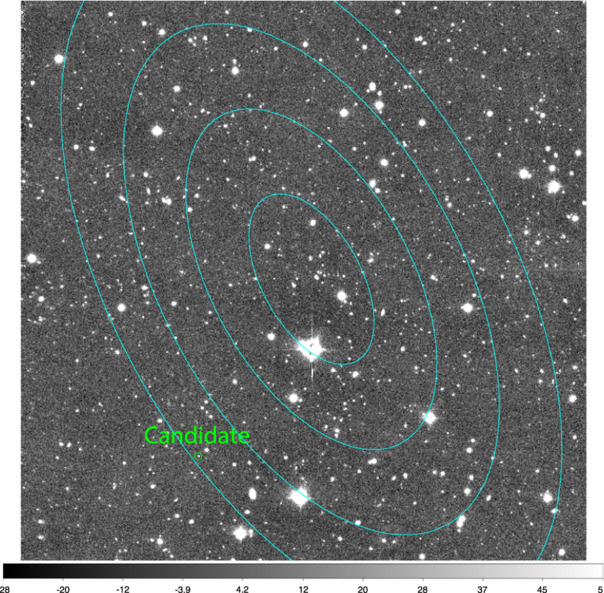
Figure 2. A coadded image by median-combined all of the LOT images using SWARP (E. Bertin et al. 2002). Location of the candidate variable star is also marked on the image. The cyan contours represent {1, 2, 3, 4} × rh (with parameters taken from W. Cerny et al. 2025).
Download figure:
Standard image High-resolution imageHowever, the brightness of this candidate variable star is ≳1 mag fainter than the expected brightness of RR Lyrae in Aquarius III (around r ∼ 20.2 mag). Nevertheless, by combining the LOT and archival light curves, we found that this candidate variable star is most likely a background RR Lyrae at a distance of ∼163 kpc. Details on the analysis of this candidate RR Lyrae can be found in the Appendix. Our dedicated search suggested there is no RR Lyrae associated with Aquarius III within its ∼4rh area (as covered by the LOT observations). On the other hand, E. A. Tau et al. (2024) shows that RR Lyrae for some of the UFD could be located beyond 4rh from the host galaxies. Hence, in the next subsection we extended our search to a larger area.
2.2. Based on Archival Photometric Data
Following the approach of E. A. Tau et al. (2024), we searched for known RR Lyrae within 16rh radius of Aquarius III from the PS1 3π RR Lyrae Catalog (B. Sesar et al. 2017) and the Gaia Data Release 3 (DR3; Gaia Collaboration et al. 2018, 2023) RR Lyrae Catalog (G. Clementini et al. 2023). An ab-type (or fundamental mode) RR Lyrae was identified at  away from Aquarius III, with a PS1 ID of 103753576326015348 or a Gaia DR3 ID of 2447369809479339136.
From Gaia DR3 catalog, the measured proper motion for this RR Lyrae is (μα*, μδ) = (0.923 ± 0.637, −0.549 ± 0.565) mas yr−1. This proper motion is consistent to the proper motion of Aquarius III reported in W. Cerny et al. (2025), with  . Furthermore, the extinction-corrected mean r-band magnitude for this RR Lyrae, reported in the PS1 3π RR Lyrae Catalog (B. Sesar et al. 2017), is 20.05 mag,3
consistent with the expected brightness of a RR Lyrae at the distance of Aquarius III. Therefore, this RR Lyre could be a RR Lyrae of Aquarius III.
. Furthermore, the extinction-corrected mean r-band magnitude for this RR Lyrae, reported in the PS1 3π RR Lyrae Catalog (B. Sesar et al. 2017), is 20.05 mag,3
consistent with the expected brightness of a RR Lyrae at the distance of Aquarius III. Therefore, this RR Lyre could be a RR Lyrae of Aquarius III.
We retrieved the gri-band light curves for this RR Lyrae from the PS1 Data Release 24 (PS1DR2; STScI Collaboration 2022) archive5 and the Zwicky Transient Facility (ZTF, E. C. Bellm et al. 2019; M. J. Graham et al. 2019) Data Release 226 (ZTFDR22). Note that the ZTF photometry has been calibrated to the PS1 system (F. J. Masci et al. 2019), hence both sets of light curves are in the same AB photometric system. The numbers of data points in the g/r/i band retrieved from PS1DR2 and ZTFDR22 are 15/22/19 and 211/225/39, respectively. Using the multiband periodogram subroutines from the gatspy (J. T. VanderPlas & Ž. Ivezić 2015) python package, we refined the pulsation period (P) of this RR Lyrae to be P = 0.648708 day, which is slightly shorter than the period reported in the PS1 3π RR Lyrae Catalog (P = 0.648710 day) or the Gaia DR3 RR Lyrae Catalog (P = 0.648712 day). Figure 3 presents the gri-band light curves folded with our refined period.
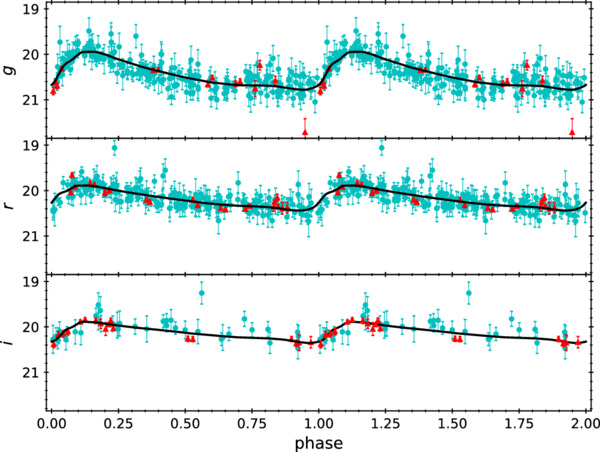
Figure 3. The gri-band phased light curves for the potential RR Lyrae identified in Section 2.2. The cyan filled circles and red triangles are the data points retrieved from ZTFDR22 and PS1DR2, respectively. The black curves are the best-fit template light curves derived in V. F. Braga et al. (2024).
Download figure:
Standard image High-resolution imageBy fitting a set of template light curves derived in V. F. Braga et al. (2024)7
to the observed gri-band light curves shown in Figure 3, the gri-band mean magnitudes are found to be 20.446 ± 0.009 mag, 20.192 ± 0.007 mag, and 20.134 ± 0.014 mag, respectively. We have also fit the gr-band light curve using the eighth-order Fourier expansion (in sine series) to derive the Fourier parameter ϕ31(=ϕ3 − 3ϕ1), as  rad and
  rad. Together with the gr-band [Fe/H]–P–ϕ31 relations derived in C.-C. Ngeow (2022), the photometric metallicity for this RR Lyrae was found to be −2.16 ± 0.24 dex and −2.60 ± 0.30 dex, based on the gr-band light curves, respectively. Averaging these two metallicities we obtained −2.38 ± 0.39 dex for this RR Lyrae, where the error is based on small number statistics (E. S. Keeping 1962). This photometric metallicity is consistent with the spectroscopic metallicity of Aquarius III (−2.61 ± 0.21 dex; W. Cerny et al. 2025).
With the period, photometric metallicity, and mean magnitudes obtained from the multiband light curves, we derived the distance to this RR Lyrae using the period–Wesenheit–metallicity (PWZ) relations found in C.-C. Ngeow et al. (2022). We prefer to use the PWZ relations because the Wesenheit magnitude is extinction-free by construction (B. F. Madore & W. L. Freedman 1991). The derived distance moduli using the gr band, the ri band, and the gi-band, the PWZ relations are 19.60 ± 0.21 mag, 19.83 ± 0.16 mag, and 19.73 ± 0.16 mag, respectively. Averaging out these distance moduli we obtained 19.72 ± 0.14 mag (the error is based on the small number statistics), which translates to a linear distance of 87.9 ± 5.7 kpc.8 Again, this distance is fully consistent with the distance of Aquarius III (85 ± 4 kpc; W. Cerny et al. 2025).
Since the distance, proper motion, and metallicity of this RR Lyrae are all consistent with Aquarius III, we concluded this RR Lyrae is the first RR Lyrae associated with Aquarius III. We propose renaming this RR Lyrae as Aquarius III-V1. The ultimate confirmation of its membership has to wait for the (multiepoch) radial velocity measurements.
3. The Synthetic CMD
Using LOT, which has a relatively small FOV, we found three RR Lyrae in Virgo III (C.-C. Ngeow & A. Bhardwaj 2024) but none in Aquarius III (Section 2.1). As discussed in Section 2.2, Aquarius III indeed has a RR Lyrae but located quite far from Aquarius III. On the other hand, C.-C. Ngeow & A. Bhardwaj (2025) pointed out that for UFD with MV ≳ −5.0 mag, the chance of a UFD to have at least one RR Lyrae is about half. This motivated us to investigate the detectability of RR Lyrae in UFD for those UFD with similar properties to Virgo III and Aquarius III. The BaSTI (a Bag of Stellar Tracks and Isochrones; A. Pietrinferni et al. 2021) suite of tools include a web interface9 to generate synthetic CMD for a set of user-specific parameters. Furthermore, the output of BaSTI synthetic CMD can include the number of pulsating stars, such as RR Lyrae and Cepheids, if there are synthetic stars falling within the theoretical instability strip (for more details, see A. Pietrinferni et al. 2021).
Using this BaSTI online tool, we generated 100 synthetic CMD with properties similar to Virgo III and Aquarius III (see Table 1). Specifically, we adopted the α-enhanced models, helium abundance of Y = 0.247, the normalize star-formation rate (SFR) of 1, age of 13 Gyr, metallicity of −2.4 dex (the mid-point value of Virgo III and Aquarius III), and using the P. Kroupa et al. (1993) initial mass function. For simplicity, we assume no metallicity spread and no binary fraction on these synthetic CMD. We set the low-mass limit to be 0.6 M⊙, because this mass is approaching the lower limit for RR Lyrae. The only parameter we altered is the SFR scale (the number of stars per age-bin, between 1300 and 1400) such that the resulted synthetic CMD has a total stellar mass of ∼2000 M⊙, and its MV is between ∼−2.8 mag and ∼−2.4 mag. From these set of 100 synthetic CMD, there are 27 and 7 of them have one and two RR Lyrae, respectively. Examples of (randomly selected) two synthetic CMD with and without RR Lyrae are shown in Figure 4. This suggested UFD with MV similar to Virgo III and Aquarius III has a nonnegligible probability to host RR Lyrae.
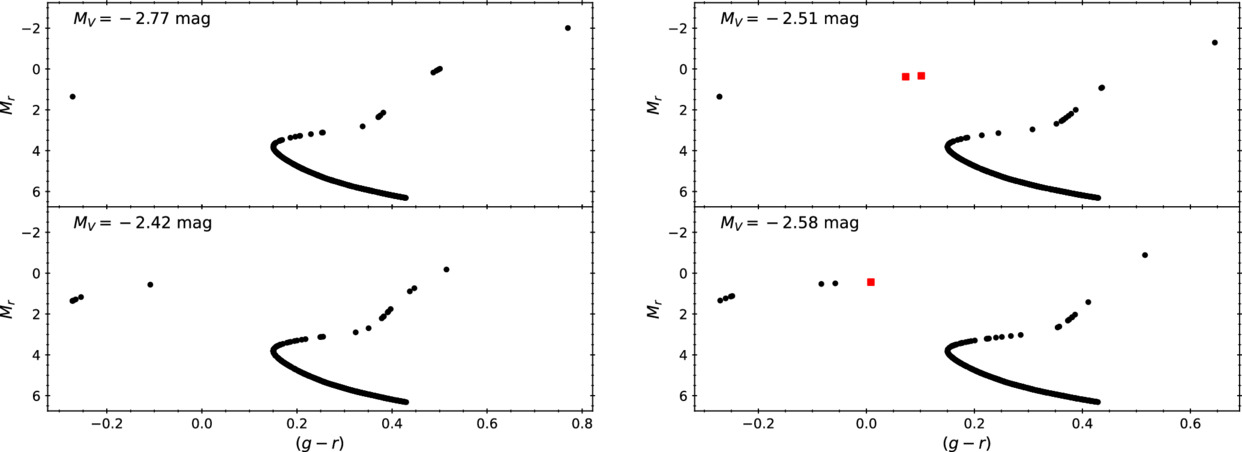
Figure 4. Two examples of the synthetic CMD without (left panels) and with (right panels; shown as red squares) RR Lyrae. These synthetic CMD were constructed using the BaSTI web tool, which also provide the identification of RR Lyrae from the synthetic stars. These four synthetic CMD have a slightly different input SFR scales and resulted a different MV (see text for more details).
Download figure:
Standard image High-resolution image4. Conclusion
The main goal of our work is to search for RR Lyrae associated with Aquarius III UFD. Using the LOT time-series observations, we identified a candidate RR Lyrae with projected angular distance of ∼4rh away from Aquarius III. However, this candidate RR Lyrae turned out to be a background halo star. Instead, a search on a larger area using the public RR Lyrae catalogs, we identified one known RR Lyrae who distance, metallicity, and proper motion are all consistent with Aquarius III. Therefore, this RR Lyrae, Aquarius III-V1, is the first RR Lyrae of Aquarius III despite it is located at a projected distance of ∼15.6rh from Aquarius III. We have also ran a set of synthetic CMD, and found that UFD with properties similar to Aquarius III (and Virgo III) has a nonnegligible probability to host (at least one) RR Lyrae. This finding encourages the search of RR Lyrae in other newly discovered UFD.
Acknowledgments
We are thankful for funding from the National Science and Technology Council (NSTC, Taiwan) under the grant 113-2112-M-008-028. We sincerely thank the observing staff at the Lulin Observatory, C.-S. Lin, H.-Y. Hsiao, and W.-J. Hou, for carrying out the queue observations for this work. We thank Z.-Y. Lin and Y.-C. Pan for sharing some of the LOT time. This publication has made use of data collected at Lulin Observatory, partly supported by NSTC grant 109-2112-M-008-001. This research has made use of the SIMBAD database and the VizieR catalog access tool, operated at CDS, Strasbourg, France. This research made use of Astropy,10 a community-developed core Python package for Astronomy (Astropy Collaboration et al. 2013, 2018, 2022).
This work has made use of data from the European Space Agency (ESA) mission Gaia11 , processed by the Gaia Data Processing and Analysis Consortium (DPAC).12 Funding for the DPAC has been provided by national institutions, in particular the institutions participating in the Gaia Multilateral Agreement.
The Pan-STARRS1 Surveys (PS1) and the PS1 public science archive have been made possible through contributions by the Institute for Astronomy, the University of Hawaii, the Pan-STARRS Project Office, the Max-Planck Society and its participating institutes, the Max Planck Institute for Astronomy, Heidelberg and the Max Planck Institute for Extraterrestrial Physics, Garching, The Johns Hopkins University, Durham University, the University of Edinburgh, the Queen’s University Belfast, the Harvard-Smithsonian Center for Astrophysics, the Las Cumbres Observatory Global Telescope Network Incorporated, the National Central University of Taiwan, the Space Telescope Science Institute, the National Aeronautics and Space Administration under grant No. NNX08AR22G issued through the Planetary Science Division of the NASA Science Mission Directorate, the National Science Foundation grant No. AST-1238877, the University of Maryland, Eotvos Lorand University (ELTE), the Los Alamos National Laboratory, and the Gordon and Betty Moore Foundation.
Funding for the Sloan Digital Sky Survey IV has been provided by the Alfred P. Sloan Foundation, the U.S. Department of Energy Office of Science, and the Participating Institutions. SDSS acknowledges support and resources from the Center for High-Performance Computing at the University of Utah. The SDSS website is www.sdss4.org.
SDSS is managed by the Astrophysical Research Consortium for the Participating Institutions of the SDSS Collaboration including the Brazilian Participation Group, the Carnegie Institution for Science, Carnegie Mellon University, Center for Astrophysics ∣ Harvard & Smithsonian (CfA), the Chilean Participation Group, the French Participation Group, Instituto de Astrofísica de Canarias, The Johns Hopkins University, Kavli Institute for the Physics and Mathematics of the Universe (IPMU) / University of Tokyo, the Korean Participation Group, Lawrence Berkeley National Laboratory, Leibniz Institut für Astrophysik Potsdam (AIP), Max-Planck-Institut fur Astronomie (MPIA Heidelberg), Max-Planck-Institut für Astrophysik (MPA Garching), Max-Planck-Institut für Extraterrestrische Physik (MPE), National Astronomical Observatories of China, New Mexico State University, New York University, University of Notre Dame, Observatório Nacional / MCTI, The Ohio State University, Pennsylvania State University, Shanghai Astronomical Observatory, United Kingdom Participation Group, Universidad Nacional Autónoma de México, University of Arizona, University of Colorado Boulder, University of Oxford, University of Portsmouth, University of Utah, University of Virginia, University of Washington, University of Wisconsin, Vanderbilt University, and Yale University.
Based on observations obtained with the Samuel Oschin Telescope 48-inch and the 60-inch Telescope at the Palomar Observatory as part of the Zwicky Transient Facility project. ZTF is supported by the National Science Foundation under grants Nos. AST-1440341 and AST-2034437 and a collaboration including current partners Caltech, IPAC, the Oskar Klein Center at Stockholm University, the University of Maryland, University of California, Berkeley, the University of Wisconsin at Milwaukee, University of Warwick, Ruhr University, Cornell University, Northwestern University and Drexel University. Operations are conducted by COO, IPAC, and UW.
Facilities: LO:1m - , Gaia - , PO:1.2m - Palomar Observatory's 1.2 meter Samuel Oschin Telescope, PS1 - Panoramic Survey Telescope and Rapid Response System Telescope #1 (Pan-STARRS), Sloan - Sloan Digital Sky Survey Telescope.
Software: astropy (Astropy Collaboration et al. 2013, 2018, 2022), dustmaps (G. M. Green 2018), gatspy (J. T. VanderPlas & Ž. Ivezić 2015), Matplotlib (J. D. Hunter 2007), NumPy (C. R. Harris et al. 2020), PSFEx (E. Bertin 2011), SCAMP (E. Bertin et al. 2006), Source-Extractor (E. Bertin & S. Arnouts 1996), SWARP (E. Bertin et al. 2002).
Appendix: Identifying a Background RR Lyrae Candidate
The SDSS DR16 objID for the candidate variable star found in Section 2.1 is 1237679433443508701, which only contains 13 LOT r-band data points (because the brightness of this star is approaching the detection limit of our LOT observations). As a result, we supplemented the available multiband light curves from the PS1DR2 archive with 5/14/8 data points in the g/r/i band, respectively. We further included the single-epoch gri-band data taken from the SDSS DR16. We have transformed the SDSS photometry to the PS1 photometric system using the transformation provided in J. L. Tonry et al. (2012), such that all photometry are in the same PS1 photometric system. We excluded the ZTFDR22 light curves, with 8/24/0 data points, because they are noisy with large photometric errors (in the order of ∼0.2 mag).
We searched the period for this candidate variable star using the multiband RR Lyrae template light curve fitting algorithm available in the gatspy (J. T. VanderPlas & Ž. Ivezić 2015) python package. By restricting the period range between 0.2 and 0.9 day (appropriate for RR Lyrae), we obtained a period of 0.510254 day using the gri-band light curves, indicating this star could be an ab-type (or fundamental mode) RR Lyrae.
The left panels of Figure 5 present the folded gri-band light curves for this candidate variable star. We then fit the observed light curves using the RR Lyrae template light curves available from V. F. Braga et al. (2024), by setting the mean magnitudes and amplitudes as free parameters. It turned out the template light curves fit poorly on the g- and the i-band data, as indicates by the dotted curves shown in the left panels of Figure 5. In contrast, the template light curve fit the r-band data points well, giving a mean magnitude of 21.496 ± 0.023 mag and an amplitude of 0.699. Therefore, we fixed the gi-band amplitudes by using the g-to-r and r-to-i amplitude ratios as derived in C.-C. Ngeow et al. (2022), and only fitting the mean magnitudes with the template light curves. The improvement of the fitted gi-band template light curves, displayed as solid curves in the left panels of Figure 5, can be clearly seen. The mean magnitudes in the gi-band were then found to be 21.720 ± 0.057 mag and 21.314 ± 0.066 mag, respectively.
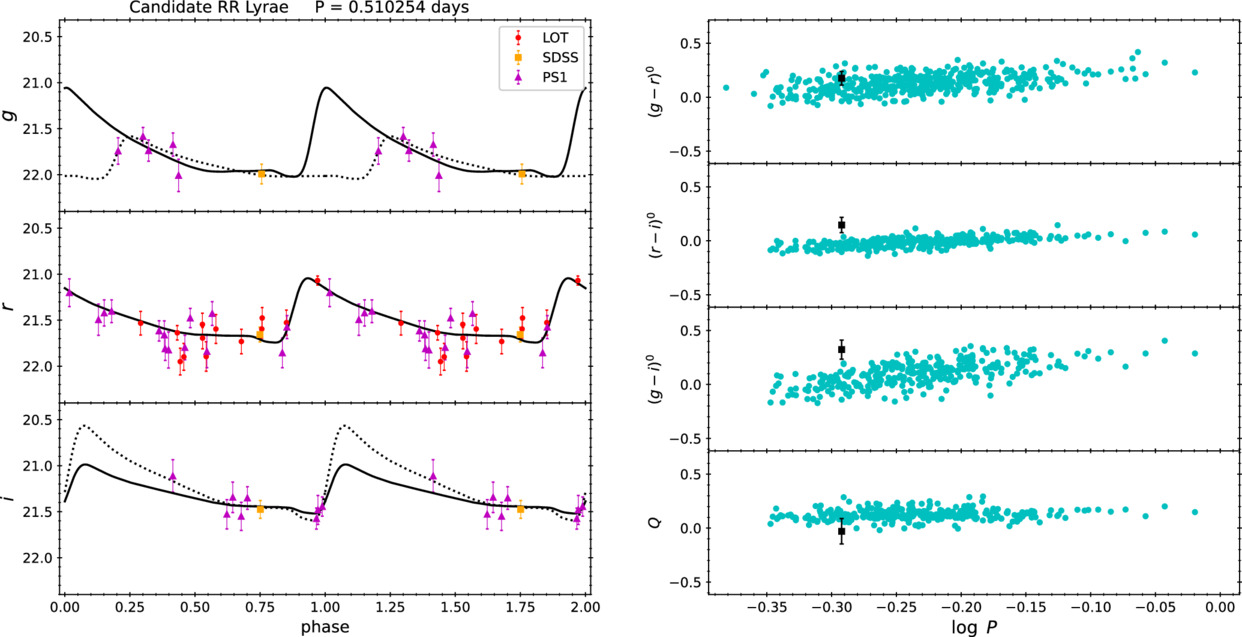
Figure 5. Left panel: folded light curves for the candidate variable star assuming it is an ab-type RR Lyrae. The dotted curves are the poorly fit template light curves by setting the amplitudes as a free parameter (in addition to the mean magnitude). In contrast, the solid curves are the best-fit template light curves by setting the amplitude either as a free parameter (in the r band) or as a fixed parameter (in the gr band; see text for more details). Right panel: comparison of the extinction-corrected colors and the reddening-free Q-index for the candidate variable star to the ab-type RR Lyrae in the globular clusters (cyan points; adopted from C.-C. Ngeow et al. 2022). The foreground extinction for this candidate variable star was obtained from using the Bayerstar2019 3D reddening map (G. M. Green et al. 2019), together with the dustmaps (G. M. Green 2018) code, which returned an extinction value of 0.054 ± 0.004 mag.
Download figure:
Standard image High-resolution imageWith the determined period and mean magnitudes, we compare the extinction-corrected colors of this candidate variable star to the ab-type RR Lyrae in the globular clusters (adopted from C.-C. Ngeow et al. 2022), assuming this candidate variable star is an ab-type RR Lyrae. In addition, we have also included the reddening-free Q-index (C.-C. Ngeow et al. 2022), defined as Q = (g − r) − 1.395(r − i), in such comparison. Except the (g − r) color, other colors and the Q-index for this star are marginally agree to the RR Lyrae in the globular clusters, as shown in the right panels of Figure 5. This could due to fixing the amplitudes in the gi-band while fitting the template light curves, and hence affecting the determination of the mean magnitudes.
Based on the extinction-corrected r-band mean magnitude, and assumed this candidate variable star has the same metallicity as Aquarius III ([Fe/H] = −2.61 dex, W. Cerny et al. 2025), we obtained a distance modulus of 21.06 ± 0.19 mag by using the r-band period–luminosity–metallicity relation derived in C.-C. Ngeow et al. (2022). This distance modulus corresponding to a distance of 163.1 ± 14.2 kpc, placing this candidate RR Lyrae as a background halo star. We did not derive the distance modulus in the gi-band, nor using the extinction-free Wesenheit magnitudes, because of their less accurate mean magnitudes.
Footnotes
- 3
Note that all of the mean magnitudes in the PS1 3π RR Lyrae Catalog have been corrected for the extinction, using the dust map from E. F. Schlafly et al. (2014); for more details, see B. Sesar et al. (2017). Specifically, the dust map returned a E(B − V) = 0.078 mag for this RR Lyrae. The corresponding mean magnitude without the extinction correction is 20.23 mag.
- 4
- 5
The API to access the PS1DR2 data is given at https://ps1images.stsci.edu/ps1_dr2_api.html.
- 6
- 7
The fitting subroutines are available at https://github.com/vfbraga/RRL_lcvtemplate_griz_LSST/tree/main.
- 8
Oddly, the parallax listed in the Gaia DR3 Catalog is 1.4323 mas, a value that is too large at the distance of Aquarius III.
- 9
- 10
- 11
- 12