Abstract
PSR J1813–1749 has peculiarities that make it a very interesting object of study. It is one of the most energetic and the most scattered pulsars known. It is associated with HESS J1813–178, one of the brightest and most compact TeV sources in the sky. Recently, Ho et al. used archival X-ray Chandra observations separated by more than 10 yr and determined that the total proper motion of PSR J1813–1749 is ∼66 mas yr−1, corresponding to a velocity of ∼1900 km s−1 for a distance of 6.2 kpc. These results would imply that this pulsar is the fastest neutron star known in the Galaxy and, by estimating the angular separation with respect to the center of the associated supernova remnant, has an age of only ∼300 yr, making it one of the youngest pulsars known. Using archival high angular resolution VLA observations taken over 12 yr we have estimated the radio proper motions of PSR J1813–1748 to be much smaller: ( ) = (−5.0 ± 3.7, −13.2 ± 6.7) mas yr−1, or a total proper motion of 14.8 ± 5.9 mas yr−1. The positions referenced against quasars make our results reliable. We conclude that PSR J1813–1749 is not a very fast moving source. Its kinematic age using the new total proper motion is ∼1350 yr. This age is consistent within a factor of a few with the characteristic age of the pulsar and with the age estimated from the broadband spectral energy distribution of HESS J1813–178, as well as the age of the associated supernova remnant.
Original content from this work may be used under the terms of the Creative Commons Attribution 4.0 licence. Any further distribution of this work must maintain attribution to the author(s) and the title of the work, journal citation and DOI.
1. Introduction
PSR J1813–1749 (=CXOU J181335.1−174957) is the most scattered and the second most energetic pulsar in the Milky Way (Halpern et al. 2012; Camilo et al. 2021). First discovered and characterized using Chandra X-ray observations (Gotthelf & Halpern 2009; Halpern et al. 2012), it has a spin-down rate of  , corresponding to a spin-down luminosity of
  erg s−1, values only below those measured for the Crab pulsar (e.g., Halpern et al. 2012).
First attempts to detect the radio pulsed emission at low frequencies (1–2 GHz) from this pulsar failed (Helfand et al. 2007; Halpern et al. 2012; Dzib et al. 2018). Recently, Camilo et al. (2021) finally detected the pulsed radio emission at higher frequencies (4–10 GHz) and showed that the pulses are highly scattered. The fact that the scattering is more severe at lower frequencies probably explains the early failed attempts to detect the radio pulsed emission. Camilo et al. (2021) show that the pulsed emission is consistent with the radio continuum source detected by Dzib et al. (2010) and Dzib et al. (2018) with the Karl G. Jansky Very Large Array (VLA) at similar frequencies. Based on the high column density at X-rays and the large dispersion measure, Camilo et al. (2021) also place a lower limit to its distance of 6.2 kpc, that could be as large as 12 kpc.
The young and relatively compact (∼2′ diameter) shell-type radio supernova remnant (SNR) G12.82–0.02 (Brogan et al. 2005) and pulsar wind nebula (PWN) observed at X-rays (Funk et al. 2007; Helfand et al. 2007; Gotthelf & Halpern 2009) have been associated to PSR J1813–1749. SNR G12.82–0.02 and the PWN are associated with one of the brightest and most compact objects discovered by the HESS Galactic Plane Survey (Aharonian et al. 2005), the TeV source HESS J1813–178. This HESS source has been associated with continuum high-energy emission from X-rays to gamma rays (Ubertini et al. 2005; Albert et al. 2006; Reimer et al. 2008; Abdo et al. 2009).
Recently, using archival X-ray observations, Ho et al. (2020) determined large proper motions for PSR J1813–1749 of ( ) = (−64 ± 9, −14 ± 7) mas yr−1. As the pulsar is at an angular distance of ∼20″ from the center of the SNR G12.82–0.02 the large proper motions would indicate a young age of around 300 yr, making it one of the youngest pulsars known. This age, while consistent at the lower end of the age range of 285–2500 yr for SNR G12.82–0.02 (Brogan et al. 2005), is, however, in conflict with the age estimated for HESS J1813–178 of 2500 yr (Zhu et al. 2018) and the characteristic age of the pulsar of 5600 yr (Halpern et al. 2012). As discussed by Camilo et al. (2021), the total proper motion of ∼66 mas yr−1 would imply a tangential velocity of the order of 2000 km s−1 at 6.2 kpc, the lower limit of the distance. This velocity is larger than that of any well-measured velocity for a neutron star (see Deller et al. 2019). The total proper motion of PSR J1814–1749 is an interesting subject to study, and in this paper we present the proper motions measured with archival high angular resolution observations taken with the VLA by us and by other groups.
2. VLA Observations
For our astrometric study we looked for VLA observations with high angular resolution. The VLA provides the finest angular resolution in its most extended configurations A and B. We also restricted our search to the C band (4–8 GHz) and X band (8–12 GHz), which provide the best sensitivity, and where PSR J1813–1749 has been previously detected. For the best astrometry it is also recommended that the observations are phase referenced to the same quasar (gain calibrator), as this provides nearly absolute astrometry.
We found two observational campaigns with all the above criteria and where the target source has been detected. These observations have been previously reported by Dzib et al. (2010) and Dzib et al. (2018). The first is one observation done in 2006 with the historical VLA at 4.86 GHz, using the A configuration, under project AL673. The second, includes a series of 12 observations, 5 centered at a main frequency of 6.0 GHz and 7 at 10.0 GHz that were made as part of project 17B-028. The observations were done in the B configuration covering the period from 2017 September to 2018 February. We also found a third observational campaign done in 2012 October under project 12B-278, at the mean frequency of 9.0 GHz, using the VLA in its A configuration. However, this third campaign used a different gain calibrator. In Section 2.1 we discuss how we corrected for this limitation. All observations were calibrated and imaged using the CASA software. Positions were determined from the image using the CASA task imfit. Fluxes and other emission properties were already given and discussed by Dzib et al. (2010) and Dzib et al. (2018), and in this work we focus on the astrometry. Basic properties of the image and position of the target source over time are listed in Table 1 and examples of the maps are shown in Figure 1.
Table 1. Image Results and Positions of PSR J1813−1749
| Epoch | ν | VLA | Gain | Beam size | Noise | R.A. (J2000) | Decl. (J2000) |
|---|---|---|---|---|---|---|---|
| (yyyy.mm.dd) | (GHz) | Conf. | Calibrator | (″ × ″; ° ) | (μJy bm−1) | (18h13m) | (−17°49′) |
| (1) | (2) | (3) | (4) | (5) | (6) | (7) | (8) |
| 2006 Feb 25 | 4.8 | A | J1811–2055 | 0.77 × 0.41; −9 | 19 | 35 | 57 |
| 2012 Oct 05 a | 9.0 | A | J1733-1304 | 0.45 × 0.22; 19 | 11 | 35 | 57 |
| 2017 Sept 18 | 6.0 | B | J1811–2055 | 1.51 × 0.74; 15 | 8 | 35 | 57 |
| 2017 Sept 18 | 10.0 | B | J1811–2055 | 0.95 × 0.46; 18 | 6 | 35 | 57 |
| 2017 Dec 11 | 6.0 | B | J1811–2055 | 1.74 × 0.77; 33 | 9 | 35 | 57 |
| 2017 Dec 11 | 10.0 | B | J1811–2055 | 1.18 × 0.49; 35 | 7 | 35 | 57 |
| 2018 Jan 8 | 6.0 | B | J1811–2055 | 1.49 × 0.77; 23 | 7 | 35 | 57 |
| 2018 Jan 8 | 10.0 | B | J1811–2055 | 0.98 × 0.47; 26 | 7 | 35 | 57 |
| 2018 Jan 13 | 6.0 | B | J1811–2055 | 1.76 × 0.76; 32 | 8 | 35 | 57 |
| 2018 Jan 13 | 10.0 | B | J1811–2055 | 1.19 × 0.47; 35 | 8 | 35 | 57 |
| 2018 Jan 21 | 10.0 | B | J1811–2055 | 1.40 × 0.51; 31 | 7 | 35 | 57 |
| 2018 Jan 28 | 6.0 | B | J1811–2055 | 1.44 × 0.77; 16 | 7 | 35 | 57 |
| 2018 Jan 28 | 10.0 | B | J1811–2055 | 0.93 × 0.48; 21 | 6 | 35 | 57 |
| 2018 Feb 4 | 10.0 | BnA | J1811–2055 | 1.16 × 0.25; −57 | 8 | 35 | 57 |
Note.
a Data averaged from the two observed dates: 2012 October 4 and October 6. The given position for this epoch is already corrected for the systematic offset discussed in Section 2.1.Download table as: ASCIITypeset image
2.1. Astrometric Correction for the 2012 Observations
The observations of 2006 and 2017–18 were made with the same gain calibrator (J1811−2055). This typically assures an astrometric precision of order ≃001 for the case of observations made at centimeter wavelengths in the A configuration (Boboltz et al. 2007; Perreault 2019). We can estimate from our data the expected precision as follows. We will use the 10 determinations of position given in Table 1 for the epochs between 2017 December 11 and 2018 February 4. Over this brief period of time we do not expect significant proper motions. The positional error scales linearly with the angular size of the synthesized beam. Since all these observations were made in the B configuration we expect positional errors about three times larger than in A configuration, that is, about 30 mas. Furthermore, since this is a southern source, we expect the beam size to be about twice bigger in decl. that in R.A. (see values in Table 1). We indeed find that the rms errors in R.A. and decl. for these 10 observations are 31.8 and 63.8 mas, respectively, approximately as expected. We conclude that the positional error is given approximately by the angular size of the synthesized beam over 20, that is θ/20.
We were very interested in using the 2012 observations of project 12B−278 to derive a measurement intermediate in time. However, these observations used a different gain calibrator (J1733−1304) and this can introduce systematic position errors of order ≃01 or more unless a correction is applied to the positions. The 12B−278 observations were made during 2012 October 04 and 06 and we concatenated the data for an average epoch of 2012.762. The observations were made in the A configuration in band X (8.0–10.0 GHz), with 16 spectral windows of 128 MHz width each.
The final images of the two epochs of project 12B-278 and the 5 C-band epochs of project 17B-028 were compared. In addition to the source associated with PSR J1813−1749 we found five compact sources in common that are also detected in the Gaia survey (Gaia Collaboration et al. 2016, 2021). The highly accurate Gaia positions and proper motions of these five sources are given in Table 2. We corrected the radio positions of these sources with the Gaia proper motions and used them to determine a systematic offset between the positions obtained in the 17B-028 and 12B-278 projects. This offset (17B-028–12B-78) is ΔR.A. = 00110 ± 0
0091; Δdecl. = −0
035 ± 0
125. After adding this offset to the positions of the 12B−278 project, we obtain a final position for PSR J1813−1749 at this epoch:


We note that the error in the final position is dominated by the offset correction applied.
Table 2. Gaia Sources Used to Correct the Astrometry of the 12B-078 Positions a
| Source | Type | R.A. (J2000) | Decl. (J2000) |

| μδ |
|---|---|---|---|---|---|
| (1) | (2) | (3) | (4) | (5) | (6) |
| CXOUJ181314.2–175343 | Wolf-Rayet | 18h13m14 | −17°53′43″46 | −0.91 ± 0.07 | −1.99 ± 0.05 |
| 2MASSJ18131908–1752585 | O8-O9If | 18h13m19 | −17°52′58″49 | −1.11 ± 0.13 | −1.81 ± 0.10 |
| (MFD2008) 15 | LBV | 18h13m20 | −17°49′47″02 | −0.57 ± 0.07 | −1.98 ± 0.06 |
| CXOUJ181322.4–175350 | Wolf-Rayet | 18h13m22 | −17°53′50″32 | −0.78 ± 0.07 | −2.08 ± 0.05 |
| UCAC2 25154559 | B0-B3 star | 18h13m24 | −17°52′56″78 | −0.85 ± 0.06 | −2.16 ± 0.05 |
Note.
a Positions and proper motions are from the Gaia eDR3 data release (Gaia Collaboration et al. 2021). The positions of Gaia are accurate to 1 mas or better. The proper motions are given in mas yr−1.Download table as: ASCIITypeset image
3. Results
We have performed linear least square fits to the positions of PSR J1813–1749, listed in Table 1, to determine its proper motions. The values obtained are ( ) = (−5.0 ±3.7, −13.2 ± 6.7) mas yr−1. The positions of PSR 1813–1749 as a function of time, and the best fit to its motion are shown in Figure 2.
4. Discussion and Conclusions
The proper motions of PSR J1813–1749 determined from the X-ray observations are ( ) =(−64 ± 9, −14 ± 7) mas yr−1. By comparing them with our results, we clearly notice a difference in the R.A. being at radio significantly smaller. Proper motions measured at radio have a major advantage over the X-ray measurements, that is, that the positions are registered against highly accurate positions measured for quasars. The observations presented in this work also have a somewhat larger time baseline, 12 yr, than that of the X-ray observations presented by Ho et al. (2020) of 10 yr. This difference does not seem too significant, but it should be emphasized that the accuracy of proper motion determinations improves as the time interval to the 3/2 power (Dzib et al. 2017). The motions reported at X-rays would be evident, between the first and last radio observations, in position offsets of −0
80 = 0
05 and −0
17 in R.A. and decl., respectively. The offset in R.A. is clearly not present, see also Figure 1.
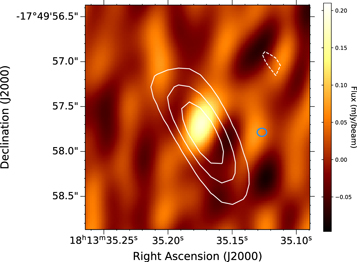
Figure 1. Background: VLA image of PSR J1813–1749 as observed in February 2006. Contours: PSR J1813–1749 as observed in 2017 December at X band. Contour levels are −3, 3, 6, and 9 times 7 μJy beam−1, the noise level on this epoch. The blue ellipse indicates the expected position of the radio source in 2017 December, following the proper motion measured by Ho et al. (2020); the ellipse semimajor axis sizes consider the propagated errors.
Download figure:
Standard image High-resolution imageThe large proper motion has also been questioned given the strong implications for the nature of the pulsar since it implies a young kinematic age and a fast tangential velocity larger than any other known pulsar (see also the discussion by Camilo et al. 2021).
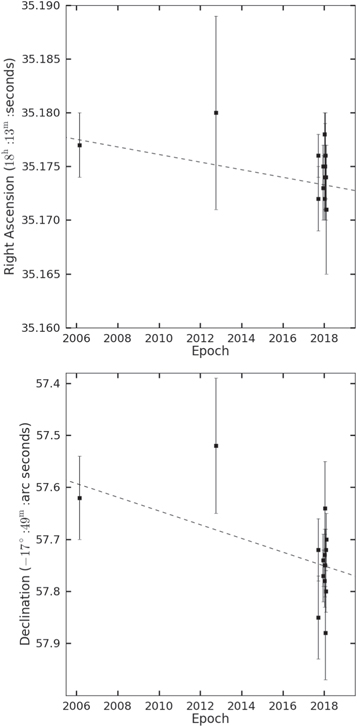
Figure 2. R.A. (top) and decl. (bottom) of the PSR J1813–1749 radio emission as a function of time. The dashed lines are least-squares linear fits to the data. The parameters of the fits are given in the text.
Download figure:
Standard image High-resolution imageBoth radio and X-ray emission are tracing the pulsar itself or material very close to it. However, given the discussion above, the measured motions at radio frequencies appear to be more reliable. We believe that most of the position shift in the X-ray image could be due to a change in the brightness structure of the PWN very near the pulsar, a possibility mentioned by Ho et al. (2020). Such structure changes have been observed in the Crab pulsar nebula (Weisskopf et al. 2011).
The total proper motion of PSR J1813–1749 from the radio is 14.8 ± 5.9 mas yr−1. The lower limit of the distance to PSR J1813–1749 is 6.2 kpc and can be as large as 12.0 kpc. Then, the tangential velocity ranges from 435 ± 174 km s−1 to 842 ± 336 km s−1. These velocities are in the range of velocities estimated for other pulsars (i.e., Deller et al. 2019). It should be noted that the error in the proper motion is large enough to accept a stationary pulsar as a possible solution.
As noted by Ho et al. (2020), PSR J1813–1749 is offset about 20″ from the center of the SNR G12.82–0.02 (see also Figure 1 in Dzib et al. 2018). To reach this shift the kinematic age of the pulsar is  yr. This age discards that this is a very young pulsar and it is in better agreement with the ages estimated for the pulsar of 5600 yr (Halpern et al. 2012) and for HESS J1813–178 of 2500 yr (Zhu et al. 2018) and for SNR G12.82–0.02 (Brogan et al. 2005).
To calculate the kinematic age we have assumed that the original position of the exploding star was at the geometric center of the SNR. However, some SNRs have shown nonuniform expansion (e.g., Borkowski et al. 2014) and the geometric center of the present-day structure does not necessarily coincide with the center of the explosion.
VLA observations have proven to be an excellent tool to determine proper motions, and, in the case of PSR J1813–1749, are at the moment the best option. Even VLBI observations will have difficulties measuring a value for this source. The angular size of the radio source is estimated to be 0034 (Camilo et al. 2021) due to broadening from plasma scattering. The angular resolution of VLBA observations at 5 GHz is ∼0
004, so the source will be resolved. The total flux density of the source is ∼100 μJy (Dzib et al. 2018); if resolved very little flux density will fall in a synthesized beam and the emission will be hard to detect with standard VLBA observations. Furthermore, astrometry of resolved sources is problematic. To better constrain the proper motion of PSR J1813–1749, future VLA observations, as those presented here, will be required.
We thank an anonymous referee for valuable comments. L.F.R. acknowledges the financial support of DGAPA, UNAM (project IN108920), and CONACyT, México. The National Radio Astronomy Observatory is a facility of the National Science Foundation operated under cooperative agreement by Associated Universities, Inc.
Facility: VLA - Very Large Array.
Software: CASA (McMullin et al. 2007).