Abstract
The Seyfert 1 galaxy NGC 7469 possesses a prominent nuclear starburst ring and a luminous active galactic nucleus (AGN). Evidence of an outflow in the innermost nuclear region has been found in previous works. We detect the ionized gas outflow on a larger scale in the galaxy using the archival Very Large Telescope/MUSE and Chandra observations. The optical emission lines are modeled using two Gaussian components, and a nonparametric approach is applied to measure the kinematics of [O iii] and Hα emitting gas. Line ratio diagnostics and spatially resolved maps are derived to examine the origin of the outflow. The kiloparsec-scale kinematics of [O iii] are dominated by a blueshifted component whereas the velocity map of Hα shows a rotational disk with a complex nonrotational substructure. The starburst wind around the circumnuclear ring is confirmed, and we find evidence of an AGN-driven outflow extending to a radial distance of ∼ 2 kpc from the nucleus, with a morphology consistent with a nearly face-on ionization cone. The previously reported circumnuclear outflow resembles part of the bright base. We derive mass and energy outflow rates for both the starburst wind and the AGN-driven outflow. The estimated kinetic coupling efficiency of the kiloparsec-scale AGN outflow is  , lower than the threshold predicted by the “two-stage” theoretical model for effective feedback. Our results reinforce the importance of spatially resolved study to disentangle feedback where AGNs and starbursts coexist, which may be common during the cosmic noon of black hole and galaxy growth.
Original content from this work may be used under the terms of the Creative Commons Attribution 4.0 licence. Any further distribution of this work must maintain attribution to the author(s) and the title of the work, journal citation and DOI.
1. Introduction
Galactic outflows are predicted by theoretical models of galaxy evolution and can be found in a variety of galaxies at different redshifts. They can be driven either by starburst processes or by an active galactic nucleus (AGN). It is generally expected that these outflows can have a profound impact on the environments and evolution of host galaxies by interacting with the interstellar and intergalactic medium (ISM and IGM, respectively). In a negative feedback scenario, outflows can heat and expel cold gas so that star formation (SF) will be suppressed by a shortage of gas supplies (e.g., Silk & Rees 1998; Hopkins et al. 2008; Fabian 2012; Silk & Mamon 2012). Alternatively some works have suggested that outflows can also trigger or enhance SF processes, known as positive feedback (e.g., Silk 2013; Zubovas & Bourne 2017).
Outflows driven by SF generally have higher impact in low-mass galaxies (e.g., Veilleux et al. 2005), which can prevent dwarf galaxies from forming and growing (e.g., Silk & Rees 1998; Silk & Mamon 2012). In nearby galaxies, especially in luminous and ultraluminous infrared galaxies (LIRGs and ULIRGs, respectively), and starburst galaxies, these outflows have been identified (e.g., Heckman et al. 2000; Rupke et al. 2005). On the other hand, outflows powered by AGNs, which can take the form of highly collimated jets or winds with larger opening angles, are believed to be the main conveyor of AGN feedback. Powerful jets produced by massive radio galaxies can heat and maintain the intracluster medium in the hot phase, which has been observed in several galaxy clusters (e.g., Fabian 2012). Strong AGN-driven outflows are usually found in luminous AGNs, where the supermassive black hole (SMBH) in the center of galaxies is in a high accretion state (e.g., Tombesi et al. 2015; Dall’Agnol de Oliveira et al. 2021).
Although unambiguous evidence of outflows driven by SF or AGNs has been found in observations, the exact physical processes and hence the ultimate impact on their host galaxies remains an open question. Spatially resolved and multiwavelength studies are becoming powerful in solving this issue over the years (e.g., Maksym et al. 2017; Wylezalek et al. 2017; Venturi et al. 2018; Mingozzi et al. 2019). In the optical and the X-ray band, extended narrow emission line regions in nearby Seyfert galaxies have been demonstrated to be a useful probe of outflows, jet-ISM collision, starburst, and/or AGN photoionization (e.g., Wang et al. 2009b, 2012b, 2014; Fabbiano et al. 2018). Warm ionized gas outflows ( ) traced by [O iii] and [N ii]+Hα are prevalent in AGNs and star-forming galaxies. Integral field spectroscopy (IFS) provides more detailed information such as spatial resolved kinematics, ionization structure, and morphology of ionized outflows, which enables better understanding of physical processes in outflows (e.g., Harrison et al. 2014; Wylezalek et al. 2017; Venturi et al. 2018; López-Cobá et al. 2020; Gao et al. 2021; Dall’Agnol de Oliveira et al. 2021).
NGC 7469 is a nearby (z = 0.01632; Keel 1996) Seyfert 1.5 (Véron-Cetty & Véron 2006) galaxy with the SMBH mass 1.1 × 10⁷ M⊙, measured by the latest reverberation mapping (Lu et al. 2021). This galaxy is classified as a LIRG due to its high IR luminosity (L8−1000 μm = 1011.6 L⊙; Sanders et al. 2003).
There exists a well-known circumnuclear starburst ring in NGC 7469 detected in almost all wavelengths (e.g., Izumi et al. 2020, and references therein), likely triggered by interaction with the companion IC 5283 galaxy ( away from NGC 7469). The outer and inner radii of this starburst ring are∼ 2
5 and ∼0
7, respectively (Genzel et al. 1995). Most star clusters in the ring are relatively young ( <30 Myr; Díaz-Santos et al. 2007). A circumnuclear disk (CND) with a radius of ∼150 pc (e.g., Davies et al. 2004; Izumi et al. 2015) is presented in the center of NGC 7469, previously studied as an X-ray dominated region produced by an AGN (Izumi et al. 2020). Davies et al. (2004) detected a bar or a pair of loosely wound spiral arms between the starburst ring and the CND based on the IRAM CO(2-1) data. Izumi et al. (2015) further suggested that these structures are possibly several spiral features according to a lacking corresponding stellar structure based on their Atacama Large Millimeter/submillimeter Array observations. In the radio, an unresolved compact source associated with the AGN and a ring emission originated from the starburst ring have been found by Wilson et al. (1991) using the Very Large Array. Further radio observations with high spatial resolutions have revealed a core-jet structure in the nuclear region on the subarcsecond scale (Lonsdale et al. 2003; Alberdi et al. 2006; Orienti & Prieto 2010). Such a small scale radio jet is commonly seen in other nearby radio-quiet Seyfert galaxies (e.g., Pedlar et al. 1993). No evidence of jet-ISM interaction was found for NGC 7469 in the literature.
In the X-ray and ultraviolet (UV), spatially unresolved AGN winds have been ubiquitously detected in absorption lines of highly ionized gas known as warm absorbers (e.g., Nandra & Pounds 1994). With a 160 ks XMM-Newton Reflection Grating Spectrometers (RGS) spectrum, Blustin et al. (2007) reported AGN winds with velocities of −580 to −2300 km s−1, which is consistent with previous UV observation (Scott et al. 2005). Later Behar et al. (2017) confirmed these results with a 640 ks RGS spectrum with velocities of −650 to −2050 km s−1, and they also found a collisionally ionized component at kT = 0.35 keV that they associated with the nuclear starburst ring since its luminosity was expected from far-infrared SF emission. Mehdipour et al. (2018) also reported AGN winds with velocities ranging from −400 to −1800 km s−1 using the Chandra HETGS. They also discovered diffuse soft (0.2–1 keV) X-ray emission extending up to 12″, which is consistent with coronal emission from a nuclear starburst ring in NGC 7469.
In the last century, Wilson et al. (1986) have reported that [O iii] emission lines in the circumnuclear region show strong, blueward-slanting profile asymmetries using long-slit mapping, which present nonrotational kinematics. Using the VLT/SINFONI IFS, Müller-Sánchez et al. (2011) detected a biconical outflow with a maximum velocity of ∼ 130 km s−1 and extending up to 380 ± 25 pc from the AGN, in the infrared coronal line [Si vi]λ1.96 μ
m. Cazzoli et al. (2020) did not report the biconical outflow in [N ii]+Hα using GTC/MEGARA but presented a nonrotational turbulent component possibly associated with an outflow. Recently, Robleto-Orús et al. (2021) have found evidence of two outflow components in the VLT/MUSE data. The slower component extends across most of the nuclear starburst ring with a median velocity of −284 km s−1, which is possibly driven by massive star-forming. The faster component with a median velocity of −581 km s−1, in the western region between the AGN and the starburst ring, is likely AGN-driven. Their work focused on only the bright innermost nuclear region of NGC 7469, whereas ionized gas on the larger scale (with radius r > 25) was unexplored possibly due to the lower signal-to-noise ratio (S/N) in those spaxels.
In this paper, we report galactic outflow features in NGC 7469 using the same Multi-Unit Spectroscopic Explorer (MUSE) data as Robleto-Orús et al. (2021), utilizing adaptive binning methods to improve the S/N. In Section 2, we describe the methodology including observations, data reduction, and the approach used to characterize emission lines. Main results including kinematics maps, ionization and excitation diagnostic diagrams and maps, and estimations of outflow rates are described in Section 3. Discussions and brief conclusions are presented in Section 4 and Section 5, respectively.
2. Observations and Data Analysis
2.1. MUSE Data
The MUSE (Bacon et al. 2010) is an IFS located at the Very Large Telescope (VLT) of the European Southern Observatory (ESO). In the wide field mode (WFM), MUSE provides a large field of view (FOV) of nearly 1 arcmin2 with spatial sampling of 02 pixel−1, and a wavelength coverage of 4650–9300 Å with a mean resolution of R ∼3000. NGC 7469 was observed in WFM-NOAO mode on 2014 August 19 during the science verification run with an exposure time of 2.4 ks and mean seeing of 1
23 (see also Galbany et al. 2016; Robleto-Orús et al. 2021).
We downloaded the processed data from the ESO Archive Science Portal 1 and fitted the data cube using the LZIFU pipeline (Ho et al. 2016), which is an IDL toolkit including the penalized pixel-fitting method (PPXF; Cappellari & Emsellem 2004) and the MPFIT routine that performs Levenberg–Marquardt least-squares minimization (Markwardt 2009). To cover the main emission lines in the optical band, for example, Hβ, [O iii]λ λ 4959,5007, Hα, [N ii]λ λ 6548,6583, and [S ii]λ λ 6716,6731, a fitting range of 4770–7550 Å was set. The redshift z = 0.01632 measured by Keel (1996) is used to correct the observed wavelength to the rest frame. Spaxels with mean S/N ≤ 1 (calculated from the spectrum between 5000 and 7000 Å) were excluded. We rebinned the remaining spaxels using the Voronoi binning method (Cappellari & Copin 2003) to achieve an S/N threshold of 25. The [O iii] emission lines show apparent blue asymmetry in the line profile, which is indicative of ionized gas outflow. The Balmer emission lines also present asymmetric profiles but are weaker than the [O iii], which is more likely dominated by rotation of the gas disk (also noted by Robleto-Orús et al. 2021). Such features in kinematics are common in nearby AGN hosts (e.g., Karouzos et al. 2016). When fitting Hβ, [O iii], Hα, and [N ii], two Gaussian components were used in the whole FOV for asymmetric line profiles. Note that the [O iii] doublets were fitted independently, and when fitting Hβ, Hα, and [N ii] emission lines, their center wavelength and velocity dispersion σ for the same component share the same value. Because [N ii]λ λ 6548, 6583 are strongly blended with Hα, it is reasonable to fix their velocity and σ with the same values of Balmer emission lines. Two components of emission lines were sorted using σ, i.e., the one with smaller σ was component one (the narrow component) and the one with larger σ was component two (the broad component). The [S ii]λ λ 6716,6731 doublets show a very weak asymmetric line profile, and only one Gaussian component is used to fit them for estimating the electron density. Figure 1 shows one example of the spectra and models. The broad component of [O iii] evidently shows larger wavelength shifts compared with other lines.
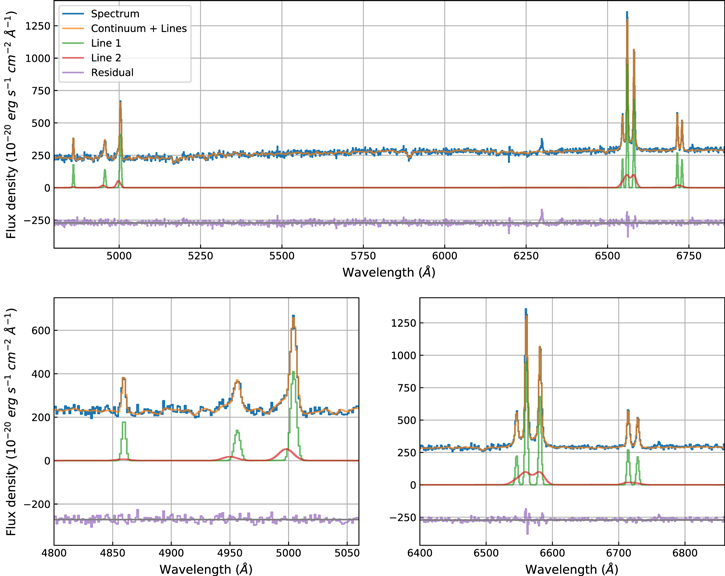
Figure 1. An example of spectra (shown in blue) with the best-fit model (continuum and emission lines shown in orange) from a spaxel at ΔR.A. = −36 and Δdecl. = −0
2 from the nucleus. The lower left panel shows the spectrum zoomed in on the emission lines Hβ, [O iii], and the lower right panel Hα, [N ii], and [S ii]. Both model components (lines one and two) of each emission line are shown in green and red, respectively. For better visualization, the residual (shown in purple) is arbitrarily shifted below zero.
Download figure:
Standard image High-resolution imageIn this work, we focus on the larger scale ionized gas of NGC 7469 with a FOV of ∼14″ × 14″ than Robleto-Orús et al. (2021) with a FOV of ∼5″ × 5″. To improve robustness of our results, we rejected components and spaxels with S/N < 5 for all fitted emission lines.
To correct the extinction effect, the Balmer decrement (the flux ratio of Hα and Hβ) was used. The attenuation law from Fitzpatrick (1999) with RV = 3.12 and an intrinsic Balmer decrement Hα/Hβ = 2.86 (Osterbrock & Ferland 2006) were adopted for galactic diffuse ISM.
2.2. Nonparametric Approach to Emission Line Fitting
A nonparametric method is applied to characterize the line width and the velocity of emission lines within each spaxel for MUSE data following Harrison et al. (2014). For simplicity, the synthetic model with two Gaussian components (fitted by LZIFU) of each emission line was used instead of the data to provide the kinematics. As shown in Figure 2, we use W80 = v90 − v10 and Δv = (v90 + v10)/2 to represent the line width and the velocity offset of the emission line model, where v10 and v90 are the velocities at the 10th and 90th percentiles.
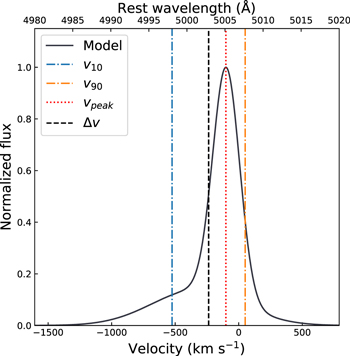
Figure 2. An illustration of the nonparametric method. The solid line is a synthetic model of [O iii]λ5007 extracted from a nuclear spaxel (ΔR.A. = 0″ and Δdecl. = −02), which is composed of two Gaussian components without the stellar continuum. v10 and v90 denote the velocities at the 10th and 90th percentiles, respectively. Δv is defined as (v90 + v10)/2. vpeak is the velocity at the line peak.
Download figure:
Standard image High-resolution image2.3. Chandra X-Ray Data
NGC 7469 was observed with ACIS-S with HETG on board the Chandra X-ray Observatory for 10 times from 2002 to 2016. Previously diffuse soft X-ray emission in NGC 7469 has been found by Mehdipour et al. (2018) using the Chandra observation with longest exposure (79ks, Obs. ID: 2956). We obtained all available Chandra observations of NGC 7469 from the Chandra Data Archive, 2 reprocessed and merged them using CIAO 4.13 (Fruscione et al. 2006) with CALDB version 4.9.4. The total exposure time is 384 ks. We use this data set to compare the diffuse soft X-ray emission (here denotes the 0.2–1.0 keV band with the optical integral field unit (IFU) data). In Figure 11 of Mehdipour et al. (2018), the observation brightness profile shows an excess than the point-spread function (PSF). Following Mehdipour et al. (2018), a PSF for the X-ray image is simulated using Chandra Ray Tracer (ChaRT; Carter et al. 2003) and MARX (Davis et al. 2012). A PSF model representing the bright nucleus of NGC 7469 is subtracted from the merged data. The smoothed soft X-ray zeroth-order image with the PSF model subtracted is shown in Figure 3.
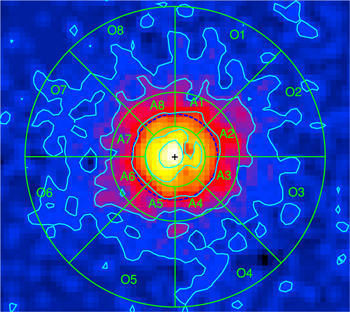
Figure 3. The 0.2–1.0 keV X-ray image with a PSF model of the nucleus subtracted is superposed with corresponding contours. The image is smoothed with the Gaussian function (σ = 1.0 pixel). Levels of contours are 0.3, 1.0, 5.0, 18, and 50 counts, respectively. The blue dash circle denotes the starburst ring with a radius of 2″ and the black cross marks location of the nucleus. The radius of three green circles are 14, 3″, and 7″, respectively. The two ring regions are separated to eight sectors and marked as A1–A8 (around the starburst ring, 1
4–3″) and O1–O8 (outside the ring, 3″–7″), respectively. North is to the top and east is to the left.
Download figure:
Standard image High-resolution image3. Results
3.1. Flux Maps of Hα and [O iii] Emission Lines
The flux maps of Hα from the MUSE data are shown in Figure 4. In the narrow component flux map of Hα (Figure 4(b)), bright clumpy ionized gas emissions can be found around the nuclear starburst ring, and the spiral arms appear outside the ring. The broad component of Hα shows a bright nucleus (Figure 4(c)), which is expected given that the line emission is severely contaminated by the broad line region (BLR). Several clumps of Hα are clearly present along the starburst ring, likely associated with the giant H ii complexes. The [O iii] flux maps (Figure 5) show no clumpy or spiral features. This may indicate that the [O iii] emission is mainly originated from the nonrotational gas instead of the disk.
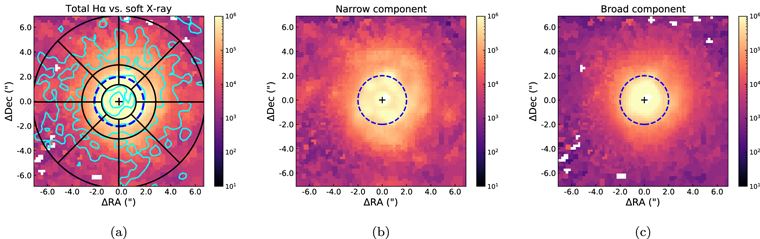
Figure 4. Flux maps of Hα. (a): The total flux overlaid with the contours of soft X-ray emission (0.2–1 keV, with the nucleus modeled by PSF component subtracted) and the labeled regions in Figure 3. (b): Flux map of the narrow component. (c): Flux map of the broad component. The color bar shows the logarithmic flux density with the unit of 10−20 erg s−1 cm−2. The blue dash circle (r = 2″) and black cross indicate the starburst ring and the nucleus, respectively. North is to the top and east is to the left.
Download figure:
Standard image High-resolution image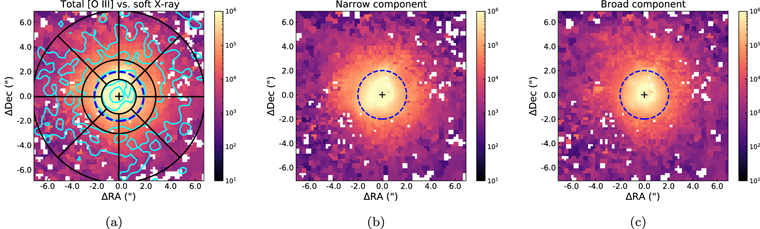
Figure 5. The same maps as Figure 4 but for the [O iii]λ5007 emission line flux.
Download figure:
Standard image High-resolution imageIn Figures 4(a) and 5(a), soft X-ray contours are superimposed on the total flux maps of Hα and [O iii]. To quantify the asymmetry of these flux maps, the surface brightness (normalized to the mean value) of different bands in the labeled regions (see Figures 3, 4(a), and 5(a)) are shown in Figure 6. Because the nuclear region ( ≤14) is strongly affected by the BLR and we mostly focus on the extended emission on a larger scale, this central region is excluded here. In general, the soft X-ray, Hα, and [O iii] emissions present an asymmetric distribution along the northwest to southeast and the soft X-ray shows less asymmetry than the two optical emission lines in three panels. As for the Hα emission, it tends to be more asymmetric along the east to the west than the soft X-ray and [O iii], which can be seen from the enhancement in the west regions (A1, O1, A2, O2, and A3) and the deficiency in the east regions (A5, O5, A6, O6, A7, and O7). The asymmetry features of the soft X-ray emission around and outside the nuclear region are more consistent with the [O iii] emission than Hα.
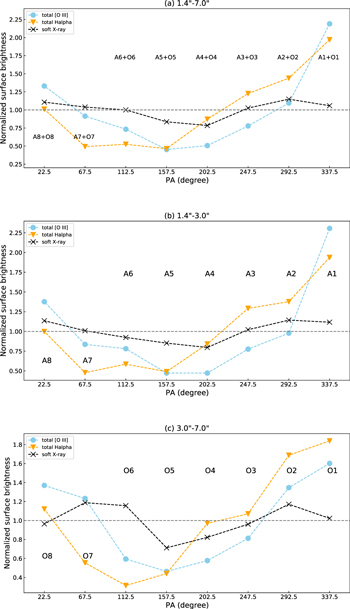
Figure 6. Normalized surface brightness (normalized to the mean value) of soft X-ray (black cross and dashed line), Hα (orange triangle and dashed line), and [O iii]λ5007 (blue circle and dashed line) in different regions (see Figure 3). (a): Regions including the starburst ring and outside sectors (14–7″). (b): Regions around the starburst ring (1
4–3″). (c): Regions outside the starburst ring (3″–7″). The horizontal gray dashed line denotes the mean surface brightness.
Download figure:
Standard image High-resolution image3.2. Kinematics Maps of Ionized Gas
The kinematics maps of Hα ionized gas are shown in Figure 7. Note that Hα, Hβ, and [N ii]λ λ 6548,6583 were fitted with the same velocity and velocity dispersion. For simplicity, the kinematics maps of Hα in fact represent the kinematics for these emission lines. Because the kinematics of [S ii]λ λ 6716,6731 (fitted with a single component) are very similar to the narrow component of Hα, we do not present the velocity and velocity dispersion maps of [S ii]λ λ 6716,6731 here.
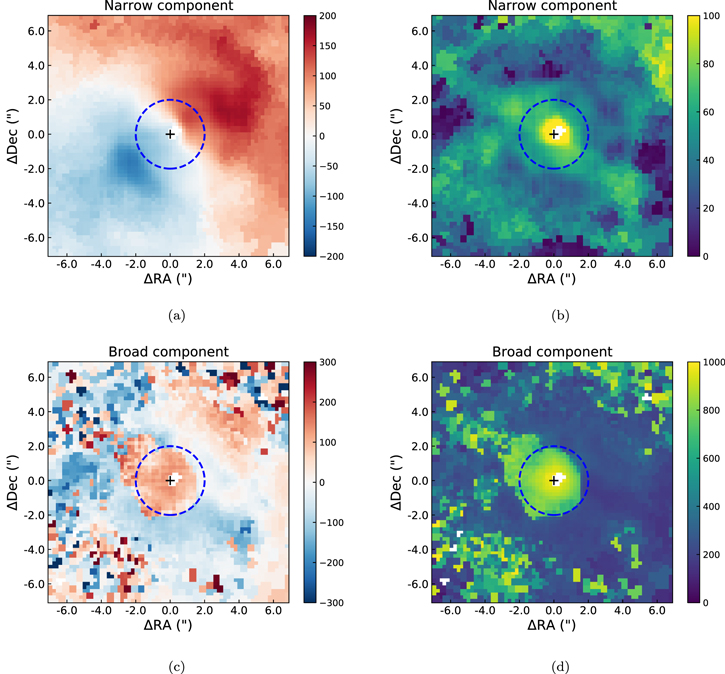
Figure 7. Velocity and velocity dispersion maps of Hα emission line with the unit of kms−1. (a): Velocity map of the narrow component. (b): Velocity dispersion map of the narrow component. (c): Velocity map of the broad component. (d): Velocity dispersion map of the broad component. North is to the top and east is to the left.
Download figure:
Standard image High-resolution imageThe narrow component of Hα is dominated by the ionized gas disk due to the rotational pattern shown by the velocity and velocity dispersion maps (Figures 7(a) and 7(b)). We verified that the stellar kinematics are very similar to that of the narrow component of Hα by fitting the stellar continuum in individual spaxels. Previous studies have also established that the kinematics maps of the narrow component of Hα are dominated by the gravitational potential of a galaxy (e.g., Karouzos et al. 2016). For the broad component, complex patterns are present in the kinematics maps of Hα (Figure 7(c)). For [O iii] the velocity map (Figure 8) of the narrow component cannot be solely explained by a rotating gas disk. However, the velocity map of [O iii] shows mostly blueshifted features across the FOV. Comparing narrow and broad components of Hα and [O iii], the corresponding relationships between them cannot be directly obtained. A possible reason is that [O iii] doublet and Balmer emission lines are dominated by different ionized gas components. Balmer emission lines are sensitive to rotational disk and low-velocity ionized outflows, while [O iii] traces the narrow line region (NLR) and relatively high-velocity ionized outflows. To compare and quantify the kinematics of Balmer emission lines and [O iii] simultaneously, the nonparametric kinematics maps are further analyzed.
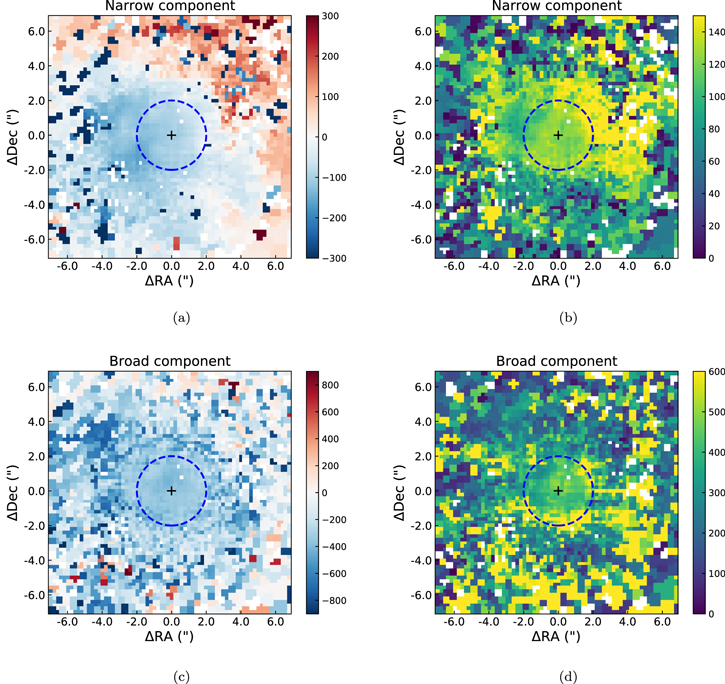
Figure 8. Same maps as Figure 7 but for [O iii]λ5007.
Download figure:
Standard image High-resolution imageFigures 9 and 10 show the nonparametric kinematics maps of Hα and [O iii], respectively. Note that the nuclear region ( <1.4″) is excluded in three panels (ΔvHα , W80H α , and ΔvHα − vHα,peak) due to the contamination from the bright BLR. The vpeak maps of Hα and [O iii] appear similar to their velocity maps of the narrow component, hence we do not show them here. Theoretically, the velocity offset Δv is affected by two physical components: a rotational gas disk and nonrotational gas component. If an emission line is dominated by a rotational component and can be fitted with a single Gaussian model well, the velocity offset Δv will be equal to the vpeak and reflect the rotational velocity. When there exists another component (i.e., a nonrotational component), an extra velocity offset from this component will be included in the Δv. For example, the ΔvHα map (Figure 9(a)) shows a rotational feature along the northwest to the southeast, whereas this feature disappears in the ΔvHα − vHα,peak map (Figure 9(c)). Therefore, the ΔvHα − vHα,peak map can represent the velocity offsets originated from the nonrotational gas component.
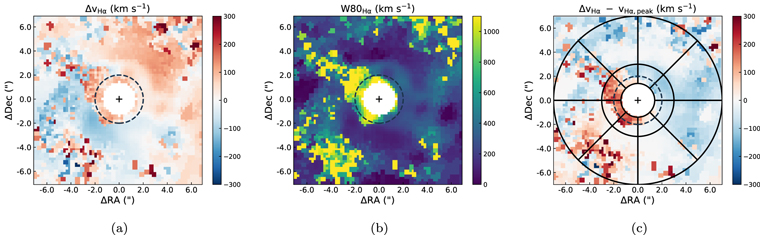
Figure 9. Nonparametric kinematics maps of Hα emission line. (a): The ΔvHα
map. (b): The W80Hα map. (c): The map of ΔvHα
− vHα,peak. Except for the vHα,peak, other maps all exclude the nuclear region (<14) for the influence of the BLR. North is to the top and east is to the left.
Download figure:
Standard image High-resolution imageThe ΔvHα − vHα,peak map shows complex and intriguing patterns. As the vHα,peak map is dominated by the rotational disk, this residual implies significant presence of the nonrotational component. In the ΔvHα − vHα,peak map, there is a remarkable redshifted structure extending from the A7 region to the O7. In the corresponding regions of the W80H α map, a high value of W80 is suggestive that this redshifted feature is an inflow-like structure. Another distinct feature in this map is located at the southeast corner of the FOV (O5 and O6 regions) with redshifted velocity and a high W80 value, which may also resemble an inflowing gas stream. In addition, the southeast redshifted structure appears in contact with a blueshifted feature in the O6 region. The presence of a Hα outflow is evident as shown in the A1, A2, O2, A3, and O3 regions, with significantly blueshifted emission (ΔvHα − vHα,peak). In the corresponding regions of the W80H α map, relatively high values of W80 are also consistent with an outflow feature.
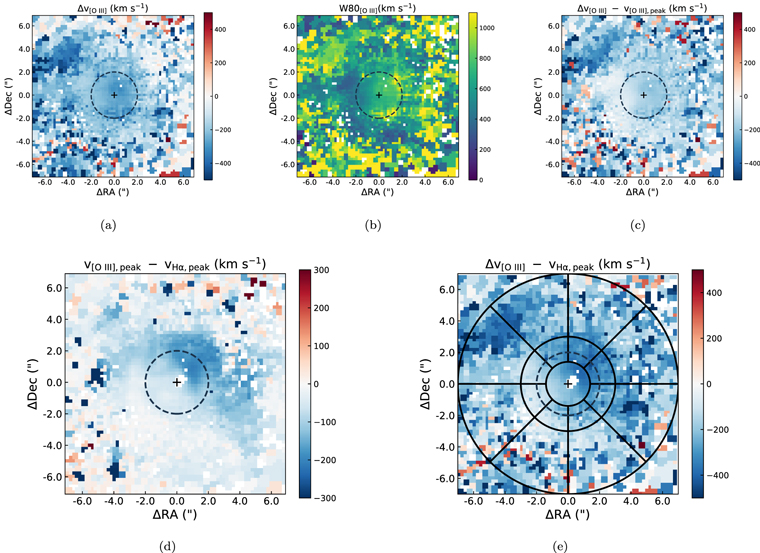
Figure 10. Nonparametric kinematics maps of [O iii]λ5007 emission line. (a): The Δv[O III] map. (b): The W80[O III] map. (c): The map of Δv[O III] − v[O III],peak. (d): The map of v[O III],peak − vHα,peak. (e): The map of Δv[O III] − vHα,peak. North is to the top and east is to the left.
Download figure:
Standard image High-resolution image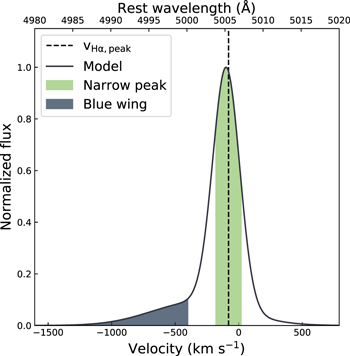
Figure 11. An illustration of the “narrow peak” and the “blue wing”. The “narrow peak” is defined by the central portion with velocity vHα,peak − 100 < v < vHα,peak + 100km s−1, which should be dominated by ionized gas from the disk. The “blue wing” is the portion with v < −400km s−1, which should be dominated by the emission from the outflow. The dashed line denotes vHα,peak and the solid line is the synthetic model.
Download figure:
Standard image High-resolution imageAs for the [O iii] maps (Figure 10), the Δv[O III] map shows mostly blueshifted velocity offsets across the FOV. The Δv[O III] − v[O III],peak and the Δv[O III] − vHα,peak maps are shown in Figures 10(c) and 10(e). The former presents less blueshift than the later especially in the A1, A2, A3, and A8 regions. The v[O III],peak map cannot be explained only by the rotational ionized gas disk, with an excess of significant blueshifted velocity especially in the A1, A2, A3, and A8 regions (Figure 10(d)), which indicates in these regions the nonrotational component is more significant. Because the vHα,peak map closely resembles a rotational disk than v[O III],peak, we use Δv[O III] −vHα,peak to represent the ionized gas outflow component traced by [O iii]. After subtracting the rotational component (vHα,peak) from the Δv[O III] map, the remaining shows blueshifted velocity offsets across the FOV (Figure 10(e)), especially in the western regions around the starburst ring (A1, A2, A3) and the regions outside the ring (O1–O8). The W80O III map (Figure 10(b)) also shows good correspondence with the Δv[O III] − vHα,peak map, indicating the Δv[O III] − vHα,peak map is dominated by ionized gas outflows.
3.3. Baldwin, Phillips, and Telervich Diagnostic Diagrams and Maps
Both AGNs and starbursts can drive galactic ionized winds, and consequently it is difficult to determine the powering source. The Baldwin, Phillips, and Telervich (BPT) diagnostic diagram (Baldwin et al. 1981) is often adopted to distinguish ionization and excitation mechanisms of ionized gas with similar kinematics. Generally it is assumed that the ionizing source of the gas also drives the outflow, so the BPT diagram of ionized gas with similar kinematics is a popular diagnostic tool.
In Figures 7 and 8, our results show that the kinematics of [O iii] and Hα are inconsistent for both the narrow and the broad components, which suggests that the BPT diagram with the two components cannot be used directly. Previous work by Robleto-Orús et al. (2021) derived the BPT diagram for the narrow component, and cautioned that the blueshifted component of [O iii] and Hβ have inconsistent kinematics for many spaxels ( <25).
To obtain the BPT diagnostic diagrams for the rotational disk and the outflow components, two intervals in the line profile are invoked: the “narrow peak” and the “blue wing”. As illustrated in Figure 11, the “narrow peak” is the portion of emission line with velocity vHα,peak − 100 < v < vHα,peak + 100km s−1, which should be dominated by the rotational disk (see the vHα,peak map in Figure 9). The “blue wing” is part of the line wing with v < −400 km s−1, which is dominated by emission from the outflow component (see the Δv[O III] −vHα,peak map in Figure 10). Such kinematically resolved BPT diagrams and maps have been demonstrated as useful by previous works (e.g., Mingozzi et al. 2019).
Figures 12(a) and 12(b) show the BPT diagnostic diagram and the corresponding ionization map of the “narrow peak” emission, respectively. Due to the exclusion of the nuclear region ( <14), the low ionization emission line region (LIER) is used instead of the low ionization nuclear emission line region (LINER) in this work. The “narrow peak” BPT diagram (Figure 12(a)) shows a concentrated distribution in the composite region extending to the Seyfert/LIER and the star-forming region, which is expected given the coexistence of starbursts and AGNs in NGC 7469. A patchy spiral arm structure classified as H ii (star formation) ionization can be found in the “narrow peak” BPT map, which is consistent with the spiral arm structure in the flux map of Hα (Figure 4). An intriguing arc structure mainly classified as LIER is also apparent in the southeast quadrant of the “narrow peak” BPT map, ∼ 2″–6″ away from the nucleus. A similar arc structure classified as LIER is also present in the “blue wing” BPT map, corresponding to the same area but slightly further away from the nucleus. According to previous work, such extended LIER regions could be associated with shocks produced by a jet or an outflow (e.g., Ho et al. 2014). Some studies also suggested that LI(N)ER can usually be found along the wall of conical outflow in an AGN (e.g., Maksym et al. 2016; Mingozzi et al. 2019). The emission from the outflow can also contribute to the “narrow peak” due to low line-of-sight velocity clouds in the outflow. We speculate that the arc structures in the “narrow peak” and “blue wing” BPT map could be associated with the edge of the kiloparsec-scale ionization cone, which is affected by shocks produced by the outflow. Based on the morphology, we can estimate the projected outflow size of ∼2kpc.
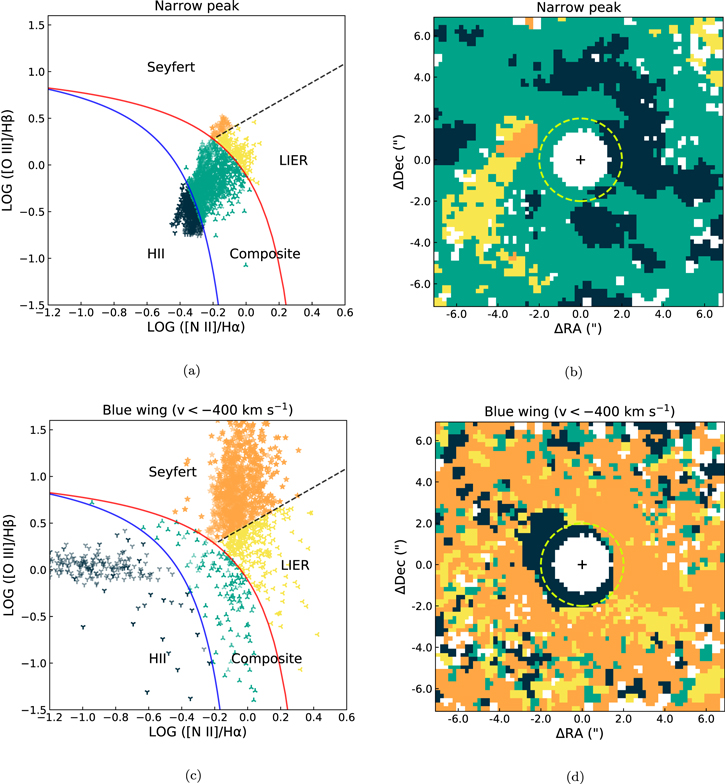
Figure 12. The BPT diagram and kinematically resolved map of the “narrow peak” emission, shown in (a) and (b), respectively. The same maps are shown for the “blue wing” emission ((c) and (d)). The blue solid line (Kauffmann et al. 2003) separates the star-forming and composite zones, the red solid line (Kewley et al. 2001) separates the composite and AGN/LI(N)ER, and the dashed line (Cid Fernandes et al. 2010) separates the AGN and LI(N)ER. Nuclear regions (<14) in these two maps are excluded due to the significant influence from the BLR. North is to the top and east is to the left.
Download figure:
Standard image High-resolution imageFigures 12(c) and 12(d) show the BPT diagnostic diagram and map of the “blue wing” emission. The “blue wing” BPT diagram shows two domains of significantly clustered spaxels, one is the H ii region and the other is the Seyfert/LIER region. Figure 12(d) shows that most spaxels beyond the starburst ring are classified as an AGN ionized region, which suggests that the outflow beyond the starburst ring is mainly powered by the central AGN. The regions around the starburst ring and extending to the northeast are dominated by H ii ionization, which indicates the outflows in these regions are likely driven by a starburst. This is consistent with the strong star-forming activities in the ring and the findings of Robleto-Orús et al. (2021).
3.4. Mass and Energy Outflow Rates
The ionized gas outflow mass can be estimated following Osterbrock & Ferland (2006), which assumes the “case B” recombination with electron temperature Te = 104K:

where LHβ is the luminosity of Hβ, ne is the electron density, which can be calculated from the ratio [S ii]λ6716/[S ii]λ6731. Assuming the electron temperature Te = 104 K, the mean electron density across the FOV is estimated to be ne ∼ 380 cm−3. The mass, energy, and momentum outflow rate are calculated following:



where vout denotes the averaged velocity of the outflow, and Rout is the outflow size.
According to the kinematics maps of Hα, the nonrotational component cannot fully represent the outflow. Consequently, the broad component of Hβ cannot be directly used to estimate the total mass of the outflowing ionized gas. The Hβ flux associated with the outflow component (FHβ,OF) can be estimated following:
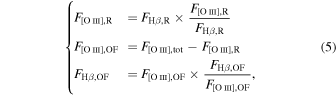
where F denotes the flux, the subscripts [O iii] and Hβ represent different emission lines, and the subscripts R, OF, and tot denote the rotational component, outflow component, and total flux, respectively. The total luminosity of Hβ and [O iii] associated with the outflow component can be estimated to be LHβ,OF =7.6 × 1041erg s−1 and L[O III],OF = 8.2 × 1041erg s−1.
In NGC 7469, both the nuclear starburst ring and the AGN are the powering source responsible for the total mass and energy outflow rates. To estimate the outflow rates, we assume that the outflows in spaxels classified as H ii in the BPT diagram are driven by starbursts, and the outflows in other spaxels are driven by AGNs (see Figure 12(d)). Robleto-Orús et al. (2021) suggest that most of the ionized outflows in the circumnuclear region (r < 25) are possibly driven by starbursts. We use the mean value of [O iii]/Hβ of those pixels classified as H ii in the BPT diagram as the [O iii]/Hβ ratio of the masked nuclear region (r < 1
4).
The luminosity of Hβ associated with the starburst wind is estimated at LHβ,SB = 4.8 × 1041 erg s−1 according to Equation (5) and as an assumption of the biconical outflow geometry. The luminosity of Hβ produced by the AGN outflow is LHβ,AGN =LHβ,tot − LHβ,SB = 2.8 × 1041 erg s−1. Note that LHβ,SB can be overestimated under our assumptions due to ignoring the AGN contribution in the masked region. For simplicity, the sizes of the starburst wind and the AGN outflow are both assumed to be Rout ∼ 2 kpc. The average v10 ∼ −510 km s−1 and electron density ne ∼ 380 cm−3 across the FOV are used to estimate the outflow rates. Based on Equations (1)–(4), the mass, energy, and momentum outflow rate of the starburst wind and the AGN outflow are estimated and summarized in Table 1. Outflow rates from starbursts are larger than the ones from AGNs, implying that starburst-driven outflows are more powerful than AGN-driven outflows in NGC 7469. Nevertheless, the AGN-driven outflows are also nonnegligible, carrying >30% of the total outflow mass and energy rates.
Table 1. Properties of Ionized Outflowing Gas
| L[O III] | LHβ |

|

|

| Fraction | |
|---|---|---|---|---|---|---|
| Source | (× 1041erg s−1) | (× 1041erg s−1) | (M⊙ yr−1) | (× 1041erg s−1) | (× 1034g cm s−2) | (%) |
| (1) | (2) | (3) | (4) | (5) | (6) | (7) |
| Starburst | 4.6 | 4.8 | 6.8 | 5.5 | 2.2 | 63.3 |
| AGN | 3.6 | 2.8 | 3.9 | 3.2 | 1.3 | 36.7 |
| Total | 8.2 | 7.6 | 10.7 | 8.7 | 3.5 | ⋯ |
Note. (1) Ionization source of the outflowing gas. (2) Luminosity of [O iii] associated with the outflow. (3) Luminosity of Hβ associated with the outflow. (4) Mass outflow rate with unit of M⊙ yr−1. (5) Energy outflow rate with unit of × 1041 erg s−1. (6) Momentum outflow rate with unit of × 1034 g cm s−2. (7) Fractions of outflow rates of ionized gas powered by AGNs and starbursts to total outflow rate.
Download table as: ASCIITypeset image
It is worth noting that in recent years, many works have pointed out the estimated mass and energy outflow rates may vary by one to two orders of magnitude when using different assumptions and derived quantities such as ionized gas mass, velocities, and densities (e.g., Dall’Agnol de Oliveira et al. 2021). Our work also cannot avoid these uncertainties, and the coexisting starburst and AGN outflows further complicate the measurement. However, the first-order estimated outflow rates and the relative contribution are still useful for our understanding of the impact of the starburst wind and the AGN outflow.
4. Discussion
4.1. The AGN-driven Outflow
In NGC 7469, a biconical outflow across the east–west direction traced by [Si vi]λ 1.96 μm emission in the near-infrared was previously discovered by Müller-Sánchez et al. (2011). Robleto-Orús et al. (2021) recently reported the discovery of a patch of fast outflow in [O iii] in the circumnuclear region possibly driven by an AGN. The location is to the northwest of the nucleus, which appears to be associated with the blueshifted edge of the outflow in Müller-Sánchez et al. (2011). We have found a subgalactic-scale AGN-driven outflow extending to at least ∼2 kpc, which resembles a blueshifted tilted cone outflowing toward us. The direction of the larger scale AGN-driven outflow does not fully correspond to the circumnuclear outflow in the inner few arcseconds.
One possible explanation of the misalignment is the projection effect and the contamination of starburst-driven outflows. NGC 7469 is a nearly face-on Seyfert 1 galaxy with an inclination angle of ∼30°, which implies that the starburst wind is heavily affected by the projection along the line of sight. The inclination angle of the AGN outflow has been modeled by Müller-Sánchez et al. (2011) with ∼57° (the blueshifted cone points to the west) using [Si vi] emission on the subarcsecond scale, which also suggests that the projection effect can have influence on the AGN outflow. The detailed geometry of the outflow requires more spatially resolved data with a higher S/N, which is beyond the capability of current data. Besides the projection effect, the emission of the starburst wind could overwhelm the emission from the AGN-driven outflow around the starburst ring. In the “blue wing” BPT map (Figure 12(d)), the H ii ionization is more extended in the eastern region (A5, A6, and A7) than in the west (A1, A2, and A3) around the starburst ring, which indicates that emission from the AGN outflow in the eastern region is weaker than the western region. The asymmetric features of optical line emissions (Figure 6) are consistent with this scenario. This may well explain why Robleto-Orús et al. (2021) only found outflows from a small region in the west region inside the starburst ring, which was attributed to be driven by an AGN. Moreover, Robleto-Orús et al. (2021) distinguish the AGN outflow only based on the kinematics and the BPT diagram of narrow component emission, while our approach is complementary to identify outflows with broad wings in emission lines. In reality, it is more likely that the AGN outflow and the starburst wind both contribute to the kiloparsec scale outflow in NGC 7469. The outflowing gas driven by a starburst could also become photoionized by the AGN once entering the AGN ionization cone, and the line ratios may be altered to values corresponding to AGN ionization (see Section 4.2).
The diffuse soft X-ray emission in NGC 7469 has been found by Mehdipour et al. (2018) using the longest Chandra observation (see Section 2.3). They suggested that the diffuse soft X-ray emission is coronal emission from a nuclear starburst ring. Our results show that the ionized outflows driven by an AGN reach to ∼2 kpc, which is fully in agreement with the size of the diffuse soft X-ray emission (see Figures 5 and 12). The asymmetry of soft X-ray is also consistent with [O iii] emission generally (Figure 6). We have shown in Figure 12 that the starburst wind is mainly concentrated in the circumnuclear regions in and around the starburst ring. Therefore, it is plausible that the AGN-driven outflow may contribute to a part of this diffuse soft X-ray emission especially on a kiloparsec scale, besides the main emission from the starburst ring.
Figure 13 shows the outflow rates as a function of the AGN bolometric luminosity following Fiore et al. (2017). Our measurement of the NGC 7469 AGN outflow is consistent with the best-fit correlation. This implies the properties of the NGC 7469 outflow are rather typical of the sources in Fiore et al. (2017).
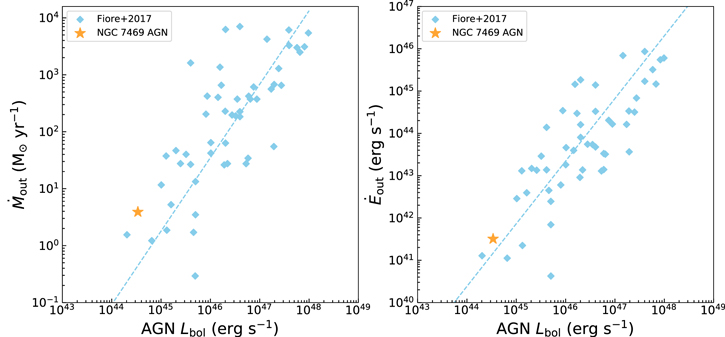
Figure 13. Mass (left panel) and energy (right panel) outflow rate as a function of the AGN bolometric luminosity. The diamonds denote the ionized outflow measurements from Fiore et al. (2017) and the dashed line is their best-fit correlation. The stars in two panels are our estimate of AGN ionized gas outflow rates.
Download figure:
Standard image High-resolution imageTheoretically the AGN outflow can be energy-driven or momentum-driven according to the different cooling efficiencies (e.g., Zubovas & King 2012). Considering the bolometric luminosity of the AGN, Lbol = 1044.53 erg s−1 (Ponti et al. 2012), the momentum of AGN radiation is  . As shown in Table 1, the momentum flux of the kiloparsec-scale AGN outflow is
  , which is consistent with the momentum-driven scenery. The kinetic coupling efficiency of AGN-driven outflows can be estimated as
  , which is lower than the threshold of 0.5% suggested by the “two-stage” feedback model by Hopkins & Elvis (2010). The low value of the kinetic coupling efficiency might suggest that the kiloparsec-scale AGN outflow does not significantly affect the growth of the host galaxy. Note that the kinetic coupling efficiency estimated here is only based on ionized gas outflow driven by the AGN; other phases of outflows and starburst winds are not included. Whereas cold gas outflow in NGC 7469 can be important, previous works (e.g., Izumi et al. 2015) have shown no significant evidence of molecular or neutral outflows have been found.
4.2. The Starburst Wind
The energy outflow rate of the starburst-driven wind can be expected by the equation as follows (Fiore et al. 2017):

where ψ denotes the fraction of massive stars under a certain initial mass function (IMF),  is the number of supernova (SN) per solar mass,
  is the total luminosity for each SN, and η denotes the efficiency from total luminosity transform to kinetic power of ISM. Assuming the Salpeter IMF,
  ,
,  , and η = 0.1,
  is expected at ∼1042 erg s−1 adopting star formation rate (SFR) ∼48 M⊙ yr−1 (Pereira-Santaella et al. 2011). This value is broadly consistent with
  estimated by us, which indicates the SN process can power the starburst wind in NGC 7469.
Combining the [O iii] kinematics maps (Figure 10) and the “blue wing” BPT map (Figure 12), the kinematics of the starburst wind in the east region around the starburst ring show lower velocity than the AGN-driven outflows in the west region, which is consistent with the findings of Robleto-Orús et al. (2021). However, considering the outflow rates (see Table 1 and Section 3.4), the starburst wind is more powerful than the AGN-driven outflow due to the higher outflowing mass in the starburst wind. These results indicate that the starburst wind could show slower kinematics but is energetically more powerful than the AGN-driven outflow in NGC 7469.
According to the “blue wing” BPT map, impact of the starburst wind is concentrated around the starburst ring, and outflows on the larger scale (∼2 kpc) are mainly driven by the AGN. This result may suggest that the starburst mainly drives a wind on a small scale (100 pc) in NGC 7469, while on the larger scale (kiloparsec), the AGN becomes the main powering source driving the outflow. Such a dynamic scenario suggests that the ionized outflow in NGC 7469 should be a joint contribution from stellar and AGN feedback. Ionized gas clouds in the starburst ring are constantly blown out of the disk by starbursts. When these clouds enter the AGN ionization cone and are far away from the starburst ring, they will be ionized and become photoionized by the AGN.
In many nearby Seyfert galaxies, a starburst nuclear ring and a galactic outflow can be found similar to NGC 7469. For example, a star formation ring and a kiloparsec-scale biconical ionized outflow can be found in Seyfert 1.8 galaxy NGC 1365 (see Wang et al. 2009a; Venturi et al. 2018, and references therein). Because the biconical outflow is mainly classified as AGN photoionization in the BPT diagram and its mass outflow rate is similar to that of nuclear AGN wind detected by X-ray, Venturi et al. (2018) attributed the driving source of the outflow to the AGN. Using the kinematically resolved BPT diagram and map, Mingozzi et al. (2019) further confirmed that the ionization source of the kiloparsec-scale outflow in NGC 1365 is dominated by the AGN, and the line ratios of the outflow are dominated by SF ionization only in the starburst ring (see Figure D.1 in Mingozzi et al. 2019). Compared to NGC 1365 (SFR ∼ 5.6 M⊙ yr−1, Alonso-Herrero et al. 2012), the starburst wind of NGC 7469 is more energetic, which might be attributed to the higher star formation rate of NGC 7469 (SFR ∼ 48 M⊙ yr−1). Both galaxies contain circumnuclear starburst rings and AGNs in the nuclear region; their outflows can be driven by different sources, i.e., AGNs and starbursts.
In most previous studies, outflows in galaxies are often assumed to be driven by a single powering source (an AGN or starburst) for simplicity, which seems appropriate for galaxies like NGC 1365 but not the ones like NGC 7469. Our results suggest that the starburst wind and the AGN outflow can both be important in some cases in terms of energetics. In the local universe, many (U)LIRGs containing both starburst and AGN activities are rather similar to NGC 7469, which can possess both powerful starburst winds and the AGN outflow. In the case of high redshift quasars, it is generally expected that nuclear starburst and AGN activities can both be more powerful than local Seyfert galaxies (e.g., Fabian 2012; Förster Schreiber & Wuyts 2020). NGC 7469 is an excellent example for further studying the feedback from both SF and AGN processes.
4.3. Putative Evidence of Inflows
As shown in Figure 9, ΔvHα − vHα,peak and W80Hα maps of Hα present a redshifted, possibly inflow-like feature in the northeast and east regions around the starburst ring. Theoretical work and many observations suggested that a bar-like structure in galaxies can dynamically drive molecular gas inflows and enhance star formation in the central region (e.g., Ellison et al. 2011; Wang et al. 2012a). A bar-like or spiral structure in molecular gas along the northeast to southwest has been detected by Davies et al. (2004), which is partially coincident with the circumnuclear inflow-like structure connecting the CND and the starburst ring . However, no stellar bar is found in the infrared (Genzel et al. 1995; Scoville et al. 2000) or radio (Condon et al. 1991; Orienti & Prieto 2010). Davies et al. (2004) also reported that no molecular gas inflow or other kinematics characteristics expected for a bar have been observed along the bar-like structure. Izumi et al. (2015) further suggest that this feature is possibly not a bar but several spiral structures blending for the lack of spatial resolution. Nevertheless, Izumi et al. (2015) noted that the existence of a faint stellar bar cannot be ruled out. In addition to the bar, the tidal interaction due to galaxies merging can also drive gas inflows and starburst activities in the central region of galaxies. In our case, NGC 7469 and IC 5283 are undergoing the merger process, and the nuclear starburst ring in NGC 7469 is believed to be produced by the tidal interaction with IC 5283 (Genzel et al. 1995). We suggest the inflow-like features in the Hα nonparametric kinematics maps might not be driven by the bar, but instead by the tidal interaction between NGC 7469 and IC 5283.
There exists another inflow-like feature in the southeast region of the FOV, approximately 4″ away from the nucleus (Figure 9). In the “narrow peak” BPT map, this region is dominated by LIER and composite emission, while star-forming, LIER, and the AGN all exist in this region in the “blue wing” BPT map. It is likely that a stream of cold gas is falling into the disk, and spatially superimposed by outflows from the AGN. However, the quality of current data is insufficient to further verify this scenario.
5. Conclusions
In this work, we study the spatial resolved ionized gas nature of NGC 7469 extending the FOV to  using the archival VLT/MUSE data. Two Gaussian fitting and nonparametric approaches are used to analyze the data cube. Zeroth-order images of soft X-ray (0.2–1.0 keV) from all available Chandra archive data are merged. Taking into account the nuclear PSF model, the morphology of extended X-ray emission is obtained (Figure 3). To identify the origins of ionized gas outflows, “narrow peak” (vHα,peak − 100 < v < vHα,peak + 100 km s−1) and “blue wing” (v < −400 km s−1) are defined to represent rotational disk and outflow components when using BPT diagnostic diagrams and maps (Figure 12). The main results and conclusions are summarized as follows:
- 1.The kinematics of [O iii] and Balmer emission lines show different patterns, which is consistent with previous studies. The former is dominated by the outflowing gas and the later shows a rotational disk superposed with complex nonrotational components.
- 2.An outflow extending to ∼2 kpc in projection traced by [O iii] is found in NGC 7469 from the MUSE data, which is mainly ionized by the AGN according to the “blue wing” BPT diagram and map (Figure 12). The geometry of the kiloparsec-scale AGN outflow does not fully match the smaller scale AGN outflow detected in the nuclear region (Müller-Sánchez et al. 2011; Robleto-Orús et al. 2021), which might be due to the projection effect and contamination of the emission from the starburst ring.
- 3.The morphology of the kiloparsec-scale outflow is consistent with that of the extended soft X-ray (Figure 5), which implies that the AGN outflow may partly contribute to the extended soft X-ray emission. However, most of this soft X-ray emission should be associated with star formation due to the star-forming ring and the intense starburst wind.
- 4.The mass and energy outflow rates of the AGN outflow are estimated to be
 and (see Section 3.4). Though the outflow rates of the AGN outflow are less than that of the starburst wind, the AGN outflow is still important energetically by carrying >30% of the total outflow rates. The kinetic coupling efficiency of the AGN-driven outflow of is lower than the threshold of 0.5% suggested by the feedback model in Hopkins & Elvis (2010), implying a marginal impact by the detected kiloparsec-scale outflow to the growth of the host galaxy.
 - 5.The starburst wind around the nuclear ring is also confirmed, consistent with the findings in Robleto-Orús et al. (2021). The mass and energy outflow rates of the starburst wind are estimated to be and . In NGC 7469, the starburst seems to be driving outflow on a smaller scale than the AGN (Figure 12), yet the starburst wind is more powerful than the AGN outflow in terms of higher outflow rate.
- 6.Inflow-like patterns are found around the starburst ring extending to the northeast and in the southeast region, about a kiloparsec distance away from the nucleus in projection. If these features are streams of inflow, the tidal interaction between NGC 7469 and IC 5283 might be the driving source.





Last but not least, many local (U)LIRGs and high redshift quasars can possess both powerful starburst winds and AGN outflows like NGC 7469. Hence, NGC 7469 is an excellent local example for studying the joint processes of feedback from SF and the AGN.
We thank the anonymous referee for the constructive comments that significantly improved the clarity of our work. We thank Dr. Cheng Li, Yanmei Chen, and Zhenzhen Li for helpful suggestions on data analysis and discussion. J.W. acknowledges the NSFC grants U1831205 and 12033004, and the science research grants from CMS-CSST-2021-A06 and CMS-CSST-2021-B02. This research has made use of the services of the ESO Science Archive Facility. Based on observations collected at the European Southern Observatory under ESO program 60.A-9339. This research has made use of data obtained from the Chandra Data Archive and the Chandra Source Catalog, and software provided by the Chandra X-ray Center (CXC) in the application packages CIAO and Sherpa. We acknowledge the allocated P200/CWI observation of NGC 7469 from the Telescope Access Program (TAP) for the PhD thesis of X.X. and the kind support by the staff at the Palomar Observatory.
Facilities: VLT (MUSE) - , CXO (HETGS). -
Software: Astropy (Astropy Collaboration et al. 2013, 2018), PPXF (Cappellari & Emsellem 2004), MPFIT (Markwardt 2009), LZIFU (Ho et al. 2016), CIAO (Fruscione et al. 2006), DS9 (Joye & Mandel 2003), ChaRT (Carter et al. 2003), MARX (Davis et al. 2012), Sherpa (Freeman et al. 2001).