Abstract
Interactions between plasma particles and electromagnetic waves play a crucial role in the dynamics and regulation of the state of space environments. From plasma physics theory, the characteristics of the waves and their interactions with the plasma strongly depend on the composition of the plasma, among other factors. In the case of the Earth’s magnetosphere, the plasma is usually composed of electrons, protons, O+ ions, and He+ ions, all with their particular properties and characteristics. Here, using plasma parameters relevant for the inner magnetosphere, we study the dispersion properties of kinetic Alfvén waves (KAWs) in a plasma composed of electrons, protons, He+ ions, and O+ ions. We show that heavy ions induce significant changes to the dispersion properties of KAWs, such as polarization, compressibility, and the electric-to-magnetic amplitude ratio, and therefore the propagation of KAWs is highly determined by the relative abundance of He+ and O+ in the plasma. These results, when discussed in the context of observations in the Earth’s magnetosphere, suggest that for many types of studies based on theory and numerical simulations, the inclusion of heavy ions should be customary for the realistic modeling of plasma phenomena in the inner magnetosphere or other space environments in which heavy ions can contribute a substantial portion of the plasma, such as planetary magnetospheres and comet plasma tails.
Original content from this work may be used under the terms of the Creative Commons Attribution 4.0 licence. Any further distribution of this work must maintain attribution to the author(s) and the title of the work, journal citation and DOI.
1. Introduction
First proposed by Hasegawa (1976), kinetic Alfvén waves (KAWs) appear at quasi-perpendicular wave-normal angles, when the kinetic effects of electrons become relevant. For that to occur, KAWs require the ion gyroradius ρi to be similar to the perpendicular wavelength (k⊥ ρi ∼ 1), with k⊥ the wavenumber in the direction perpendicular to the background magnetic field (Narita et al. 2020). The gyroradius is given by ρi = αi /Ωi , where αi and Ωi are the thermal speed and gyrofrequency of the ions, respectively. KAWs are mainly characterized by their right-handed polarization in the plasma frame (Gary 1986), in contrast to the left-handed polarized electromagnetic ion–cyclotron (EMIC) waves. Therefore, the wave-normal angle at which Alfvénic waves shift from EMIC waves to KAWs strongly depends on the plasma beta parameter (Gary 1993; Gary & Nishimura 2004).
KAW–particle interactions are mostly resonant with electrons and nonresonant with ions (Lakhina 2008; Barik et al. 2020); and, as such, they have been proposed as a possible mechanism for energy transfer from ion to electron scales (Nandal et al. 2016). Thus, the interest in studying the role of these waves in space plasmas, such as the Earth’s magnetospheric environment, has been increasing over the last few decades. KAWs have been observed as playing important roles in several processes, such as energy dissipation at kinetic turbulence (Chasapis et al. 2018; Macek et al. 2018; Dwivedi et al. 2019); reconnection in the magnetosheath (Chaston et al. 2005; Boldyrev & Loureiro 2019); electron acceleration in the plasma sheet (Wygant et al. 2002; Duan et al. 2012); and energization of the ionosphere (Keiling et al. 2019; Cheng et al. 2020) or ionospheric outflow (Chaston et al. 2016). These waves have also been observed in the inner magnetosphere during geomagnetic storms (Chaston et al. 2014; Moya et al. 2015).
Besides their right-hand polarization, KAWs in the plasma frame exhibit positive magnetic helicity and other signature dispersion properties that are helpful for identifying these waves using observations. For example, due to their quasi-perpendicular wave-normal angles, KAWs usually have large magnetic compressibility, and they have larger parallel fluctuating electric fields when compared to Alfvénic EMIC waves (Gary 1986; Voitenko & Goossens 2006; Chaston et al. 2014; Moya et al. 2015). Moreover, the δ
E∥/δ
B⊥ spectral ratio between field-aligned electric fluctuations, δ
E∥, and transverse magnetic field fluctuations, δ
B⊥, is an important signature for distinguishing between EMIC waves, magnetosonic waves (MSWs), and KAWs. In the case of EMIC waves, δ
E∥/δ
B⊥ have values on the order of the local Alfvén speed,  (where mp
is the proton mass and n0 is the total number density), whereas for KAW this ratio is several times VA
and increases with increasing frequency (Chaston et al. 2014; Moya et al. 2015). The δ
E∥/δ
B⊥ spectrum is also useful for distinguishing between MSW and KAW modes, as the MSW mode has a monotonically increasing δ
E∥/δ
B⊥ ratio frequency spectrum, whereas KAWs have a δ
E∥/δ
B⊥ ratio spectrum with a local maximum at a given frequency, which then decreases for larger frequencies (Salem et al. 2012; Moya et al. 2015). In summary, all these dispersion properties provide useful information for identifying and distinguishing different Alfvénic modes using in situ space plasma wave observations (Narita et al. 2020).
(where mp
is the proton mass and n0 is the total number density), whereas for KAW this ratio is several times VA
and increases with increasing frequency (Chaston et al. 2014; Moya et al. 2015). The δ
E∥/δ
B⊥ spectrum is also useful for distinguishing between MSW and KAW modes, as the MSW mode has a monotonically increasing δ
E∥/δ
B⊥ ratio frequency spectrum, whereas KAWs have a δ
E∥/δ
B⊥ ratio spectrum with a local maximum at a given frequency, which then decreases for larger frequencies (Salem et al. 2012; Moya et al. 2015). In summary, all these dispersion properties provide useful information for identifying and distinguishing different Alfvénic modes using in situ space plasma wave observations (Narita et al. 2020).
From the theoretical point of view, most of the mentioned dispersion properties of KAWs have in general been studied in proton–electron plasmas or electron–ion plasmas. However, most astrophysical and space plasmas are multispecies. Thus, in these systems, it is expected that the dispersion properties of the EMIC or KAW modes will be dependent not only on the parameters of the proton and electron distributions, but also on the plasma composition and the parameters of heavier ions, such as O+ ions (Moya et al. 2021), O+ and He+ ions (Moya et al. 2015), or N+ ions (Bashir & Ilie 2018). The impact of heavier ions may be especially relevant in the inner magnetosphere during geomagnetic storms, as there is a strong dependence between the relative abundance of protons, O+ ions and He+ ions, and geomagnetic activity. It has been shown that due to the ionospheric outflow during geomagnetic storms, O+ ions can dominate the plasma composition in the ring current region (Daglis 1997; Daglis et al. 1999; Yue et al. 2018), and the abundance of each ion species is highly dependent on the radial distance to the Earth (L-shell) and the strength of the geomagnetic storm (Jahn et al. 2017). Thus, depending on the level of geomagnetic activity, the inner magnetosphere composition may favor or hinder the propagation of KAWs and, therefore, the kinetic processes mediated by these waves. In this context, during recent years, studies have shown that ion beams can provide the free energy necessary to generate KAWs in the inner magnetosphere and auroral region (Lakhina 2008; Barik et al. 2019a, 2019b, 2019c, 2021). In addition, Moya et al. (2021) computed the exact numerical dispersion relation of KAWs, without the use of approximations, considering different abundances of O+, using plasma parameters relevant to the Earth’s inner magnetosphere and cometary environments. They found that the presence of O+ ions allows the propagation of weakly damped or unstable KAW modes at smaller wave-normal angles than if the plasma were composed only by protons and electrons. However, isotropic heavy ions can drastically reduce the growth rates of unstable KAWs triggered by anisotropic protons, or even inhibit the instability, if their relative abundance is large enough. Therefore, heavy ions may play an important role in mediating energy transfer processes from large to small scales through wave–particle interactions between plasma particles and KAWs.
In this work, we study the effect of magnetospheric heavy ions such as O+ and He+, in combination with protons and electrons, on the dispersion relation and dispersion properties of KAWs, and compare them with the pure electron–proton case, using plasma parameters traditionally observed during geomagnetic storms in the Earth’s inner magnetosphere. In Section 2, we present the Vlasov dispersion relation and dispersion properties of KAWs in a multispecies warm plasma (a plasma where each species has a not-zero temperature), in which each species follows a bi-Maxwellian velocity distribution function. In Section 3, considering plasma parameters relevant to the inner magnetosphere, we compute the exact numerical dispersion relation and spectral properties for Alfvénic waves at different propagation angles, comparing the results obtained in a simple electron–proton plasma and the results when magnetospheric heavy ions (He+ and O+) are considered. Finally, in Section 4, we summarize our numerical results, outline the main conclusions, and discuss the physical scope and relevance of our findings.
2. Linear Analysis: Vlasov–Maxwell Dispersion Relation and Kinetic Dispersion Properties
Let us consider a warm multispecies plasma in the presence of a background magnetic field  , in which each species s follows a bi-Maxwellian velocity distribution function (VDF):

where  and
and  are the squares of the thermal speeds of the species s, and T⊥s
and T∥s
are the perpendicular and parallel temperatures with respect to
B
0. Also, in Equation (1), n0s
and ms
correspond to the equilibrium number density and mass of the sth species, respectively, and kB
is the Boltzmann constant. In such a plasma, the warm Vlasov–Maxwell kinetic dispersion relation for electromagnetic waves is determined by
are the squares of the thermal speeds of the species s, and T⊥s
and T∥s
are the perpendicular and parallel temperatures with respect to
B
0. Also, in Equation (1), n0s
and ms
correspond to the equilibrium number density and mass of the sth species, respectively, and kB
is the Boltzmann constant. In such a plasma, the warm Vlasov–Maxwell kinetic dispersion relation for electromagnetic waves is determined by

or ∣D(ω,
k
; pp)∣ = 0, where the so-called dispersion tensor D represents the linear response of the plasma media to electromagnetic perturbations, and is a function of the frequency ω, wavevector
k
, and the macroscopic plasma parameters here denoted by pp. The particular functional form of D depends on the shape of the VDF (Equation (1)). For a bi-Maxwellian distribution given by Equation (1), details can be found extensively in the literature (see, e.g., Stix 1992; Viñas et al. 2000; Yoon 2017, and references therein). The Vlasov–Maxwell linear analysis provides a robust framework for characterizing the linear response of the media to the propagation of electromagnetic waves in different plasma environments. Considering Equation (2) as an eigenvalue problem, δ
E
k
corresponds to the fluctuating electric field (eigenmodes) of the plasma, and ω = ω(
k
) corresponds to the solutions of the dispersion relation (eigenfrequencies) as a function of the wavevector
k
. Thus, the wave-normal angle θ between the mean field and the direction of propagation of the waves is given by  , where k = ∣
k
∣ is the wavenumber.
, where k = ∣
k
∣ is the wavenumber.
Besides the solutions ω(
k
) of the dispersion relation, using Equation (2) and Maxwell’s equations it is also possible to obtain information about the spectral properties of each eigenmode δ
E
k
(ω,
k
), such as the polarization P = i
δ
Ekx
/δ
Eky
; the reduced magnetic helicity σmk
= 〈δ
A
k
· δ
B
k
〉/∣δ
B
k
∣2, where δ
A
and δ
B
are the magnetic vector potential and the magnetic field, respectively; the magnetic compressibility CB
=∣δ
Bkz
∣/∣δ
B
k
∣; and the ratio between parallel electric fluctuations and transverse magnetic fluctuations  , among other dispersion properties. Without loss of generality, for all these definitions we have assumed
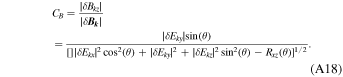
  , such that
  (see the Appendix for details).
The solutions of the dispersion relation, Equation (2), and the dispersion spectral properties of each wave mode will vary depending on the particular value of the wave-normal angle, the composition of the plasma, and the characteristics and macroscopic parameters of the plasma. In the case of bi-Maxwellian VDFs, this dependence can be expressed in terms of a reduced set of dimensionless quantities, such as the relative abundance ηs
= n0s
/n0 of each species s with respect to the total density, the plasma beta  and the temperature anisotropy μs
= T⊥s
/T∥s
of each species, the ratio between the local Alfvén speed and the speed of light CA
= VA
/c, and the angle of propagation of the waves. All these linear properties are well-known descriptors of plasma waves, and they have been widely used to characterize different wave modes using theory and offer key information for identifying them through observations (see, e.g., Gary 1986, 1993; Viñas et al. 2000; Moya et al. 2015). Each of these properties is important for discriminating between KAWs, EMIC modes, or MSW modes (Gary 1986; Salem et al. 2012; Moya et al. 2015), so that their combination will allow us to assess whether the presence of heavy ions such as O+ and He+ favor or not the existence and propagation of KAWs in the inner magnetosphere.
and the temperature anisotropy μs
= T⊥s
/T∥s
of each species, the ratio between the local Alfvén speed and the speed of light CA
= VA
/c, and the angle of propagation of the waves. All these linear properties are well-known descriptors of plasma waves, and they have been widely used to characterize different wave modes using theory and offer key information for identifying them through observations (see, e.g., Gary 1986, 1993; Viñas et al. 2000; Moya et al. 2015). Each of these properties is important for discriminating between KAWs, EMIC modes, or MSW modes (Gary 1986; Salem et al. 2012; Moya et al. 2015), so that their combination will allow us to assess whether the presence of heavy ions such as O+ and He+ favor or not the existence and propagation of KAWs in the inner magnetosphere.
3. Results: The Effect of O+ and He+ Ions
To analyze the properties of KAWs in the inner magnetosphere, we consider realistic parameters of the ring current region, in which the plasma is composed of electrons, protons (H+ ions), and O+ ions and He+ ions, with abundances that can vary significantly, especially during geomagnetically disturbed periods. In particular, depending on the strength of a given geomagnetic storm, the abundance of O+ ions ηO+ can vary between 20% and 80% (Hamilton et al. 1988; Daglis et al. 1999). Moreover, Jahn et al. (2017) showed that O+ abundance can be parameterized as a function of L-shell and the Kp index, so that warm O+ can vary from ηO+ ∼ 60% at L = 4 to ηO+ ∼ 40% at L = 6, when Kp ≥ 4, and the He+ abundance ηHe+ does not exceed 10% during geomagnetically active times for all 4 < L < 6. To solve the dispersion relation with parameters representative of the ring current during geomagnetic storms, we select the average abundances of the H+, O+, and He+ ions reported by Jahn et al. (2017) at L = 4, L = 5, and L = 6 during geomagnetic storms. We consider a quasi-neutral plasma in which the total ion density n0 is equal to the total electron density ne , and then ηH+ + ηO+ +ηHe+ = 1.
The beta parameter of each species at each L-shell is calculated considering (for simplicity) a nondrifting (Us
= 0), isotropic (μs
= 1), and isothermal (Ts
= T) plasma, with a temperature T = 10 keV typical for the ring current region (Kamide & Chian 2007) and a total electron number density ne
= 10 cm−3. We also assume a dipolar field, so that at each L-shell B0 ∼ BD
/L3, and then  , where BD
= 3.12 × 10⁴ nT is the average strength of the magnetic field at the magnetic equator at L = 1. With this information, all the necessary dimensionless parameters are determined and they are shown in Table 1. The only free parameter remaining is the wave-normal angle. It is important to mention that, depending on the position of the plasmapause, the warm or hot populations may not dominate the composition of the plasma at 4 < L < 6, meaning that our selection of parameters may not be appropriate in such cases. However, during geomagnetic active times, when plasmaspheric plumes transport the cold plasma toward the magnetopause (Foster et al. 2014), the plasmasphere is eroded and confined to lower L-shells, so it is reasonable to consider L ≥ 4 to be outside the plasmasphere. For example, in O’Brien & Moldwin (2003), it is shown that empirical models predict a plasmapause at L ∼ 4.18 for Kp = 4, and at L < 4 for Kp > 5. Therefore, for geomagnetically active times, our model of the region of interest is a reasonable choice. Furthermore, as the important quantity that seems to control the shift from EMIC waves to KAWs is plasma beta (Gary 1993; Gary & Nishimura 2004), and considering that plasma beta depends on a particular combination of density, temperature, and magnetic field, other values of electron density and temperature, combined with a different model for the magnetic field strength, could lead to the same beta values shown in Table 1, and therefore the same results from the kinetic theory analysis (Moya et al. 2015).
, where BD
= 3.12 × 10⁴ nT is the average strength of the magnetic field at the magnetic equator at L = 1. With this information, all the necessary dimensionless parameters are determined and they are shown in Table 1. The only free parameter remaining is the wave-normal angle. It is important to mention that, depending on the position of the plasmapause, the warm or hot populations may not dominate the composition of the plasma at 4 < L < 6, meaning that our selection of parameters may not be appropriate in such cases. However, during geomagnetic active times, when plasmaspheric plumes transport the cold plasma toward the magnetopause (Foster et al. 2014), the plasmasphere is eroded and confined to lower L-shells, so it is reasonable to consider L ≥ 4 to be outside the plasmasphere. For example, in O’Brien & Moldwin (2003), it is shown that empirical models predict a plasmapause at L ∼ 4.18 for Kp = 4, and at L < 4 for Kp > 5. Therefore, for geomagnetically active times, our model of the region of interest is a reasonable choice. Furthermore, as the important quantity that seems to control the shift from EMIC waves to KAWs is plasma beta (Gary 1993; Gary & Nishimura 2004), and considering that plasma beta depends on a particular combination of density, temperature, and magnetic field, other values of electron density and temperature, combined with a different model for the magnetic field strength, could lead to the same beta values shown in Table 1, and therefore the same results from the kinetic theory analysis (Moya et al. 2015).
Table 1. Linear Theory Calculation Parameters
| L-shell | B0 (nT) | CA = vA /c | Species | η | β |
|---|---|---|---|---|---|
| H+ | 0.40 | 0.068 | |||
| 4 | 487.5 | 1.12 × 10⁻² | O+ | 0.50 | 0.085 |
| He+ | 0.10 | 0.017 | |||
| H+ | 0.50 | 0.323 | |||
| 5 | 249.6 | 5.74 × 10⁻³ | O+ | 0.45 | 0.291 |
| He+ | 0.05 | 0.032 | |||
| H+ | 0.58 | 1.120 | |||
| 6 | 144.4 | 3.32 × 10⁻³ | O+ | 0.40 | 0.772 |
| He+ | 0.02 | 0.039 | |||
Note. The total electron density is ne = 10 cm−3, and T = 10 keV for all species.
Download table as: ASCIITypeset image
To study how the presence of both O+ and He+ ions, together with protons and electrons, influence the existence of KAWs at each L-shell shown in Table 1, we numerically solve the exact dispersion relation, considering wave-normal angles of θ = 60°, 70◦, and 80◦, as these propagation angles should be the most suitable for a KAW solution. We then compare the dispersion relation and dispersion properties spectra (polarization, helicity, magnetic compressibility, and the ratio of the parallel electric field to the transverse magnetic field) obtained for the multispecies magnetospheric plasma with an electron–proton plasma of the same density and temperature for each considered L and θ. The calculation and comparison was done without the use of any approximation to the elements of the dispersion tensor—something that was possible because we used our own kinetic dispersion solver written in Python (Moya et al. 2021). Figure 1 shows a comparison between the dispersion relation obtained considering a pure electron–proton plasma (top panels) and the magnetospheric multispecies case (bottom panels), for wave-normal angles θ = 60° (red), 70° (green), and 80° (blue), and the three L-shells shown in Table 1. Further, in the multispecies case, of the three Alfvénic solutions that exist in a plasma composed of three different ion species (see, e.g., Saikin et al. 2015; Blum et al. 2017, and references therein), here we only show the results associated with the H+ band, as this frequency band is the most similar to the Alfvén branch in an electron–proton plasma compared to the O+ or He+ bands. Moreover, for comparison purposes, in the multispecies case we have also included the solutions of the cold multifluid dispersion relation (Stix 1992; Fitzpatrick 2014; the dashed lines in Figure 1). From this figure, we can clearly appreciate the effect of the plasma beta and the propagation angle. Even for the case with smaller beta values (L = 4; left panel), the figure shows how the dispersion relation does not follow the typical Alfvénic solutions obtained with the cold multifluid plasma approximation. When heavy ions are considered when computing the susceptibility of the media, the departure from the multifluid dispersion relation (the dashed lines in Figure 1) is evident. In summary, these ions can clearly affect the dispersion tensor and dispersive properties of the plasma.
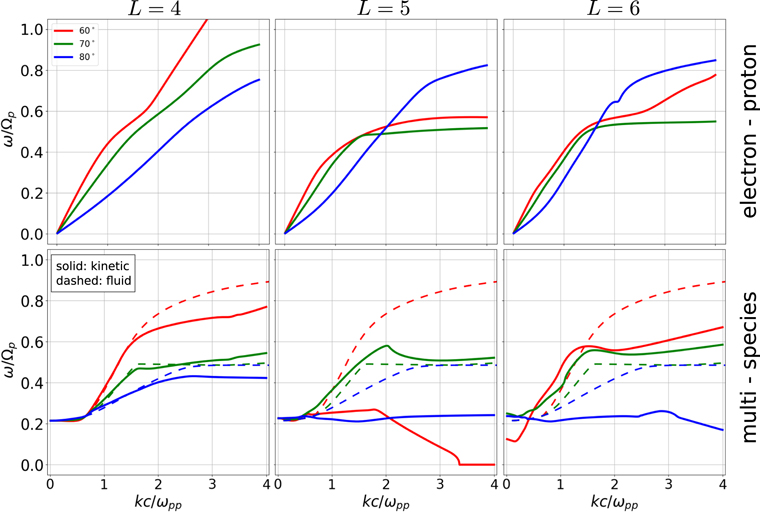
Figure 1. Electron–proton (top) and multispecies plasma (bottom) dispersion relations of Alfvénic solutions for wave-normal angles θ = 60° (red), 70° (green), and 80° (blue), considering the parameters shown in Table 1 for L = 4 (left), L = 5 (center), and L = 6 (right). Frequencies and wavenumbers are expressed in units of the proton gyrofrequency and the proton inertial length, respectively. In the bottom panels, the solid and dashed lines represent the kinetic and fluid dispersion relations, respectively.
Download figure:
Standard image High-resolution imageTo analyze the effect of the heavier ions on the existence of KAWs, we need to search for the signature characteristics of KAWs in the dispersion properties of the Alfvénic modes shown in Figure 1: namely, the positive polarization and helicity, large magnetic compressibility, and the ratio of the parallel electric to transverse magnetic fluctuation. For each of the dispersion relation solutions presented in Figure 1, we show in Figure 2 the polarization spectra (normalized to their maximum values). From Figure 2, we can see that for all L-shells in the electron–proton plasma case (top panels), the polarization is positive only for θ = 80° and kc/ωpp ∼ 1. In contrast, the bottom panels in Figure 2 show that the multispecies plasma allows Alfvénic solutions with positive polarization for all three considered wave-normal angles, consistent with KAW modes, and a wider wavenumber range. In general, this region moves from smaller to larger wavenumber values (larger to smaller scales) as the wave-normal angle increases, and goes up to kc/ωpp ∼ 4 for θ = 80° at L = 6, but this range is relatively smaller when compared to the ranges at L = 4 and 5. Note that for this last case, the solution at 80° exhibits positive polarization only for kc/ωpp > 3. Thus, even though the abundance (and therefore the influence) of heavy ions decreases with increasing L-shell, as the magnetic field is weaker farther from the Earth, the plasma beta of all species increases, and solutions with positive polarization (compatible with KAW modes) still exist, even though the range in wavenumber with right-handed solutions is not the same for all L-shells. It is important to note that the first principles reasons for the changes in polarization at different k intervals as a function of composition, wave-normal angle, and plasma beta must be related to the properties of the dispersion tensor, and subsequently its eigenmodes (the electric field of the waves). That being said, to the best of our knowledge, the exact reason for this phenomenon is still unknown. Indeed, even in the electron–proton case, the answer to these questions is not trivial at all. We may speculate about possible changes in the sign, magnitude, and/or topology of some of the elements of the dispersion tensor (see the Appendix) in the complex plane, depending on the values of  and
and  . However, the exact answer as to why plasma waves transit from EMIC waves to KAWs as the plasma beta and wave-normal angle increase is beyond the scope of this study.
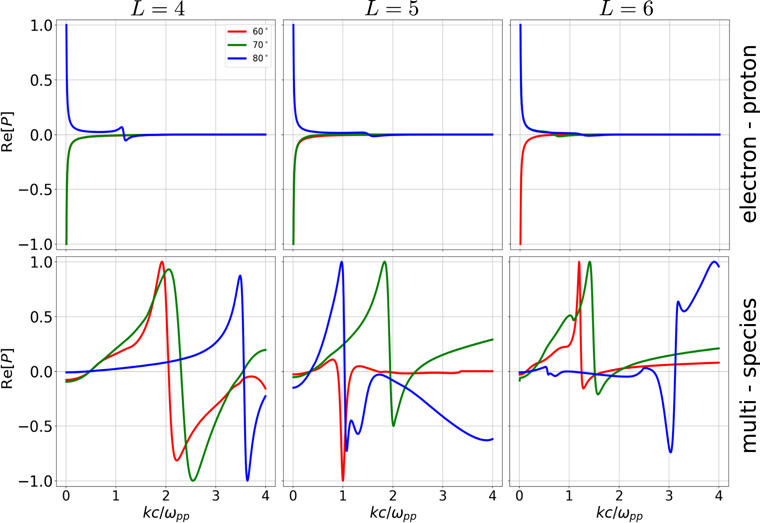
Figure 2. Polarization spectra for the Alfvénic modes shown in Figure 1, for electron–proton (top) and multispecies plasma (bottom), for L = 4 (left), L = 5 (center), and L = 6 (right). The red, green, and blue curves represent wave-normal angles of 60°, 70°, and 80°, respectively, considering the parameters shown in Table 1. Each polarization curve is normalized to its maximum value, and wavenumbers are expressed in units of the proton inertial length.
Download figure:
Standard image High-resolution imageThe differences in the dispersion properties between the electron–proton and multispecies plasmas can also be seen in the magnetic helicity and magnetic compressibility spectra, in which, regardless of the wave-normal angles or L-shell, the presence of O+ and He+ ions introduces nontrivial changes to the helicity and magnetic compressibility. Regarding the helicity, and consistent with the polarization, Figure 3 shows that in multispecies plasmas, the wave modes have positive and larger helicity at smaller wavenumber values, compared to an electron–proton plasma at all considered wave-normal angles and at all different L-shells. Furthermore, comparing with Figure 2, we can see that in all cases both polarization and helicity are positive in the same wavenumber range, as expected for KAW modes. Moreover, regarding the magnetic compressibility spectra, Figure 4 shows that, in contrast with the electron–proton case, the multi-ion plasma allows solutions with large magnetic compressibility CB ⪆ 0.5, even for kc/ωpp = 1, a wavenumber range in which helicity and polarization are positive as well, which is not possible in an electron–proton plasma at all considered wave-normal angles.
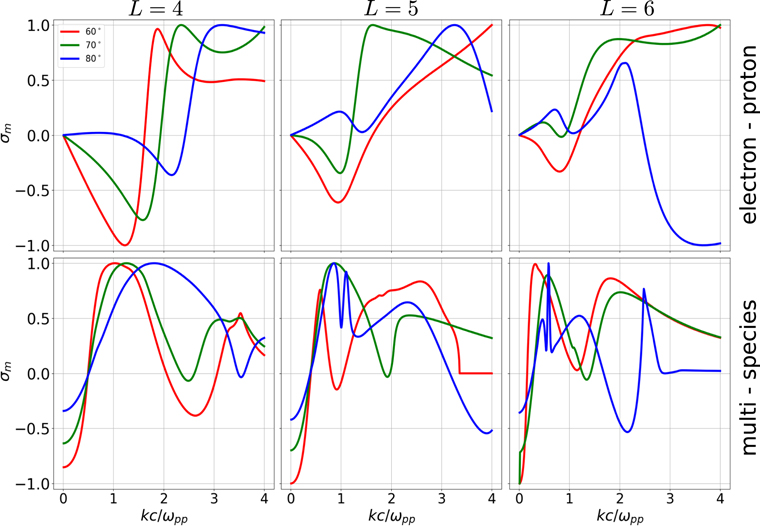
Figure 3. Electron–proton (top) and multispecies plasma (bottom) magnetic helicity spectra for the wave-normal angles θ = 60° (red), 70° (green), and 80° (blue), considering the parameters shown in Table 1 for L = 4 (left), L = 5 (center), and L = 6 (right). Wavenumbers are expressed in units of the proton inertial length.
Download figure:
Standard image High-resolution image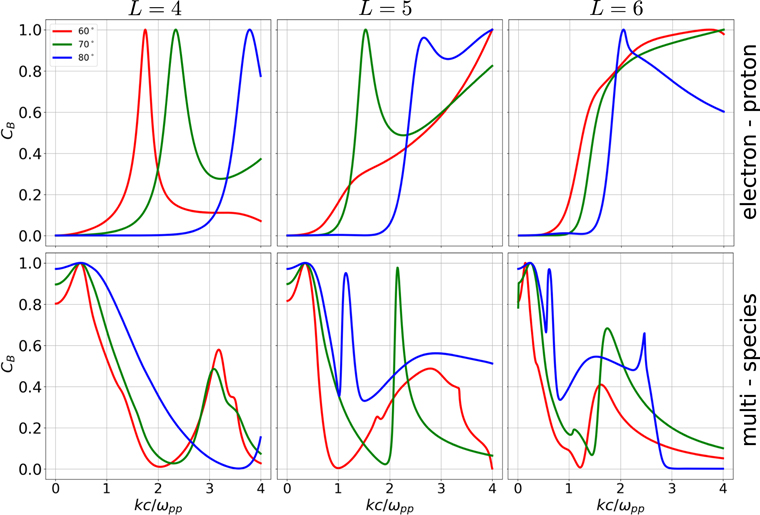
Figure 4. Electron–proton (top) and multispecies plasma (bottom) magnetic compressibility spectra for the wave-normal angles θ = 60° (red), 70° (green), and 80° (blue), considering the parameters shown in Table 1 for L = 4 (left), L = 5 (center), and L = 6 (right). Wavenumbers are expressed in units of the proton inertial length.
Download figure:
Standard image High-resolution imageThus, the multispecies plasma can allow the propagation of magnetically compressive Alfvénic waves with positive magnetic helicity, at wavenumbers that would not be accessible if the heavier ions were not present. Finally, even though compressive Alfvénic modes with positive polarization, and also positive magnetic helicity, are good candidates for KAWs and clearly not for EMIC waves, MSWs can also share these properties. As already mentioned, a key signature for distinguishing between MSWs and KAWs is the δ E∥/δ B⊥ spectrum (Salem et al. 2012; Chaston et al. 2014; Moya et al. 2015). Figure 5 shows these spectra, in units of the local Alfvén speed, for all considered wave-normal angles and L-shells for both cases: the electron–proton (top panels) and the multispecies (bottom panels) plasma. From Figure 5, we can see that for the electron–proton case, only for L = 4 does the δ E∥/δ B⊥ spectrum have a clear peak for the three considered wave-normal angles. For L = 5 and L = 6, only the solution at 80° exhibits a δ E∥/δ B⊥ spectrum compatible with KAWs. In contrast, when He+ and O+ are considered in the dispersion relation, the situation is the opposite. For L = 4, the δ E∥/δ B⊥ spectrum is less than one at all wave-normal angles, and for all wavenumbers, showing that in this case the Alfvénic modes are not KAWs. Therefore, even in this case, where the polarization is positive (see Figure 2), as the plasma beta values are rather small, the k⊥ ρi ∼ 1 condition is not fulfilled and the KAW modes are not present (in this case, the solutions correspond to MSW modes). However, for larger L-shells, all the δ E∥/δ B⊥ spectra exhibit a peak larger than one. This shows that the obtained solutions at L = 5 and L = 6 are indeed KAW modes, and that the existence of the KAWs is only possible due to the presence of the heavier magnetospheric ions.
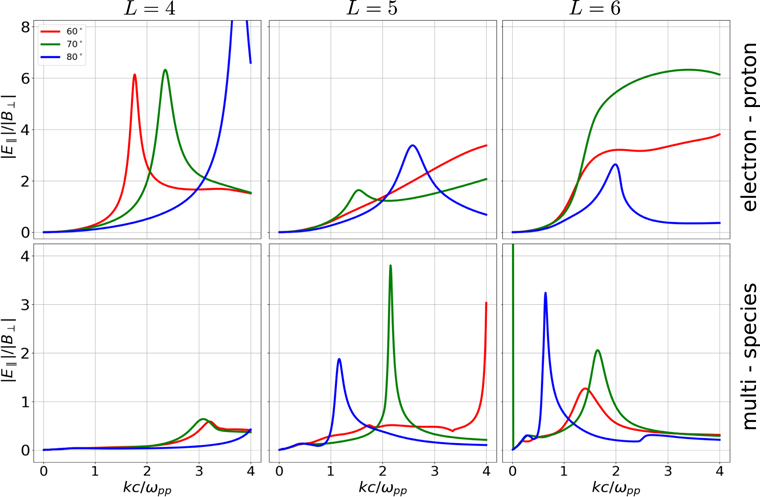
Figure 5. Spectra of the ratio of the parallel electric field to the transverse magnetic field, δ E∥∣/∣δ B⊥∣, for electron–proton (top) and multispecies magnetospheric (bottom) plasma, considering the same wave-normal angles and L-shells as in all previous figures. In all panels, δ E∥∣/∣δ B⊥∣ is expressed in units of the local Alfvén speed vA , and wavenumbers are normalized to the proton inertial length.
Download figure:
Standard image High-resolution image4. Discussion and Conclusions
By using the Vlasov–Maxwell linear theory of plasma waves, we have obtained the dispersion relation and analyzed the dispersion properties of Alfvénic modes in two different scenarios: an electron–proton plasma and a magnetospheric multispecies plasma composed of electrons, protons, and He+ and O+ ions, with plasma parameters motivated by in situ observations in the inner magnetosphere. We analyzed the changes introduced in the dispersion relation and dispersion properties, such as polarization, magnetic helicity, magnetic compressibility, and electric and magnetic field perturbations, due to the inclusion of heavier ions (in combination with protons and electrons). We compared the possibility of obtaining KAW-mode solutions in both scenarios, as in a multispecies plasma, such as the inner magnetosphere, the properties of the KAW should not only depend on the parameters of the proton and electron distributions, but also on the relative abundances of heavier ions and their properties. As shown in Table 1, and depending on the L-shell, thanks to the shrinking of the plasmapause to L < 4 during geomagnetic active intervals, it is possible that the dominant ion species in the inner magnetosphere can correspond to O+ and not to protons.
In the electron–proton case, our results show that, considering temperatures and number density values relevant for the ring current region outside the plasmasphere, for kc/ωpp ≤ 4 the presence of KAWs is not possible at wave-normal angles θ ≤ 70°. In contrast, the presence of He+ and O+ ions introduces significant changes to the dispersion properties of Alfvénic modes, allowing the existence of KAW-mode solutions at L ≥ 5, even at θ = 60°, which is consistent with observations (see, e.g., Moya et al. 2015). In addition, compared to the electron–proton case, the KAW solutions are possible in a wider wavenumber range, and in general the range shifts from smaller to larger wavenumber values (larger to smaller scales) as the wave-normal angle increases.
It is important to emphasize that in the inner magnetosphere, KAWs have been predominantly observed during geomagnetically disturbed time intervals, either during substorms, in association with particle injections from the magnetospheric tail (Wygant et al. 2002), or during geomagnetic storms (Chaston et al. 2014, 2015a, 2015b; Moya et al. 2015; Chaston et al. 2020), over roughly the same period of time in which the abundance of heavy ions increases (Jahn et al. 2017). This is consistent with our own findings, which suggest that in the inner magnetosphere, the conditions necessary for the occurrence of KAWs in multispecies plasmas are those that can also be found during geomagnetic storms.
In summary, we have shown that for the plasma parameters relevant for the ring current outside of the plasmasphere during geomagnetic storms, the propagation of KAWs is highly determined by the presence of O+ and He+. Thus, as wave–particle interactions with KAWs correspond to a possible channel mechanism for energy transfer from ions to electrons, our results suggest that magnetospheric ions may play an important role in the energization of subionic and electronic spatial scales and the acceleration of plasma particles, especially during intense geomagnetic storms, in which O+ ions can dominate the plasma composition in the inner magnetosphere. However, in order to quantify the relevance of these processes, it will be necessary to increase the scope of the study by analyzing the complex frequency (growth/damping rate) of the waves, and also to include the nonlinear effects that are necessary for properly assessing the energy transfer between KAWs and plasma particles. We expect this theoretical analysis, motivated by observations, to provide evidence that, for many types of studies based on particle or fluid simulations, and linear, quasi-linear, or nonlinear models, the inclusion of heavy ions should be customary for the realistic modeling of plasma phenomena in the inner magnetosphere, or other space environments where heavy ions contribute a substantial portion of the plasma density, such as planetary magnetospheres and comet plasma tails.
We are grateful for the support of ANID, Chile, through FONDECYT grant No. 1191351 (PSM) and National Doctoral Scholarships Nos. 21181965 (BZQ), 21182002 (IGM), and SIA SA772100112 (VAP). The dispersion analysis output files are available at https://doi.org/10.5281/zenodo.3900556.
Appendix: Dispersion Tensor and Dispersion Properties
Here, we briefly present basic expressions for the dispersion tensor and dispersion properties of electromagnetic waves propagating through a magnetized, collisionless, and uniform bi-Maxwellian plasma, with distribution functions given by Equation (1).
A.1. Dispersion Tensor
Considering the background magnetic field as  , and wavevectors for parallel propagating waves given by
  (where
  and
and  , with θ being the wave-normal angle), the dispersion tensor D(ω,
k
) can be written in the following form (Stix 1992; Viñas et al. 2000; Moya et al. 2021):
, with θ being the wave-normal angle), the dispersion tensor D(ω,
k
) can be written in the following form (Stix 1992; Viñas et al. 2000; Moya et al. 2021):

where each element is given by
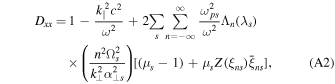

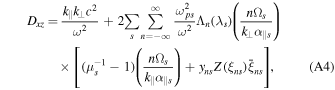


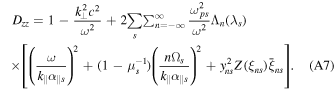
Here, ωps = 4π n0s q2/ms and Ωs = qs B0/ms c are the plasma and gyrofrequency of the species s, and μs = T⊥s /T∥s is its temperature anisotropy. In addition, we have defined the following quantities:
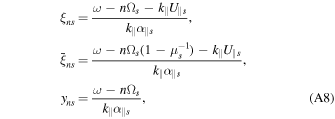
where In represents the nth modified Bessel of the first kind,

A.2. Kinetic Dispersion Properties
As the dispersion relation implies that ∣D(ω,
k
)∣ = 0, it is not possible to obtain the three components of the fluctuating electric field  independently. Here, we impose the normalization ∣δ
Ekx
∣2 + ∣δ
Eky
∣2 +∣δ
Ekz
∣2 = 1 and obtain:
independently. Here, we impose the normalization ∣δ
Ekx
∣2 + ∣δ
Eky
∣2 +∣δ
Ekz
∣2 = 1 and obtain:


In addition, the fluctuating magnetic field is given by Faraday’s law:

so that



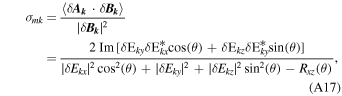
Thus, using Equations (A10)–(A15), we can define all the relevant dispersion properties, such as polarization, reduced magnetic helicity, magnetic compressibility, and the ratio of the parallel electric field to the transverse magnetic field, in terms of fluctuating fields. Following Gary (1993), we here provide a list of all these quantities. Namely:
- 1.Polarization:

- 2.Reduced magnetic helicity:where A k is the fluctuating vector potential, given by B k = i k × A k , and we have defined.
- 3.Magnetic compressibility:
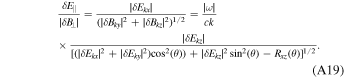
- 4.Ratio between the parallel electric field and the transverse magnetic field:

![${R}_{{xz}}(\theta )\,=\mathrm{Re}\left[\delta {E}_{{kx}}\,\delta {E}_{{kz}}^{* }\sin (2\theta )\right]$](https://content.cld.iop.org/journals/0004-637X/933/1/32/revision1/apjac713bieqn18.gif)